
Astronomers Discover Unexplained Triple-Star System 28 Light-Years Away
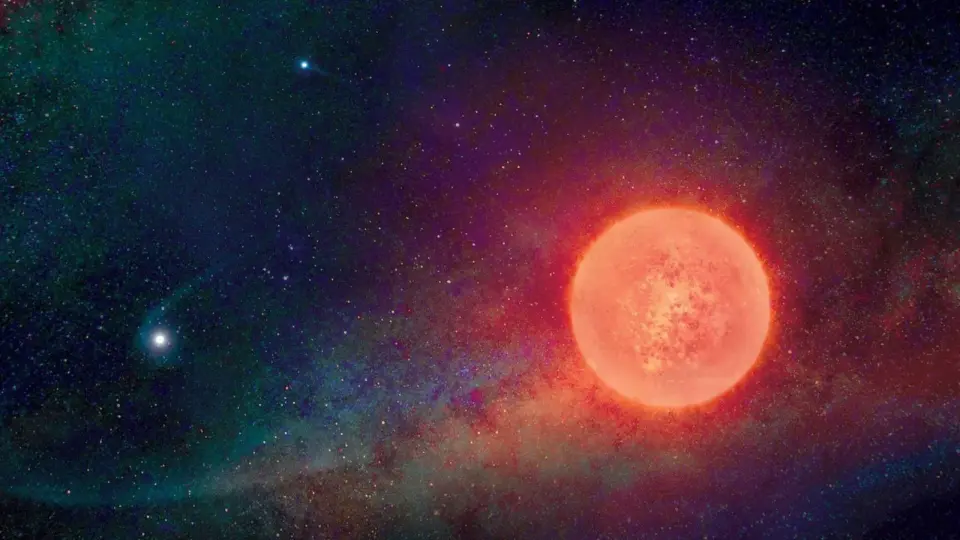
Astronomers at the Université de Montréal have identified a rare triple-star system named Welopōʻai, located 28 light-years from Earth. The system consists of a red dwarf and two white dwarfs, a configuration that defies current models of stellar evolution. Discovered while searching for exoplanets using the SPIRou instrument, the system’s existence remains unexplained, as the red dwarf should have been destabilized or destroyed when its companion evolved into a red giant. The finding, published in Astronomy & Astrophysics, offers a unique opportunity to study the survival mechanisms of stars in dense, multi-body gravitational environments.
Key points
- The Welopōʻai system is a hierarchical triple containing a red dwarf and two white dwarfs, located 28 light-years from Earth.
- The discovery was made accidentally by Étienne Artigau’s team while using the SPIRou spectrograph on the Canada–France–Hawaii Telescope to search for exoplanets.
- The inner white dwarf orbits the red dwarf at 4.6 astronomical units, with a mass of 0.618 solar masses, measured with 0.7% precision.
- The system is unique; no similar configuration exists within 100 light-years of Earth.
- The red dwarf’s survival is puzzling because the inner white dwarf’s progenitor star would have expanded into a red giant, likely destabilizing the orbit.
- The system is estimated to be 9 to 11 billion years old, yet the red dwarf remains metal-rich, which is unusual for such an ancient star.
Background
Recent discoveries in stellar astrophysics have highlighted the complexity of white dwarf systems. In November 2026, researchers identified radio pulses from a white dwarf in a binary system 5,000 light-years away, and in October 2026, a double debris disk was found around a white dwarf 1,600 light-years away. These findings, along with the anticipated nova flare of T. Coronae Borealis, underscore the dynamic and often unpredictable nature of stellar evolution in binary and multi-star systems. The Welopōʻai discovery adds to this body of research by presenting a system that challenges existing models of how stars survive the violent phases of stellar death.
How outlets are covering it
All four sources agree on the basic facts: the discovery of a triple-star system with two white dwarfs and a red dwarf, located 28 light-years away, and the lack of a clear explanation for its existence. However, they differ in emphasis. The primary source (Space) and ZME Science focus on the surprise of the discovery and the impossibility of the system’s configuration, quoting Patrick Dufour’s statement that the system 'should not exist.' Popular Science highlights the initial confusion during the exoplanet search, noting that the velocity swings were too large for a planet. Sci.News provides the most technical details, including the precise mass measurements (0.618 solar masses for the white dwarf, 0.419 for the red dwarf) and the tentative detection of a dusty debris disk around the inner white dwarf. Sci.News also notes the system’s age (9-11 billion years) and the unusual metal-richness of the red dwarf, details not mentioned in the other sources. The primary source and ZME Science emphasize the proximity of the system as a valuable laboratory for studying stellar evolution, while Popular Science focuses on the serendipitous nature of the discovery.
Why it matters
The discovery of Welopōʻai challenges existing models of stellar evolution and the stability of multi-star systems. The fact that a red dwarf survived the red giant phase of its companion, despite the expected gravitational destabilization, suggests that our understanding of orbital dynamics in such systems is incomplete. The system’s proximity to Earth allows for high-precision measurements, which can help refine models of white dwarf formation and the behavior of stars in dense gravitational environments. Additionally, the system’s age and the metal-richness of the red dwarf provide clues about the chemical evolution of stars over billions of years. Future observations with telescopes like the James Webb Space Telescope and Gaia may help resolve the system’s three-dimensional layout and confirm the presence of a debris disk, potentially revealing more about the system’s history and the fate of planetary bodies in such environments.
What to watch
The research team plans to conduct further observations to better understand the gravitational interactions between the three stars in the Welopōʻai system. They aim to determine how the red dwarf survived the red giant phase of its companion and to confirm the tentative detection of a dusty debris disk around the inner white dwarf. Future observations with the James Webb Space Telescope and Gaia are expected to provide a more detailed three-dimensional map of the system, which could help resolve the mystery of its formation. The team also hopes to use the system as a test case for models of stellar evolution, particularly those related to the formation of white dwarfs and the behavior of stars in multi-body gravitational environments.
- Astronomers just discovered a rare triple star system 28 light-years away, and they have ‘no clean explanation for how it got here’ Space
- A rare triple-star system near Earth ‘should not exist’ Popular Science
- Astronomers Find Hidden White Dwarf Lurking in Nearby Binary System Sci.News
- Astronomers Discover Bizarre Triple-Star System That Shouldn't Exist Just 28 Light-Years Away ZME Science
- A real '3 Body Problem': Astronomers discover a nearby 'weirdo' triple-star system CBC
Want the full story? Read the original reporting
Read on Space