Tag

Cmb

All articles tagged with #cmb

Three Observational Frontiers to Decode the Specific Model of Cosmic Inflation
science-and-tech2 days ago

Three Observational Frontiers to Decode the Specific Model of Cosmic Inflation

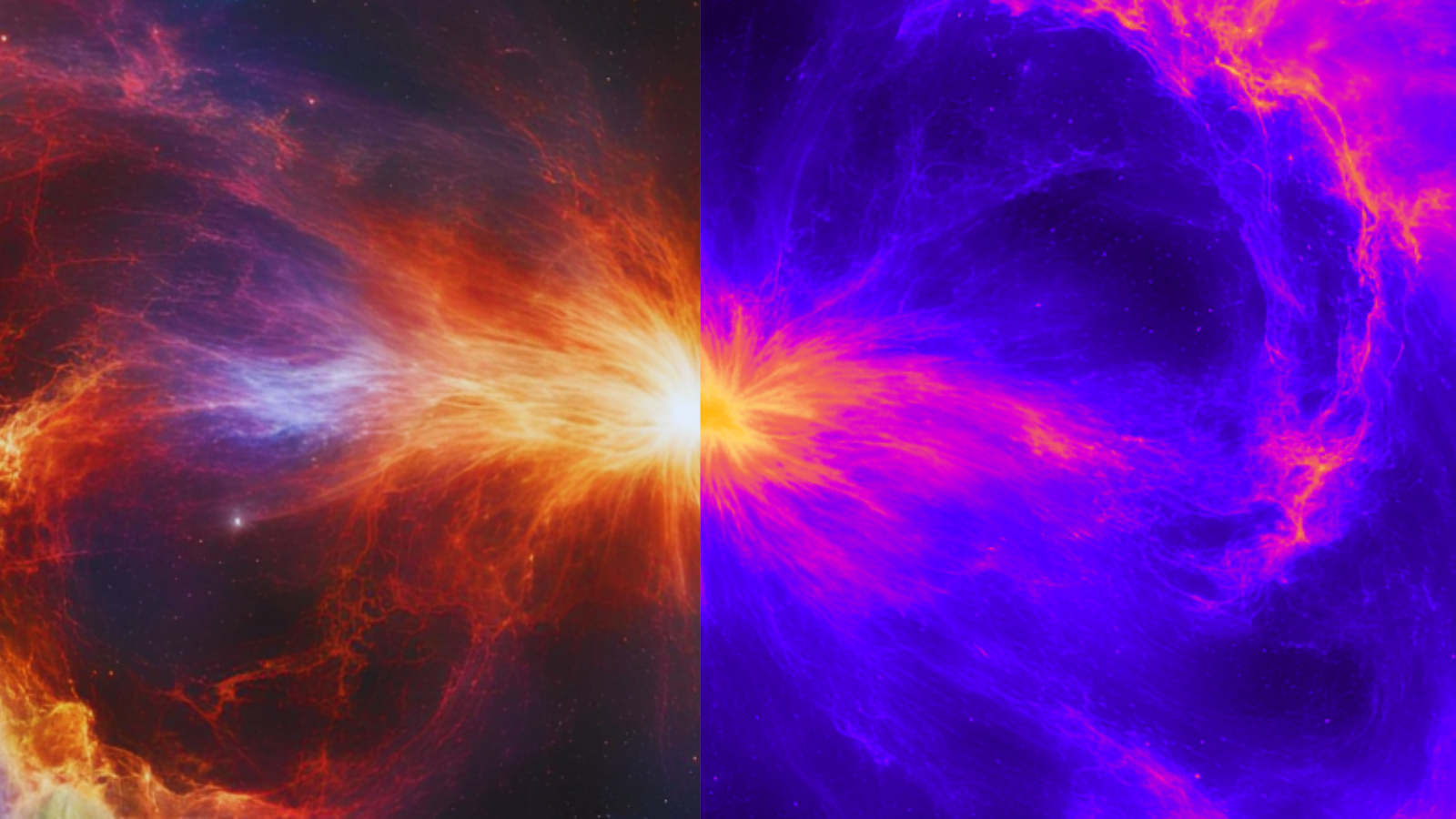
Theoretical astrophysicist Ethan Siegel argues that while the hot Big Bang and preceding cosmic inflation are established, the specific 'flavor' of inflation remains unknown. He identifies three key observational avenues to resolve this: detecting primordial gravitational waves, mapping large-scale structure for non-Gaussian fluctuations, and analyzing small-scale dark matter substructures and seed black holes. These tests utilize upcoming missions like LiteBIRD, DESI, and the Square Kilometer Array to move beyond general confirmation toward precise model validation.
Cosmic Budget: Ordinary Matter Is Just 5% of the Universe’s Energy
science2 months ago

Cosmic Budget: Ordinary Matter Is Just 5% of the Universe’s Energy

Standard cosmology estimates that ordinary matter makes up only 4.9% of the universe’s current mass-energy density, with dark matter at 26.8% and dark energy at 68.3%. These figures, derived from the 2013 Planck mission data, represent a present-day snapshot within the flat Lambda-CDM model, not a fixed historical recipe. While ordinary matter includes all atoms and visible objects, much of it exists as invisible gas. Dark matter is inferred through gravitational effects, and dark energy drives cosmic acceleration. Recent data from the Dark Energy Spectroscopic Instrument (DESI) hints at potential tensions with the standard model, suggesting dark energy might vary over time, though this remains statistically uncertain. The core finding remains that known atoms account for less than one-twentieth of the cosmos.

Cosmic Expansion Makes the Observable Universe Bigger Than Its Age
science4 months ago

Cosmic Expansion Makes the Observable Universe Bigger Than Its Age

Space itself expanded as photons traveled, so the present observable diameter is about 92–93 billion light-years even though the universe is ~13.8 billion years old. The 13.8 billion years is the lookback time, not a static travel distance; the farthest observable regions are now ~46 billion light-years away. Distances depend on cosmological definitions and parameters, such as the particle horizon, Hubble radius, and event horizon, all described within the Lambda-CDM framework and Planck data. No local light-speed limit is violated.

Universe's Shape: Doughnut, Not Pancake?
science3 years ago

Universe's Shape: Doughnut, Not Pancake?

New research suggests that the universe could have a more complicated shape, like a giant doughnut, despite all evidence suggesting it's flat. The study finds that strange patterns found in echoes of the Big Bang could be explained by a universe with a more complicated topology, and astronomers have not fully tested the universe's flatness. While most observations suggest the universe is flat, there are 18 possible geometrically flat, 3D topologies, and a universe with a complicated topology could explain some of the anomalies in the cosmic microwave background.

Unveiling Cosmic Mysteries: Dark Matter and Black Holes in the Universe
astronomy3 years ago

Unveiling Cosmic Mysteries: Dark Matter and Black Holes in the Universe

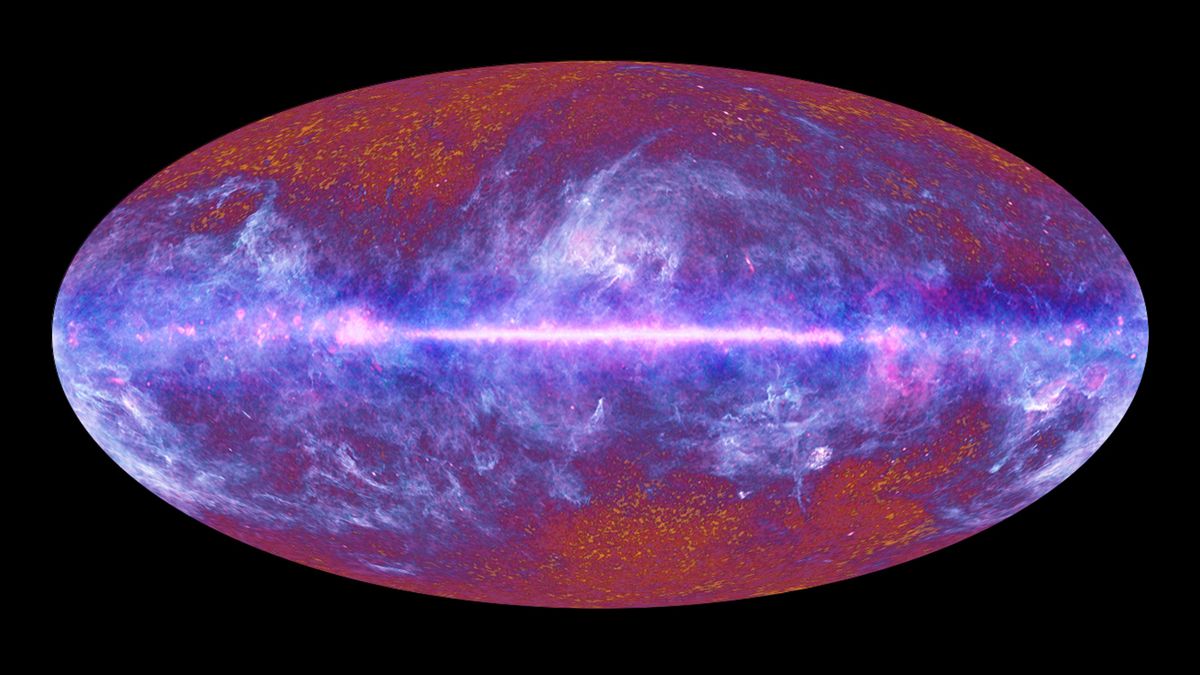
Cosmologists are using the cosmic microwave background (CMB) radiation to map the distribution of both ordinary matter and dark matter in the universe. The CMB light has been stretched, squeezed, and warped by all the matter in its way, leaving detectable imprints on its magnification and color. By examining CMB data taken by the European Space Agency’s Planck satellite and the ground-based Atacama Cosmology Telescope, scientists have been able to measure the alignment of ordinary matter and dark matter, providing estimates for the strength and temperature of the dispersing blasts. These insights are helping to settle some long-standing cosmological mysteries and pose some new ones.