
NASA’s COFFIES AI Predicts Sunspots 12 Hours Before They Surface
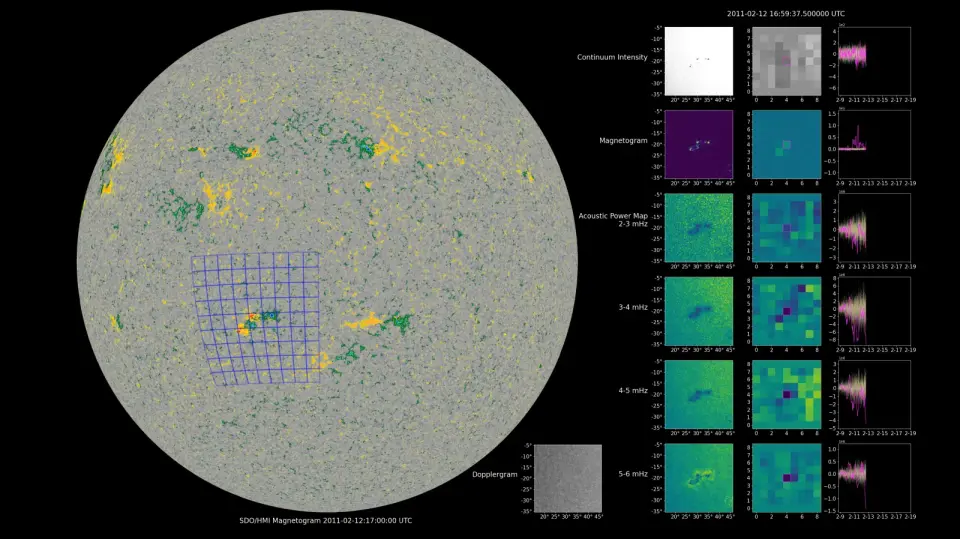
A new machine learning model developed by NASA’s COFFIES team can predict the emergence of solar active regions up to 12 hours before they become visible. By analyzing subtle changes in acoustic waves and magnetic fields, the system offers earlier warnings for potential space weather events.
Key points
- The model, named EarlyDetect, uses a sliding-window transformer architecture to process long sequences of solar data.
- It identifies precursor signals, such as drops in acoustic power, that occur beneath the solar surface before sunspots appear.
- The system achieved an average prediction lead time of 9.24 hours in tests, outperforming previous benchmarks.
- The research was published in the Journal of Geophysical Research: Machine Learning and Computation.
- The team released a public dataset called SolARED to support further research in solar activity forecasting.
Background
This development builds on NASA’s ongoing efforts to improve space weather forecasting, which is critical for protecting astronauts on Artemis missions and satellites on Earth. While previous models relied on counting visible sunspots, this new approach aims to detect hidden magnetic activity. The project is part of NASA’s DRIVE Science Centers initiative, which fosters multidisciplinary collaboration to study the Sun’s influence on the solar system.
How outlets are covering it
NASA and NJIT emphasize the model’s potential to safeguard deep-space explorers and infrastructure by providing earlier warnings of solar flares. Hackaday highlights the practical value of the extra warning time for geomagnetic storms but notes the model is still a 'black box' and not yet operationally ready. Inshorts provides a concise summary of the 12-hour prediction capability. A key technical insight from NJIT is that a filtering technique initially thought to help isolate patterns actually hindered the model by removing faint but critical fluctuations, a finding that surprised the researchers.
Why it matters
Earlier detection of solar active regions could significantly improve the lead time for space weather alerts, helping to protect satellites, radio communications, and astronauts from the damaging effects of solar flares and coronal mass ejections.
What to watch
The team plans to validate the model across more solar events to reduce false alarms and improve accuracy. They aim to integrate these predictions into operational space weather monitoring tools used by NASA and NOAA, though the system is not yet ready for real-time forecasting.
- Machine Learning COFFIES “Hears” Sunspots Before We Can See Them Hackaday
- NASA’s COFFIES Uses AI to Predict Storm-Causing Active Regions on Sun NASA Science (.gov)
- NASA develops AI to predict solar storms 12 hours before they appear | It'll also help improve space weather forecasts | Inshorts Inshorts
- New computer model can help trace magnetic energy builds up & forecast impact of resulting CMEs PIB
- New AI Model Detects Hidden Signs of Solar Eruptions Hours Before They Emerge NJIT News
Want the full story? Read the original reporting
Read on Hackaday