
Artemis II Launch Created Unprecedented Ionospheric Gaps Affecting GPS Accuracy
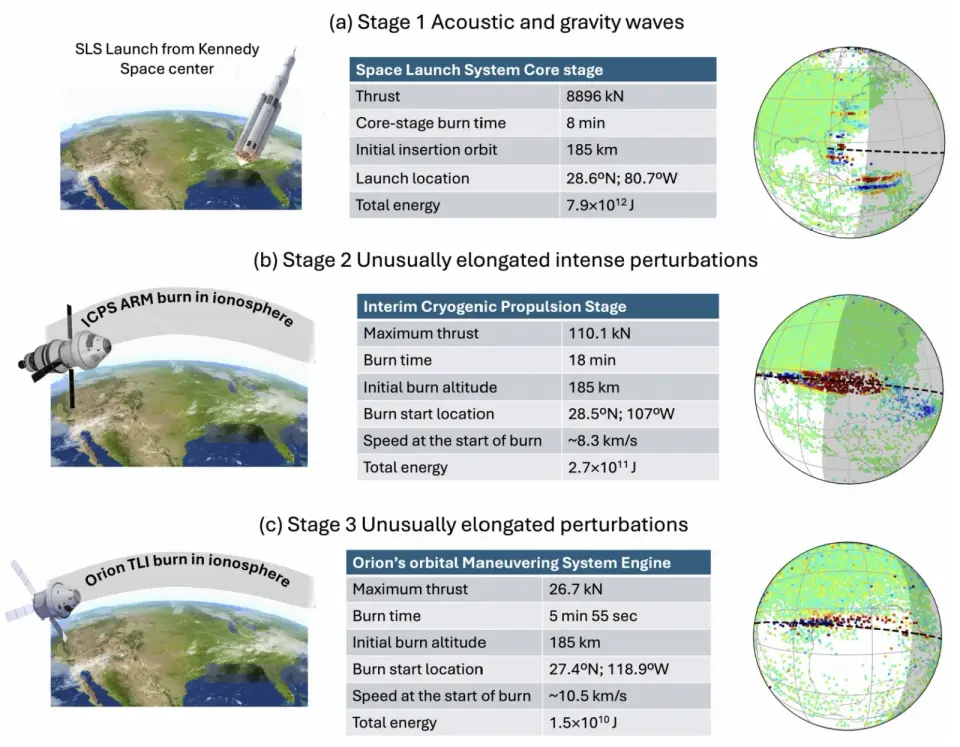
A new study reveals that the April 2026 launch of NASA's Artemis II mission caused significant disturbances in Earth's ionosphere, potentially disrupting GPS signals. Researchers from National Cheng Kung University found that the Space Launch System's upper-stage burns created atmospheric gaps wider than those from previous launches, posing risks to autonomous vehicles and drones. While no widespread GPS failure occurred, the study warns that future heavy rocket launches could impact terrestrial technology as lunar missions increase in frequency.
Key points
- The Artemis II launch on April 1, 2026, generated three distinct disturbances in Earth's ionosphere, with the upper-stage burns causing the most significant impact.
- The ionospheric disturbances were up to ten times more intense than those observed following SpaceX Starship test launches, despite Starship being twice as powerful based on liftoff thrust.
- The disturbances created 'holes' in the ionosphere that stretched across North America, potentially causing GPS positioning errors of several meters.
- Researchers warn that as rocket launches become more frequent and powerful, these atmospheric effects could disrupt communications, autonomous vehicles, and drones.
- The study, published as a pre-print in Geophysical Research Letters, used data from high-precision ground-based GPS receivers to measure changes in electron density.
Background
This development follows the successful Artemis II mission, which was the first crewed lunar mission since the Apollo program. NASA Administrator Jared Isaacman has prioritized annual Space Launch System launches to outpace China in the 2028 lunar race, indicating that such atmospheric disturbances may become more common as the frequency of heavy rocket launches increases.
How outlets are covering it
Hackaday emphasizes the broad impact of rocket launches on the upper atmosphere, noting that the second and third stages' impact was large enough to sustainably disrupt GPS signals. BBC Sky at Night Magazine highlights the unprecedented nature of the disturbances, noting that they were stronger than any other rocket launches to date. Space.com focuses on the potential risks to technologies like self-driving cars and drones, with co-author Charles Lin stating that a positioning error of a couple of meters could cause an autonomous car to change lanes. All sources agree that while no widespread GPS disruption occurred during Artemis II, future launches could pose significant risks.
Why it matters
As the frequency and power of rocket launches increase, the potential for atmospheric disturbances to disrupt critical technologies like GPS becomes a growing concern. This could impact not only space missions but also terrestrial technologies that rely on precise positioning, such as autonomous vehicles and drones. Understanding these effects is crucial for mitigating risks and ensuring the reliability of global navigation systems.
What to watch
Researchers will continue to monitor the impact of future rocket launches on the ionosphere, particularly as NASA accelerates its plans for lunar landings and Mars missions. The findings from this study may inform future launch schedules and mitigation strategies to minimize the impact on terrestrial technologies.
- Artemis II Rocket Was Powerful Enough To Disrupt GPS Hackaday
- Artemis II launch tore a hole in Earth's atmosphere, say scientists BBC Sky at Night Magazine
- NASA's Artemis II moon launch tore a hole in Earth's upper atmosphere so huge it disrupted GPS signals Space
- NASA rocket may have punched a hole in the atmosphere, here's how it could impact GPS signals WUSA9
- Space Mission Created ‘Hole’ in Atmosphere, Could Have Impacted GPS: Study People.com
Want the full story? Read the original reporting
Read on Hackaday