
China Scrubs Historic Chang'e-7 Moon Mission Due to Weather and Safety Concerns
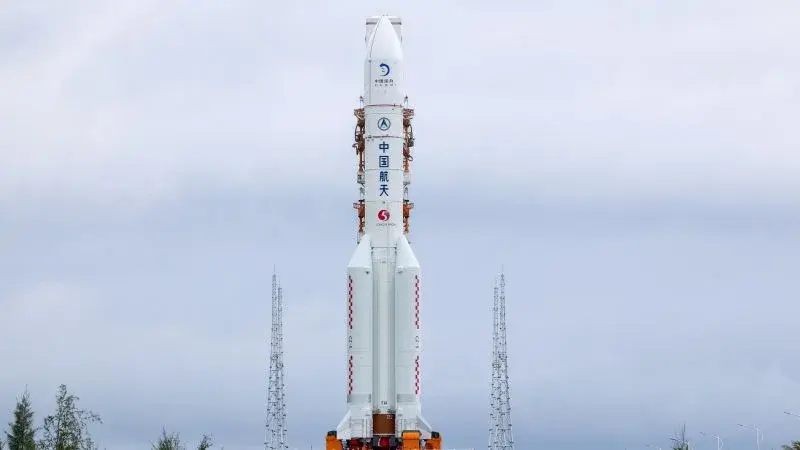
China has postponed its unprecedented Chang'e-7 lunar mission, which was scheduled to launch from Hainan to search for water ice near the Moon's south pole. The China Manned Space Agency cited safety and reliability assessments, while the National Astronomical Research Institute of Thailand attributed the delay to Tropical Storm Narra in the South China Sea. The mission, featuring an orbiter, lander, rover, and a unique hopping probe, aims to characterize water ice in permanently shadowed craters, a critical resource for future lunar bases. This delay impacts China's race against the United States to establish a permanent presence on the Moon, with NASA Administrator Jared Isaacman emphasizing the urgency of the competition. The next launch window is at least a month away, as the specific orbital alignment required for the south pole landing site cannot be met immediately.
Key points
- The China Manned Space Agency announced on Sunday that the Chang'e-7 mission does not meet launch conditions and cannot proceed within the scheduled window this year, citing safety and reliability.
- The National Astronomical Research Institute of Thailand (Narit), which developed a scientific instrument for the mission, stated that Tropical Storm Narra in the South China Sea forced the postponement.
- The mission was set to launch from the Wenchang spaceport in Hainan aboard a Long March-5 rocket, with an expected arrival at lunar orbit in about five days.
- Chang'e-7 includes an orbiter, lander, rover, and a thruster-powered 'hopping' probe designed to drill for water ice in the Shackleton crater near the lunar south pole.
- A delay of just a few days pushes the next possible launch window to at least a month later, due to the specific solar alignment required for the target landing site.
- NASA Administrator Jared Isaacman has framed the lunar exploration as a 'space race,' noting that China is moving at 'incredible speeds' and may land astronauts on the Moon before the US returns.
Background
China's Chang'e-7 mission is part of a broader lunar exploration program that has seen successful previous missions, including the first-ever landing on the Moon's far side. The mission targets the Shackleton crater, a region of high scientific and strategic interest due to its potential water ice deposits. The United States, through NASA's Artemis program, is also pursuing a lunar base in the same region, with Artemis III preparations accelerating for a 2027 launch. The competition between the two nations for lunar resources and presence has intensified, with both countries viewing the south pole as critical for long-term settlement.
How outlets are covering it
The China Manned Space Agency and Xinhua emphasized that the delay was due to a comprehensive safety and reliability assessment, stating that the mission does not meet launch conditions. In contrast, the National Astronomical Research Institute of Thailand (Narit) attributed the postponement specifically to Tropical Storm Narra in the South China Sea, noting that the storm affected the launch window. ABC News and Ars Technica highlighted the geopolitical implications of the delay, framing it within the context of a US-China space race, with NASA Administrator Jared Isaacman expressing concern about China's progress. Ars Technica also raised the possibility that China might assert territorial rights over the explored region, potentially creating a keep-out zone for NASA. South China Morning Post focused on the technical and logistical aspects of the delay, noting the specific orbital alignment required for the south pole landing site.
Why it matters
The delay of Chang'e-7 is significant because it represents a setback in China's efforts to establish a permanent presence on the Moon, a goal that NASA has also prioritized. The mission's success would have provided critical data on water ice, a resource essential for sustaining human life and producing rocket fuel on the Moon. The postponement may affect the timeline for both China's and the US's lunar base plans, potentially altering the dynamics of the space race. Additionally, the delay highlights the challenges of launching missions to specific lunar locations, where orbital alignment and weather conditions play a crucial role. The competition for lunar resources and presence is likely to intensify, with both nations seeking to secure a foothold on the Moon for scientific and strategic reasons.
What to watch
The next launch window for Chang'e-7 is at least a month away, as the specific solar alignment required for the south pole landing site cannot be met immediately. China will need to reassess the mission's readiness and address any safety concerns before attempting another launch. NASA and the US Congress are likely to monitor the situation closely, as the delay may provide an opportunity to accelerate Artemis III preparations. The scientific community will be watching for updates on the mission's progress and any new insights into the lunar south pole's water ice deposits. The geopolitical implications of the delay may also influence international cooperation and competition in space exploration.
- China postpones launch of unprecedented water-hunting moon mission amid space race CNN
- China's bid for lunar water launches Sunday as the new space race heats up ABC News - Breaking News, Latest News and Videos
- The United States is about to wake up to the threat from China’s space program Ars Technica
- China puts off Chang’e-7 mission to drill for ice near lunar south pole South China Morning Post
- Due to need for ‘absolute success,’ China delays critical Moon launch to 2027 Ars Technica
Want the full story? Read the original reporting
Read on CNN