
Mars Rover Captures First Surface-Based Occultation of Earth by Phobos
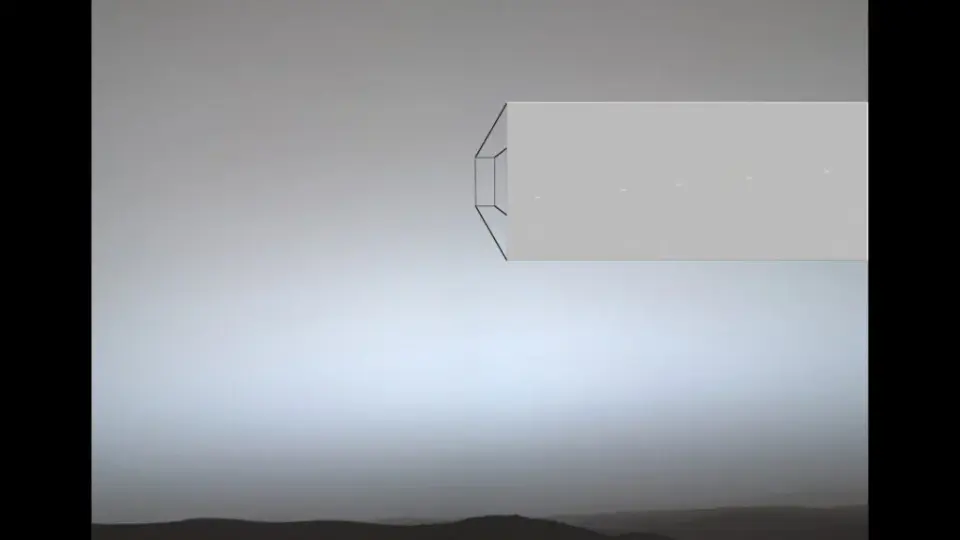
NASA’s Perseverance rover recorded the first-ever image of Earth disappearing behind Mars’ moon Phobos from the surface of another planet. Captured on July 2, 2026, the event was documented via a composite of nine still images, not a video.
Key points
- The observation occurred on July 2, 2026, at 7 p.m. local solar time on Mars (sol 1,907) from Jezero Crater.
- Earth appeared as a single bright pixel, while Phobos appeared as a crescent moon roughly one-third the apparent size of Earth’s Moon.
- The images were processed into an annotated composite to make the tiny alignment visible, as Earth vanished for approximately 10 seconds.
- This is the first time an instrument on the surface of another planet has recorded Earth being fully occulted by another object.
- Phobos orbits Mars every 7.5 hours, moving west to east, which allows for frequent but precise alignment opportunities.
Background
Perseverance has previously captured astronomical events, including Phobos transiting the Sun in 2022 and 2024. Earlier missions like Spirit and Curiosity have also imaged Earth from Mars, but none had recorded a full occultation from the planetary surface. The rover’s primary mission focuses on geology and sample caching, but its Mastcam-Z camera enables such astronomical observations.
How outlets are covering it
Space Daily emphasizes the technical precision of the composite image, noting it is not a continuous video but a reconstruction from nine frames. Universe Today highlights the 'wow factor' of the image and notes that while the event is rare, Phobos’s rapid orbit makes such alignments possible with careful planning. Both sources agree on the historical significance but differ in emphasis: Space Daily focuses on the narrow definition of 'first from the surface,' while Universe Today frames it as a unique 'self-portrait' with a 'photobomb.'
Why it matters
This event demonstrates the capability of Mars rovers to serve as astronomical observation platforms, providing unique perspectives on celestial mechanics. It also helps refine orbital models of Phobos, which is gradually spiraling inward toward Mars and may eventually break apart or impact the planet in 20-50 million years.
What to watch
Future missions, including JAXA’s MMX and Roscosmos’s Mars-Grunt, aim to study Phobos directly. Human observers may eventually witness similar events from Mars, though current robotic missions are capturing these rare alignments. Mars will reach opposition again in February 2027, offering new opportunities for Earth-based observation of the planet.
- On 2 July 2026, NASA's Perseverance rover captured Earth disappearing behind Phobos from the surface of Mars — the first time in history a camera on another planet has watched our world vanish behind another object. Space Daily
- Percy Sees An 'Eclipse' of Earth, From Mars Universe Today
- Look What NASA's Perseverance Rover Just Spotted Vanishing Behind the Martian Moon Phobos The Debrief
- NASA’s Perseverance rover watches Earth vanish from the surface of Mars Science Daily
- NASA watched Earth disappear from the surface of Mars for the first time ever earth.com
Want the full story? Read the original reporting
Read on Space Daily