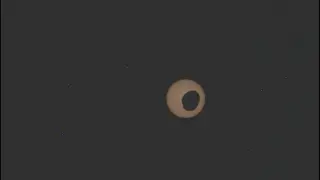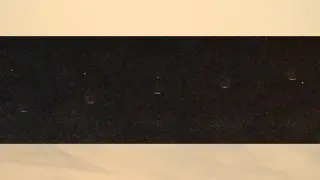
NASA's Perseverance rover on Mars used its Mastcam-Z cameras to capture Phobos partially obscuring the Sun, producing Mars' own solar eclipse; the image highlights how robotic explorers expand humanity's reach and offer unique views of cosmic events from the Martian surface.
NASA’s Perseverance rover on Mars recorded a nine-image sequence in which Earth, a one-pixel dot 314 million kilometres away, passes behind Phobos, marking the first observation of Earth disappearing behind another world from the surface of a different planet; the event is presented as an annotated composite rather than a continuous video, highlighting careful geometry and timing.
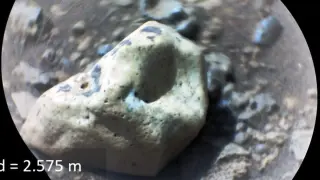
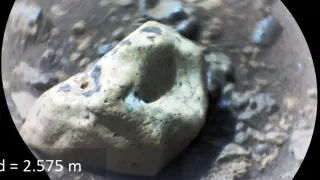
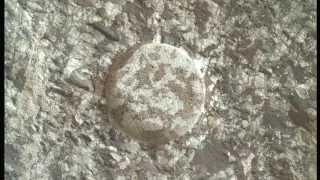
NASA's Perseverance rover used time-resolved luminescence spectroscopy to identify corundum, a gemstone mineral that forms rubies and sapphires, in three plagioclase-rich float rocks at Jezero Crater—marking the first detection of corundum on Mars and suggesting formation under heat and fluids possibly tied to the crater's ancient impact; findings published in Geophysical Research Letters highlight new clues about Mars' geological history and the potential for sample-return studies.
NASA's Perseverance rover identified chromium-bearing corundum grains (the mineral behind rubies and sapphires) in three plagioclase-rich float rocks at Jezero Crater using time-resolved luminescence spectroscopy, marking the first detection of corundum on Mars. The grains imply aluminum-rich, silicon-poor chemistry likely formed during ancient impacts or hydrothermal activity; spectral matches to Earth corundum suggest a surprising Martian geology, and returning a sample could confirm exactly how this mineral formed.
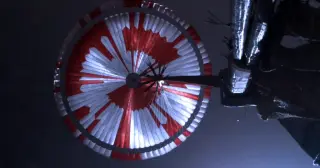
NASA’s Perseverance parachute carries an orange-and-white pattern that encodes a binary message by Ian Clark, a systems engineer and crossword hobbyist. Decoded within hours of landing, it reveals the motto “Dare Mighty Things” and GPS coordinates pointing to NASA’s Jet Propulsion Laboratory in Pasadena—home base for the rover’s creators. The pattern also serves as a visual aid to track parachute orientation during descent, turning a diagnostic tool into a public invitation to engage with the mission.
Perseverance has completed a 42.195 km drive on Mars, while NASA revisits and redesigns the Mars Sample Return plan to reduce risk and cost (considering two landing concepts and a smaller ascent vehicle); at the same time, NASA’s partnership with Relativity Space to deliver Aeolus instruments to Mars will improve wind, temperature, and atmospheric data to guide future landings, illustrating that Martian exploration now relies on weather-aware planning and sustained institutional commitment rather than a single dramatic mission.
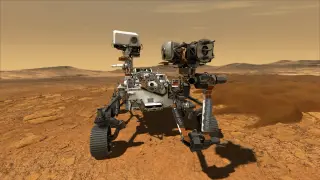
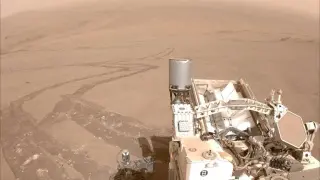
NASA’s Perseverance rover is on track to exceed 45.16 km of driving on Mars, with roughly 90% of its travel autonomous thanks to an onboard Vision Compute Element. This autonomous navigation lets it roam Jezero Crater efficiently, outpacing Curiosity’s driving and maximizing science return, while its RTG power and redesigned wheels promise years of continued exploration.
NASA’s Perseverance rover used the Mastcam-Z camera to produce a grainy composite showing Earth as a tiny bright dot passing behind Mars’ moon Phobos on July 2, 2026. It’s the first time Earth has been photographed from the surface of another planet while an astronomical object occluded it, achieved by stacking nine frames and processing to darken the background; the event also nods to earlier Earth-from-Mars shots by Spirit (2004) and Curiosity (2014).
Harvard rejected Paul Devlin in 1981; he replied with a witty letter rejecting the rejection after spotting a grammar error. The New York Times published it, and in 2022 a British actor performed a dramatic reading. Devlin went on to win nine Emmys as a documentary producer/director.
NASA’s Perseverance rover captured a rare occultation where Earth briefly disappears behind Mars’ moon Phobos. The composite image, taken on July 2, 2026, shows Earth as a bright dot crossing behind Phobos in the Martian sky, an alignment that requires precise timing since Phobos crosses the sky about three times a day.
NASA's Perseverance microphone on Mars captured sounds showing a two-speed acoustic world: low-frequency sound travels about 240 m/s, high-frequency sound about 250 m/s due to the CO2-dominated, low-pressure atmosphere. Over distance, high notes arrive earlier but are attenuated and masked; this effect lets acoustic data probe Martian temperature, wind, and turbulence, providing a new way to study the planet's atmosphere.
NASA's Ingenuity began as a 30-sols tech demo on Mars but far exceeded expectations, completing 72 flights, traveling over 17 km, and supporting Perseverance for 1,004 sols—until a damaged rotor blade grounded it in January 2024, with NASA announcing the mission's end on Jan 25, 2024. The mission's remarkable success reshaped future planetary exploration and inspired rotorcraft concepts for the Moon, Mars, and Titan.
NASA’s Perseverance carries 43 ultra-clean titanium sample tubes designed in a hyper-clean room to limit Earth-derived organics to 150 nanograms in total (and 15 ng for life-relevant compounds). A single fingerprint (~45,000 ng) would exceed the entire allowance by about 300x, so any contaminant would trigger cleaning and retesting. Tubes feature a titanium nitride surface, a reflective coating to limit heating, and hermetic seals, and are accompanied by five witness tubes to monitor contamination. Each tube comes with hundreds of pages of documentation, underscoring that cleanliness is part of the science. While a future Mars Sample Return is politically uncertain, this approach ensures that if Martian signals are found, they can be distinguished from Earthly material, even if the tubes never reach Earth.
NASA's Ingenuity, built to complete five flights over 30 Martian days, ended up flying 72 times across nearly three years before a hard landing shattered its rotor blades. Now grounded, it continues to wake each Martian day, inspect itself, photograph the surface, and log temperatures as a weather-like memory bank, with no live link to Earth and data stored for future retrieval.
A Scientific American piece argues that definitive proof of life on Mars remains elusive, but growing evidence from Viking’s life-detection tests, Curiosity and Perseverance findings, and ongoing debates about biosignatures keep open the possibility that ancient Mars was habitable—perhaps even inhabited—while highlighting the need for quantitative methods and future sample-return missions to settle the question.