
PRISM2 Foundation Model Achieves Clinical-Grade Pathology Diagnosis via Multimodal Slide Analysis
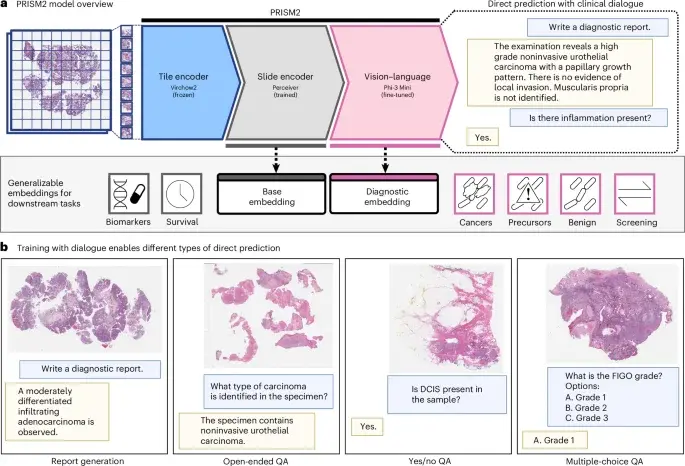
Researchers have introduced PRISM2, a multimodal foundation model designed to interpret whole-slide pathology images. Trained on 2.3 million slides and 14 million question-answer pairs derived from 700,000 reports, the system aligns histological images with diagnostic reasoning. PRISM2 supports both prompt-based inference and transferable embeddings, achieving performance levels that match or exceed existing clinical-grade AI products in detecting invasive cancer and subtyping tumors. The model utilizes a dual-objective training approach, combining contrastive learning for image-text alignment with autoregressive next-token prediction to generate diagnostic reports. This advancement moves computational pathology beyond simple image patch encoding toward comprehensive slide-level understanding, offering a tool for downstream tasks such as survival prediction and biomarker analysis.
Key points
- PRISM2 is trained on 2.3 million whole-slide images and 14 million question-answer pairs from 700,000 pathology reports.
- The model uses a dual-objective training method: contrastive loss for aligning image and text representations, and autoregressive cross-entropy loss for generating diagnostic text.
- In prompt-based inference tests, PRISM2 matches or exceeds the performance of established clinical AI products like Paige Prostate and Paige Breast for detecting invasive cancer.
- The system generates 'diagnostic' embeddings that can be adapted for downstream tasks, including survival prediction and biomarker analysis, without requiring extensive retraining.
- PRISM2 demonstrates the ability to handle compound questions and integrate patient history, though errors were noted in specific grading scenarios, such as FIGO grade misclassification in uterine specimens.
Background
This development follows a broader trend in 2026 where foundation models are being applied to specialized domains beyond general language processing. While previous archive entries highlighted the integration of foundation models into consumer devices like Apple’s iOS 27 and the release of large-scale open-weight models like Inkling, the focus here is on high-stakes medical diagnostics. The shift from patch-level to whole-slide understanding represents a significant step in making computational pathology tools clinically viable, moving beyond theoretical benchmarks to practical diagnostic assistance.
How outlets are covering it
The primary source, Nature Medicine, emphasizes the clinical utility and performance metrics of PRISM2, highlighting its ability to match existing commercial AI products in cancer detection. In contrast, the secondary source from Bioengineer.org discusses a separate but related study by Bareja et al. in Nature Communications, which focuses on benchmarking the robustness of foundation models against technical variabilities like stain differences and scanner artifacts. While the primary source celebrates the diagnostic accuracy of PRISM2, the secondary source raises critical questions about whether such models maintain performance under real-world distribution shifts, suggesting that benchmark success must account for resilience rather than just leaderboard accuracy. The two sources together illustrate a field where high performance is being achieved, but rigorous validation of generalizability remains a key concern.
Why it matters
The introduction of PRISM2 signifies a maturation of AI in pathology, moving from experimental tools to systems that can rival human-level diagnostic performance in specific tasks. By integrating clinical dialogue supervision, the model bridges the gap between image recognition and medical reasoning, potentially reducing the workload for pathologists and improving diagnostic consistency. However, the emphasis on robustness in the secondary source underscores the need for careful validation before widespread clinical adoption, ensuring that these powerful tools do not fail due to minor technical variations in slide preparation or imaging.
What to watch
Future research will likely focus on addressing the generalization challenges highlighted by the benchmarking study, ensuring that models like PRISM2 can perform reliably across diverse clinical settings. There may also be increased scrutiny on the error cases identified in the primary source, such as grading inaccuracies, to refine the model's reasoning capabilities. As these foundation models become more integrated into clinical workflows, the development of standardized benchmarks that account for real-world variability will be crucial for establishing trust and regulatory approval.
Want the full story? Read the original reporting
Read on nature.com