
SpaceX Falcon 9 Launch Creates Rare 'Jellyfish' Cloud Over East Coast
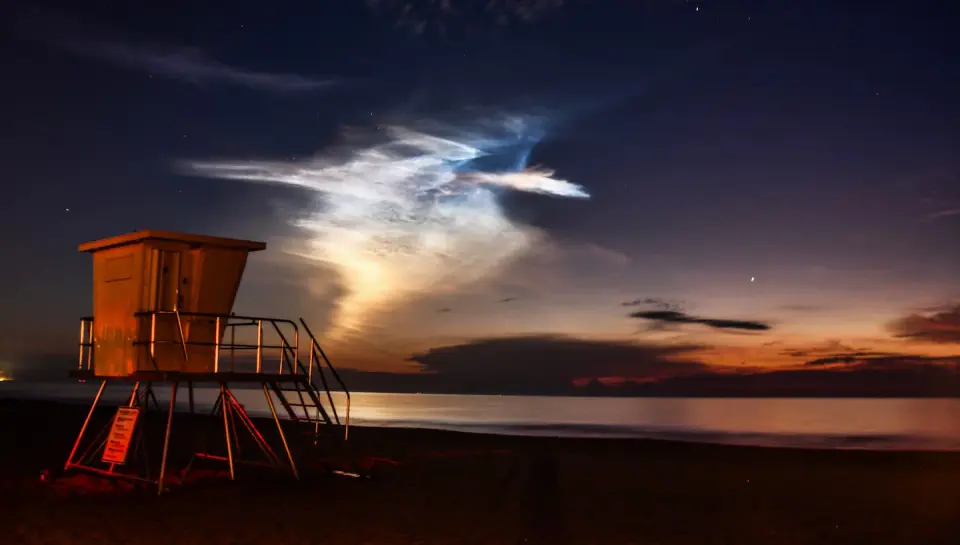
A SpaceX Falcon 9 rocket launched from Cape Canaveral on August 25, 2026, carrying 29 Starlink satellites. The early morning liftoff created a rare, human-made 'jellyfish' cloud visible across the East Coast. This event highlighted the visual impact of rocket exhaust in the upper atmosphere and marked a record-breaking 37th flight for the booster.
Key points
- A SpaceX Falcon 9 rocket launched from Cape Canaveral Space Force Station at 5:33 a.m. EDT on August 25, 2026, carrying 29 Starlink satellites into low Earth orbit.
- The launch produced a rare 'jellyfish' cloud, a human-made noctilucent phenomenon, visible to early risers along the East Coast from Florida to New York, New Jersey, and Delaware.
- The event occurred during the pre-sunrise window, allowing sunlight to illuminate the rocket's exhaust plume, creating a striking visual effect that lasted until shortly after 6:00 a.m.
- The booster, tail number B1067, achieved a record-breaking 37th flight, landing on the droneship 'A Shortfall of Gravitas' in the Atlantic Ocean approximately 8.5 minutes after liftoff.
- This launch was part of SpaceX's Starlink 10-49 mission, adding to a constellation of over 11,000 satellites, with the Cape Canaveral site potentially pausing Starlink launches as focus shifts to Starship preparations.
Background
SpaceX has significantly increased its launch cadence in 2026, with Falcon 9 reliability remaining strong despite earlier aborts. The company has shifted a majority of Starlink missions to Vandenberg Space Force Base in California, refocusing Cape Canaveral operations on Starship development. Previous 'space jellyfish' events have been reported in other locations, including California and Finland, highlighting the global visibility of such atmospheric phenomena.
How outlets are covering it
The Washington Post emphasized the rarity and visual spectacle of the 'jellyfish' cloud for East Coast observers. Spaceflight Now focused on the technical achievement of the booster's 37th flight and the operational shift away from Cape Canaveral for Starlink missions. Florida Today highlighted the widespread visibility of the launch across multiple states and explained the atmospheric science behind the 'space jellyfish' effect, noting its occurrence during twilight hours.
Why it matters
The event underscores the increasing frequency of rocket launches and their visible impact on the atmosphere, while also highlighting SpaceX's operational strategies and the growing global presence of its satellite constellation. It serves as a reminder of the intersection between space technology and atmospheric science, with potential implications for future launch scheduling and public awareness of space activities.
What to watch
SpaceX is expected to continue its high launch cadence, with potential pauses in Starlink missions from Cape Canaveral as resources are redirected to Starship preparations. Future launches may produce similar atmospheric phenomena, depending on timing and weather conditions. The company's focus on booster reuse and cost reduction will likely continue to shape the global launch market.
- Falcon 9 rocket launch creates unusual jellyfish cloud over East Coast The Washington Post
- SpaceX launches Starlink mission on a Falcon booster’s record-breaking 37th flight Spaceflight Now
- SpaceX rocket launch in Florida visible in New York, New Jersey and DC Florida Today
- What kind of ‘cloud’ is in the sky this morning? WFLA
- SpaceX Starlink satellite launch seen in sky over Maryland WBAL-TV
Want the full story? Read the original reporting
Read on The Washington Post