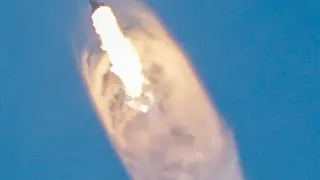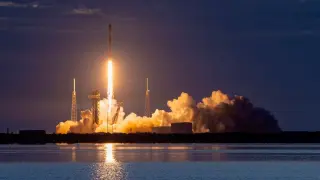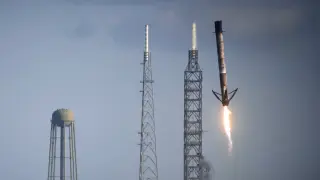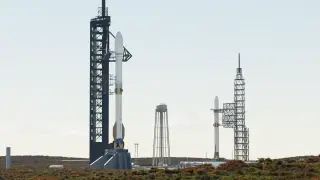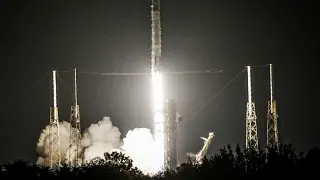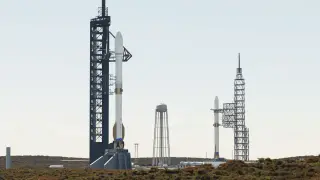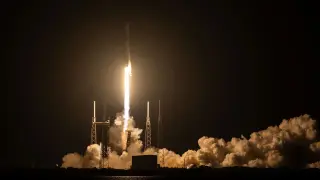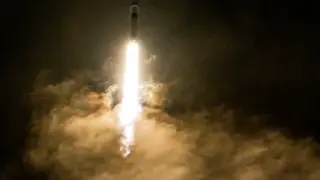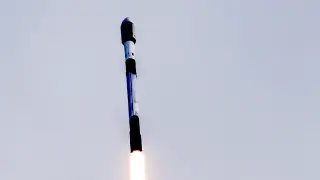
SpaceX lifts off from Cape Canaveral on Memorial Day, captured in photos
SpaceX launched a rocket from Cape Canaveral on Memorial Day morning, with the event documented in a photo gallery accompanying the report.
All articles tagged with #cape canaveral

SpaceX launched a rocket from Cape Canaveral on Memorial Day morning, with the event documented in a photo gallery accompanying the report.

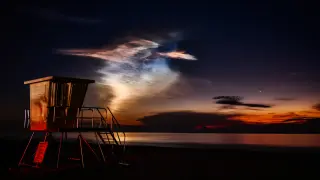
A SpaceX Falcon 9 launch from Cape Canaveral produced a luminous, jellyfish‑shaped cloud visible across Florida as dawn broke, drawing early risers to witness the unusual sky display likely linked to rocket exhaust and Starlink activity.

SpaceX launched a Falcon 9 rocket from Cape Canaveral Space Force Station on May 21, 2026, delivering 29 Starlink broadband satellites into low-Earth orbit.

SpaceX’s CRS-34 Falcon 9 launch from Cape Canaveral was scrubbed due to adverse weather, including anvil clouds and lightning warnings. Brevard County deactivated its launch operations support after the scrub, and SpaceX now targets Friday, May 15, for liftoff around 6:05 p.m. ET, with fueling underway and the countdown halted with 28 seconds remaining.

SpaceX will launch a Falcon 9 from Cape Canaveral to deliver a Cargo Dragon to NASA's ISS as part of CRS-34; liftoff is scheduled for 7:16 p.m. ET on May 12 on a northeast trajectory, with the first stage aiming to land at LC-40 near the launch site, triggering a sonic boom over Brevard County. Weather forecasts show only a 35% chance of favorable conditions, and a backup liftoff at 6:50 p.m. on May 13 is planned if needed.
SpaceX launched the Starlink 10-38 mission from Cape Canaveral, sending 29 Starlink satellites into low Earth orbit and continuing the year’s heavy Starlink cadence; the Falcon 9 first stage B1069 landed on the drone ship A Shortfall of Gravitas about 8 minutes after liftoff, the mission occurring under favorable weather prospects (80% chance) and adding to SpaceX’s growing fleet now numbering over 10,000 spacecraft.

SpaceX successfully launched the Falcon Heavy from Florida to deploy the ViaSat-3F3 satellite into geosynchronous transfer orbit; the two side boosters returned to Cape Canaveral for landing (with sonic booms), while the core stage was expended. The article also provides a detailed countdown timeline and booster-by-booster history.

An Atlas V rocket launched from Cape Canaveral at 8:52 p.m., carrying 29 Amazon Leo satellites for United Launch Alliance, and was visible across the Philadelphia region thanks to clear skies.

SpaceX has retired the East Coast drone ship Just Read the Instructions from Falcon 9 recoveries, repurposing it to support Starship operations in Florida after supporting 156 Falcon 9 landings since 2015. With Just Read the Instructions moving to Starship duties, A Shortfall of Gravitas becomes the sole Florida-based Falcon 9 recovery vessel, and onshore Cape Canaveral landings may increase as SpaceX readies Starship launches from Florida by year’s end.

United Launch Alliance's Atlas V with five solid rocket boosters is set to lift off from Cape Canaveral at 8:52 p.m. ET on April 27, 2026, launching 29 Amazon Leo satellites into low-Earth orbit. A ULA visibility map suggests the launch could be visible across much of Florida and up the East Coast, weather permitting, with Palm Beach County viewers advised to seek clear, unobstructed viewpoints.

ULA’s Atlas V rocket from Cape Canaveral, carrying the next batch of Amazon’s Leo satellites, is set to lift off at 8:52 p.m. ET on Monday, April 27, 2026. Weather and clouds willing, the brightness could be visible from most of Florida up the East Coast to New England, with sightings reported or projected for states including New Jersey, North Carolina, West Virginia, Indiana, Tennessee and Alabama on ULA’s visibility map. Florida Today will provide 90 minutes of prelaunch coverage at floridatoday.com/space, and viewers can watch via the Florida Today app or NASA+. Past Cape Canaveral launches have been seen well beyond Florida, highlighting the potential sky show for East Coast observers.

SpaceX will launch GPS III SV10, the 10th and final GPS III satellite for the U.S. Space Force, from Cape Canaveral aboard a Falcon 9. GPS III SV10 delivers a threefold boost in positional accuracy and eightfold jam resistance; liftoff will occur within a 15-minute window opening at 2:57 a.m. EDT, with SV10 deployed into medium Earth orbit roughly 90 minutes after liftoff. The launch follows the Space Force’s decision to move the mission from a Vulcan Centaur due to booster issues, and SpaceX will provide live coverage of the flight.

SpaceX kicked off and closed the day with two Starlink launches: 29 satellites (group 10-24) blasted off from Cape Canaveral in the morning, and about 19 hours later 25 more satellites (group 17-27) lifted off from Vandenberg, joining the SpaceX megaconstellation. Both missions succeeded, with the Falcon 9 first stages returning to Earth on droneships (B1080 and B1082), bringing SpaceX’s Starlink fleet past 10,200 satellites in orbit.

A SpaceX Falcon 9 rocket lifted off from Cape Canaveral early Tuesday, deploying 29 Starlink satellites. Its northeasterly trajectory made the morning launch visible from the Philadelphia area, with viewers sharing videos of the sight.
SpaceX launched its 1,000th Starlink satellite of 2026 from Cape Canaveral on a Falcon 9, deploying 29 Starlink 10-24 satellites. It marked SpaceX’s 37th dedicated Starlink mission this year, bringing the total Starlink satellites launched in 2026 to 1,002. Liftoff occurred at 5:33:10 a.m. EDT, with payload deployment about an hour after launch, while the first-stage booster B1080 landed about 8.5 minutes later on the drone ship Just Read the Instructions — the 157th booster landing on that vessel and the 598th booster landing to date.