
13-Year Effort Yields Largest 2D Map of the Universe, Cataloging 4 Billion Objects
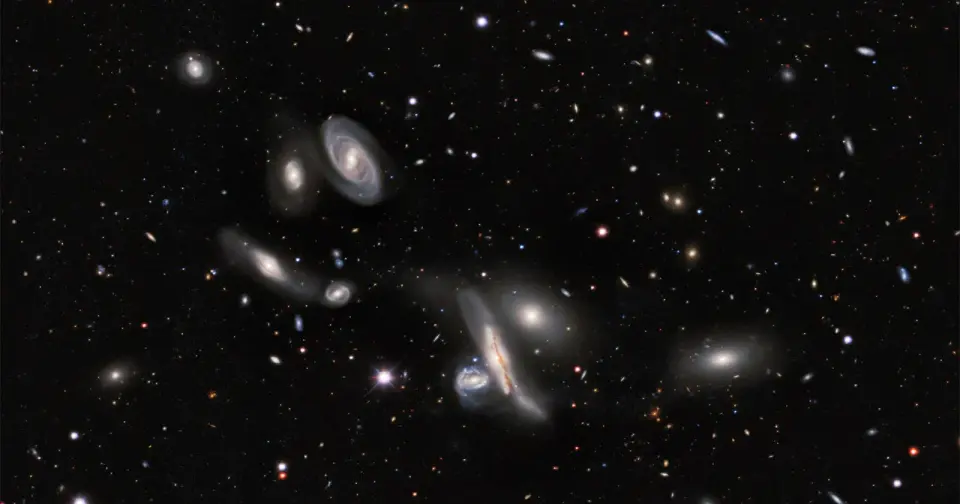
A 13-year astronomical project has released the largest two-dimensional map of the universe, covering 75% of the sky and cataloging nearly four billion celestial objects. The 5.6-trillion-pixel dataset, built from 263,407 photos, serves as a foundational reference for studying dark energy and future telescope missions.
Key points
- The DESI Legacy Imaging Surveys map covers three-quarters of the sky in visible and near-infrared light.
- The catalog includes nearly four billion objects, such as stars, galaxies, black holes, and asteroids.
- Data was collected over 13 years using the NSF Mayall and Blanco telescopes, including the 570-megapixel Dark Energy Camera.
- The map is publicly available and has already been cited in over 1,800 scientific papers.
- It provides the necessary 2D baseline for the Dark Energy Spectroscopic Instrument (DESI) to build a 3D map of the universe.
Background
This release follows the recent launch of the Vera C. Rubin Observatory’s Legacy Survey of Space and Time, which will create a dynamic 10-year movie of the southern sky. The new 2D map complements these efforts by providing a static, high-resolution reference for the expanding universe, which is currently understood to be roughly 92 billion light-years in diameter due to cosmic expansion.
How outlets are covering it
PetaPixel and NOIRLab emphasize the map’s scale and its role as a foundational tool for the astronomy community, noting that over 160 scientists contributed to the data collection. NOIRLab highlights the map’s utility for studying dark energy and its accessibility to citizen scientists. In contrast, AZoQuantum focuses on the broader context of dark energy research, detailing how the Dark Energy Survey (DES) used similar imaging technology to confirm that dark energy behaves like a steady cosmological constant. While PetaPixel and NOIRLab stress the map’s comprehensive coverage and public availability, AZoQuantum frames the data within the ongoing debate about the nature of the universe’s accelerating expansion.
Why it matters
This map provides a critical baseline for understanding the universe’s structure and the behavior of dark energy. By offering a detailed 2D view of nearly four billion objects, it enables researchers to track the expansion history of the universe and prepare for next-generation observatories like the Vera C. Rubin Observatory. The public availability of this data also democratizes access to high-resolution astronomical information, allowing both professionals and enthusiasts to explore cosmic phenomena.
What to watch
Researchers will use this 2D map to guide the Dark Energy Spectroscopic Instrument (DESI) in building the largest high-resolution 3D map of the cosmos. DESI is expected to publish improved results using its first five years of data in 2027 and will continue observations into 2028. Additionally, the data will be used to train artificial intelligence tools for analyzing petabytes of astronomical data, supporting future missions like the Vera C. Rubin Observatory and the Nancy Grace Roman Space Telescope.
- Biggest 2D Map of the Universe Took 13 Years and 263,407 Photos to Make PetaPixel
- DESI releases biggest 2D map of the universe Phys.org
- Scientists create largest 2D map of the universe with 5.6 trillion pixels and nearly 4 billion cosmic objects Space
- Scientists Release Biggest 2D Map of the Universe NOIRLab
- Landmark Cosmic Survey Maps the Accelerating Expansion of the Universe AZoQuantum
Want the full story? Read the original reporting
Read on PetaPixel