
JWST Identifies 'Black Hole Star' Candidate to Solve Little Red Dot Mystery
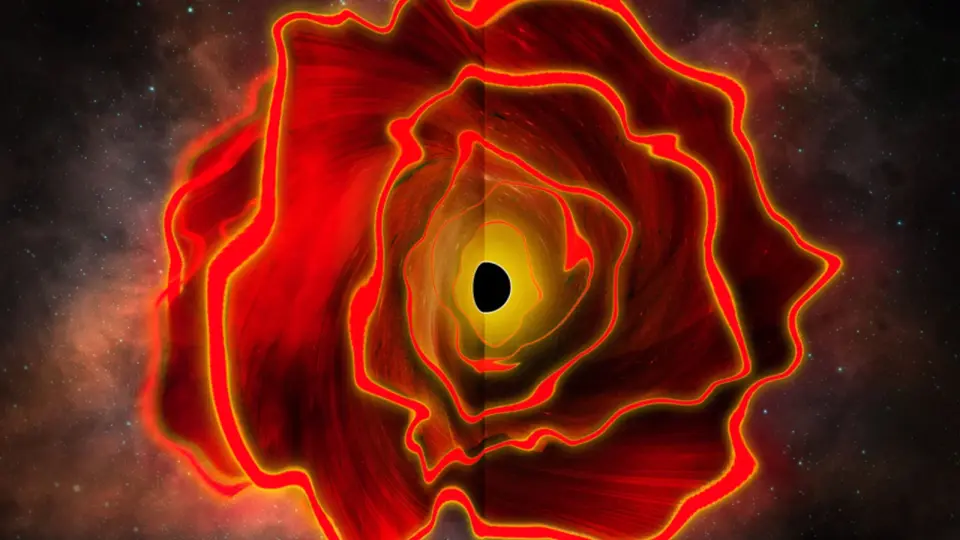
Astronomers have identified a new candidate for a 'black hole star,' a hypothetical object consisting of a supermassive black hole surrounded by a dense, dust-free gas envelope. Discovered by the James Webb Space Telescope (JWST) in the constellation Cetus, the object, designated MoM-BH*-1, dates to 660 million years after the Big Bang. It shines 100 billion times brighter than a typical star and is roughly the size of our solar system. This finding offers the strongest evidence yet for this object class and may explain the origin of 'little red dots' (LRDs), a group of hundreds of bright, crimson objects observed in the early universe that do not match standard stellar or galactic models.
Key points
- MoM-BH*-1 was detected by the JWST’s Miracle or Mirage (MoM) survey as the reddest source in the Ultra Deep Survey field, appearing luminous at infrared wavelengths but fading at shorter ones.
- The object exhibits an extreme Balmer break, a spectral feature indicating dense hydrogen gas absorption, which is stronger than any previously observed in stellar populations.
- Researchers propose that MoM-BH*-1 is a black hole with a mass of approximately 100,000 solar masses, enveloped in a turbulent gas cocoon that is heated by the black hole's accretion rather than nuclear fusion.
- The discovery suggests that LRDs are likely black hole stars embedded in early galaxies, with MoM-BH*-1 being unique because its black hole outshines its host galaxy, allowing for a 'pure' observation of the object.
- The study, published in Nature on August 12, 2026, notes that the red color is caused by gas scattering and absorption, not dust, challenging previous assumptions about LRDs.
Background
The 'little red dots' (LRDs) have been a major puzzle since JWST began operations in 2022, with over 300 identified by 2025. These objects are brighter than stars but too dim to be full galaxies, appearing in the 'cosmic dawn' era. Previous candidates, such as 'the Cliff,' identified last year, showed similar characteristics but were less distant. The current finding, MoM-BH*-1, is older and farther away, making it a critical test case for theories on how supermassive black holes formed so rapidly in the early universe.
How outlets are covering it
Live Science and Smithsonian Magazine emphasize the novelty of the 'black hole star' concept, highlighting that MoM-BH*-1 is the best evidence yet for this object class. They note that while LRDs were previously thought to be dust-enshrouded, the new data suggests the redness is due to gas. KCCI focuses on the resolution of the LRD mystery, noting that the object's brightness rules out nuclear fusion as a power source. The Nature study, led by Rohan Naidu, provides the technical details, confirming the extreme gas density and the lack of dust, which distinguishes this object from standard quasars or stars. All sources agree that further observations are needed to confirm the model, but the consensus is that MoM-BH*-1 is a singular object that may explain the LRD population.
Why it matters
This discovery could resolve one of the biggest puzzles in modern astronomy: the origin of LRDs and the rapid formation of supermassive black holes in the early universe. If confirmed, black hole stars may be common in the cosmic dawn, acting as seeds for galaxy evolution and influencing how we understand the growth of black holes. The finding also challenges existing models of stellar and galactic evolution by introducing a new class of object powered by accretion rather than fusion.
What to watch
Researchers plan to conduct further spectroscopic follow-up observations to confirm the black hole star model. They will also analyze other LRDs to see if they share the same characteristics, such as the extreme Balmer break and gas-dominated redness. The study suggests that if MoM-BH*-1 merged with a brighter neighbor, it would resemble typical LRDs, implying that many LRDs may be black hole stars embedded in galaxies. Future JWST observations will aim to verify the variability and spectral features of these objects to solidify the new object class.
- Black hole star? Solar-system-size 'dot' from the early universe is our best evidence yet of a brand-new type of cosmic object Live Science
- A gas-enshrouded and gas-reddened black hole at cosmic dawn Nature
- Astronomers discover black hole star for the first time ever FOX Weather
- Astronomers Peered at the Early Universe and May Have Discovered a New Kind of Celestial Object: Black Hole Stars Smithsonian Magazine
- Astronomers identify new type of 'black hole star' in universe while hunting space mystery KCCI
Want the full story? Read the original reporting
Read on Live Science