
New Fossil Data Revises Evolution of Land-Dwelling Vertebrates
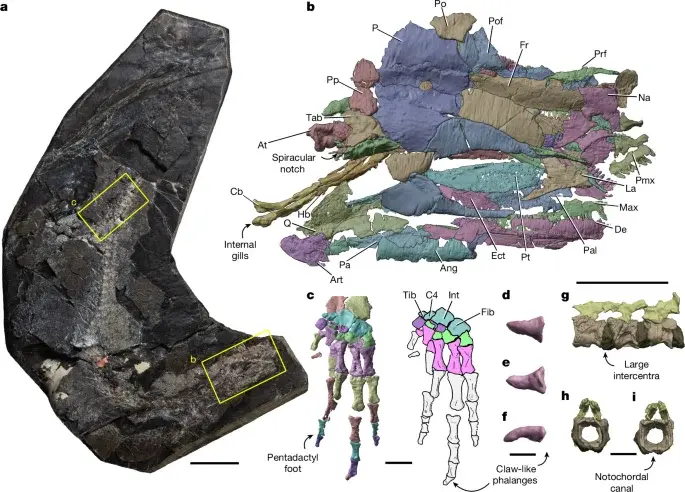
A new study in Nature reclassifies the Early Carboniferous fossil Westlothiana lizziae as a stem tetrapod rather than an early amniote, revealing that terrestrial adaptations evolved in a mosaic fashion within an amphibious context.
Key points
- Researchers used CT scans and phylogenetic analysis to re-evaluate Westlothiana lizziae, previously considered the earliest stem amniote.
- The fossil exhibits aquatic traits, including an ossified internal gill skeleton and extensive denticles on the palate and mandible.
- The study finds that terrestrial features, such as an amniote-like foot structure and claw-like phalanges, evolved independently from aquatic adaptations.
- This suggests a gradual, amphibious transition to land rather than a sudden shift, challenging previous views of early tetrapod evolution.
- The findings highlight significant gaps in anatomical knowledge for small-bodied early tetrapods, complicating the understanding of the water-to-land transition.
Background
Recent studies, including a 2026 analysis of the stem insect Chosha praecursor, have supported the idea of gradual, amphibious transitions for various lineages moving from water to land. This aligns with the new findings on Westlothiana, which also suggest a prolonged transitional phase rather than a rapid shift to terrestrial life.
Why it matters
This research refines the timeline and mechanism of one of evolution's most significant transitions: the move from water to land. By reclassifying a key fossil, it provides a more nuanced understanding of how vertebrates adapted to terrestrial environments, impacting broader models of vertebrate evolution.
What to watch
Further research is needed to fill anatomical gaps in small-bodied early tetrapods. Future studies may focus on additional fossil specimens and advanced imaging techniques to clarify the mosaic evolution of terrestrial traits in the tetrapod stem lineage.
Want the full story? Read the original reporting
Read on nature.com