Tag

Fossils

All articles tagged with #fossils

Oldest 'octopus' fossil reclassified as nautiloid
science23 hours ago

Oldest 'octopus' fossil reclassified as nautiloid

A fossil long hailed as the oldest octopus, Pohlsepia mazonensis from Mazon Creek (~311–306 million years ago), has been re-examined with advanced imaging. Using synchrotron X-ray, micro-CT, SEM, and multispectral imaging, researchers found no octopus features (no eight-arm anatomy, no internal shell, no ink sac, no hooks) and no ocular pigments. They identified a preserved radula and dental pattern that match nautiloids, revealing it died, decomposed, and was flattened into mud, preserving soft tissue as two-dimensional stains. This makes Pohlsepia the oldest confirmed nautiloid soft-tissue fossil in the Paleozoic, and the study suggests other Mazon Creek fossils could yield similar revelations.

Ancient mummy fossil reveals rib-powered breathing’s ancient origins
science2 days ago

Ancient mummy fossil reveals rib-powered breathing’s ancient origins

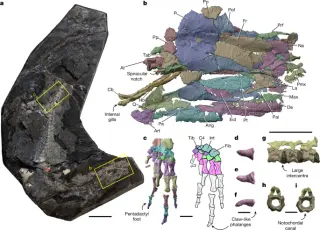
A 289-million-year-old mummy fossil of Captorhinus aguti from Oklahoma shows a complete rib cage and cartilage sternum, preserved in three dimensions, providing the oldest evidence of costal (rib-based) respiration in amniotes and suggesting this rib-powered breathing system underpins modern reptiles, birds, and mammals; neutron tomography enabled the reconstruction of its early breathing apparatus.

Earth’s green revolution: how land plants transformed the planet
science24 days ago

Earth’s green revolution: how land plants transformed the planet

Plants first evolved from green algae and began colonizing land around 470 million years ago. To survive, they developed a waxy cuticle to reduce water loss, stronger cell walls, and simple anchor structures; by about 420 million years ago, vascular tissue allowed taller growth and the creation of soils, accelerating weathering and increasing atmospheric oxygen. Later, seeds around 380 million years ago improved reproductive success in dry conditions, and flowering plants around 140 million years ago spread with animal pollinators and fruit dispersal, driving widespread biodiversity. This chain of innovations transformed Earth’s atmosphere, soils, and ecosystems, enabling life to flourish on land.

Texas Construction Finds Ice Age Giant Sloth Tooth, Shaping Roadwork and History
science27 days ago

Texas Construction Finds Ice Age Giant Sloth Tooth, Shaping Roadwork and History

During an environmental survey for the Loop 88 project in Lubbock, Texas, workers uncovered a tooth from a giant Ice Age ground sloth. Paleontologists from the Museum of Texas Tech University will study the remains, but construction is expected to proceed with minimal delays, illustrating a balance between development and scientific discovery.

Hemoglobin Traces Detected in Dinosaur Bones, Hinting at Long-Lived Blood Molecules
science29 days ago

Hemoglobin Traces Detected in Dinosaur Bones, Hinting at Long-Lived Blood Molecules

Scientists using resonance Raman spectroscopy found signals in fossil vessels from Tyrannosaurus rex and Brachylophosaurus canadensis that resemble hemoglobin fragments, suggesting ancient blood components may survive in some fossils and offering clues on how soft tissues can persist for tens of millions of years, potentially via mineralization processes like goethite formation.

Ancient Salamander Relative Went Plant-Eating with a Jaw Twist
science1 month ago

Ancient Salamander Relative Went Plant-Eating with a Jaw Twist

Paleontologists at the Field Museum describe Tanyka amnicola, a 275-million-year-old stem tetrapod whose jaw is unlike any seen in early vertebrates: a twisted shape with backward-facing, denticle-covered teeth that likely ground plants. Once thought to be a deformity, the jaw appears to be an evolutionary design, suggesting an herbivorous lifestyle for this three-foot-long, salamander-like ancestor and revealing a long-surviving, now-extinct lineage. Only the jaw has been found, so the full appearance remains speculative.

Early Permian Predators Targeted Big Plant-Eaters, Study Finds
science1 month ago

Early Permian Predators Targeted Big Plant-Eaters, Study Finds

A Scientific Reports study of bite marks on three young Permian herbivores shows that large predators were already shaping ecosystems more than 280 million years ago, with candidates like varanopid and sphenacodontid synapsids (e.g., Varanops and Dimetrodon) preying on big herbivores. The findings push back the timeline for predator–prey hierarchies on land and reveal a complex Permian food web that also involved arthropod borings and scavengers.

Cambrian Comeback: 91 New Species Revealed in China After Earth's First Mass Extinction
science1 month ago

Cambrian Comeback: 91 New Species Revealed in China After Earth's First Mass Extinction

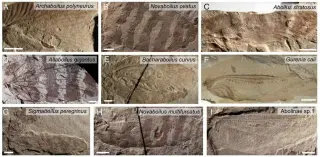
In a Chinese quarry, researchers uncovered the Huayuan biota dating to about 513 million years ago—over 50,000 fossils across 153 species, 91 of which are new—preserving soft tissues like guts, nerves, and eyes. This Konservat Lagerstätte shows a rapid ecological rebound within roughly 1.5 million years after the first mass extinction, with deep-water refuges and larval dispersal linking Cambrian communities across oceans to later deposits such as the Burgess Shale.

Ancient reptile buttprint rewrites early evolution story
science1 month ago

Ancient reptile buttprint rewrites early evolution story

Scientists describe a 298–299 million-year-old fossil imprint from a bolosaurian reptile in Germany, preserving belly scales and a cloaca—the oldest known soft-tissue imprint of its kind and the earliest reptile skin details—offering new insights into early reptile evolution. Named Cabarzichnus pulchrus, the 3.5-inch trace extends the fossil record of back-end anatomy by more than 150 million years and suggests anatomical similarities to modern turtles, lizards, and snakes.