
New Study Reveals Duck-Billed Dinosaur Beak Was a Complex, Bird-Like Sensory and Cooling Organ
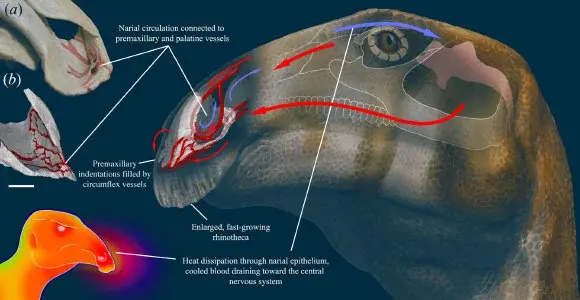
A new analysis of the 81-million-year-old dinosaur Tethyshadros insularis reveals its beak was not a simple toothed comb, but a highly complex, vascularized organ comparable to modern bird bills. Micro-CT scans show the 'spikes' on its snout were actually dense networks of blood vessels and nerves, not teeth. This suggests the beak served multiple functions, including cropping abrasive food, sensing mechanical stress, and regulating body heat. The findings challenge previous reconstructions and highlight the evolutionary sophistication of hadrosauroid oral structures.
Key points
- Researchers used micro-computed tomography to scan the jaw bones of three Tethyshadros insularis specimens, including the holotype, to trace internal canals and openings.
- The structures previously identified as forward-facing, rod-like tooth spikes are now interpreted as osteological correlates for a dense neurovascular network, not teeth.
- The beak likely supported a keratin sheath (rhamphotheca) that exceeded the underlying bone in size and complexity, similar to the bills of modern birds.
- Deep wear scratches on the teeth, some wider than 150 micrometers, suggest the dinosaur consumed abrasive material, such as limestone particles from its coastal habitat.
- The vascular network likely facilitated thermoregulation, allowing the warm-blooded dinosaur to shed heat through its head, a strategy similar to that of the toco toucan.
- The study, published in Royal Society Open Science on November 11, is the first detailed description of such vascular structures in ornithopods.
Background
This discovery builds on recent paleontological findings that challenge traditional views of dinosaur and bird evolution. For instance, a 2026 study on the Late Jurassic avialan Yuezhuornis yangyuanensis highlighted that early bird evolution was not solely driven by flight, but by rapid ecological diversification. Similarly, this new research on hadrosaurs suggests that the evolution of complex beaks was a key innovation that facilitated dietary versatility and ecological expansion, rather than just a precursor to avian flight.
Why it matters
This research fundamentally changes our understanding of hadrosauroid anatomy and physiology. By revealing that the beak was a multifunctional organ for sensing, eating, and cooling, it provides a new framework for understanding how these dinosaurs adapted to their environments. It also underscores the importance of detailed micro-CT analysis in paleontology, as previous interpretations based on external bone structures were misleading. This could lead to a re-evaluation of other dinosaur reconstructions and highlight the evolutionary parallels between dinosaurs and modern birds.
What to watch
Researchers may apply similar micro-CT analysis techniques to other hadrosauroid and ornithischian specimens to determine if this complex beak-nares system is widespread in the group. Further studies could also explore the specific dietary habits and environmental adaptations of these dinosaurs, potentially revealing more about their ecological roles in their respective habitats.
Want the full story? Read the original reporting
Read on Sci.News