
October Science Highlights: From Neanderthal Hands to Tardigrade Moulting
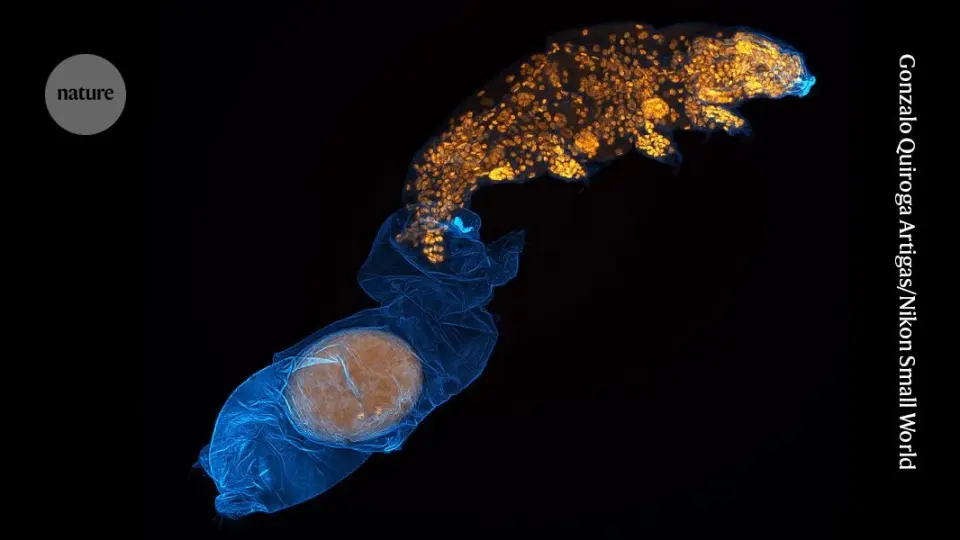
Nature’s October science image roundup features a 46,000-year-old Neanderthal hand found in Spain, a tardigrade shedding its skin, and NASA’s Astrobee robots on the ISS. The selection also includes a bee stinger mechanism study, an elephant mourning ritual in Namibia, and 57 new marine species discovered in Argentina.
Key points
- A 46,000-year-old Neanderthal hand was discovered in a cave in northern Spain, with findings presented in Tarragona on 19 October but not yet peer-reviewed.
- NASA’s Astrobee robots, which are 30-centimetre cubes, operate autonomously inside the International Space Station to inventory items and record experiments.
- Researchers at the University of New South Wales identified a bee stinger mechanism involving two collapsible cylinders that act as pistons to inject venom.
- Italian photographer Federico Veronesi won the 2026 Wildlife Photographer of the Year competition for an image of an elephant carrying a dead calf in Namibia.
- Scientists identified 57 new marine species, including a sea cucumber named 'Loki', during a workshop in Buenos Aires using samples from Argentina’s Mar del Plata Canyon.
Background
This month’s highlights follow recent scientific discussions on biological shedding processes, such as metastatic cancer cells releasing migrasomes and theoretical models of black holes shedding scalar fields. The Neanderthal discovery adds to ongoing paleogenomic research, while the ISS robotic operations continue to support microgravity experiments.
Why it matters
These images and findings highlight advances in paleoanthropology, robotics, and marine biology. The Neanderthal hand offers potential insights into ancient DNA preservation, while the bee stinger study provides new understanding of insect mechanics. The discovery of new marine species underscores the importance of deep-sea exploration for biodiversity.
What to watch
The Neanderthal findings await peer review, which may validate the ancient DNA analyses. The Wildlife Photographer of the Year exhibition will remain open at London’s Natural History Museum until 11 July 2027. Continued monitoring of ISS robotic operations and marine species identification will likely yield further data.
Want the full story? Read the original reporting
Read on Nature