
Pluto's 20-Year Demotion Sparks Debate Over Planetary Definitions
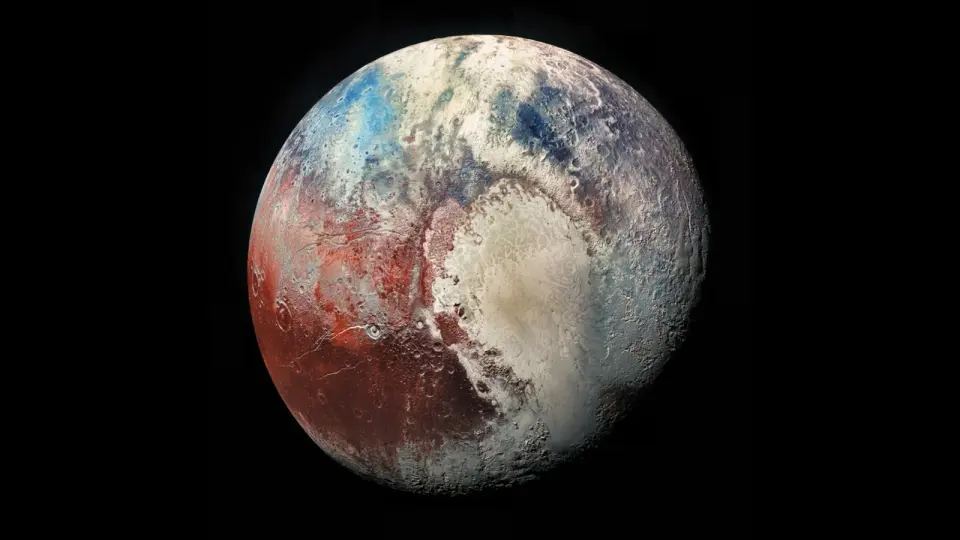
Twenty years after the International Astronomical Union reclassified Pluto as a dwarf planet, the debate over planetary definitions remains unresolved. While the 2006 vote established that planets must clear their orbital neighborhoods, critics argue this excludes Earth and other bodies sharing orbits with asteroids. New discoveries, such as the exosatellite around CD-35 2722, further complicate classification, leading some scientists to propose quantitative criteria for gravitational dominance rather than relying on the current ambiguous standards.
Key points
- The IAU reclassified Pluto as a dwarf planet on August 24, 2006, citing its failure to clear its orbit of other Kuiper Belt objects.
- NASA's New Horizons mission, launched in 2006, revealed Pluto's complex geology, including active glacial flows and the heart-shaped Tombaugh Regio, countering views of it as a dead rock.
- Mike Brown, who discovered Eris, argues that restoring Pluto's status would require classifying Earth's moon and other large moons as planets, which contradicts common scientific usage.
- A new system, CD-35 2722, features a Jupiter-sized object orbiting a brown dwarf, leading researchers to coin the term 'exosatellite' to avoid classification disputes.
- Jean-Luc Margot proposed a quantitative definition for orbital clearing in 2024, but the IAU declined to adopt it, leaving the debate open for the 2027 assembly.
Background
Pluto was discovered in 1930 by Clyde Tombaugh at the Lowell Observatory. For decades, it was considered the ninth planet. The 2006 reclassification followed the 2005 discovery of Eris, a body more massive than Pluto, which challenged the existing planetary definition. The IAU's decision sparked public outrage and ongoing scientific debate, with some advocating for Pluto's reinstatement and others supporting the current classification to maintain a clear distinction between planets and dwarf planets.
How outlets are covering it
Space.com highlights the public's emotional attachment to Pluto and the scientific complexity revealed by New Horizons. Scientific American, through Mike Brown, argues that the current definition is scientifically consistent, as restoring Pluto would necessitate classifying moons as planets. Smithsonian Magazine emphasizes the cultural impact of the reclassification and the continued scientific interest in Pluto. National Geographic focuses on the broader issue of planetary definitions, noting that new discoveries like CD-35 2722 make classification even more difficult and that the IAU's current definition is widely criticized for its ambiguity.
Why it matters
The debate over Pluto's status reflects a larger issue in astronomy: the lack of a precise, universally accepted definition for planets. This ambiguity affects how we classify new discoveries, from exoplanets to rogue planets, and impacts public understanding of the solar system. Resolving this could lead to a more accurate and consistent classification system, enhancing our understanding of the universe.
What to watch
The IAU is expected to consider new planetary definitions at its 2027 General Assembly in Rome. Jean-Luc Margot and his team may propose their quantitative criteria for orbital clearing. Additionally, ongoing research into objects like CD-35 2722 and 2017 OF201 will continue to challenge existing classifications, potentially leading to further debates and refinements in astronomical terminology.
- On this day in space! Aug. 24, 2006: Pluto loses its planet status Space
- Mike Brown is very sorry, but Pluto still isn’t a planet Scientific American
- Why do we care so much that Pluto isn't a planet? Space
- Once the Solar System's Ninth Planet, Pluto Was Reclassified 20 Years Ago. Here's Why Planetary Scientists and the Public Alike Love the Small, Icy Body Smithsonian Magazine
- Pluto Got Demoted 20 Years Ago. We’re Still Not Sure What a Planet Really Is. National Geographic
Want the full story? Read the original reporting
Read on Space