Tag

New Horizons

All articles tagged with #new horizons

Pluto Reveals a Blue Sky, Floating Ice and a Binary-Style Orbital Dance
space10 days ago

Pluto Reveals a Blue Sky, Floating Ice and a Binary-Style Orbital Dance

New Horizons’ Pluto flyby uncovers a blue atmospheric haze, water-ice mountains, and nitrogen-ice glaciers with buoyant blocks, a Pluto–Charon barycentre outside Pluto that makes them orbit in a binary-like pattern, and an orbital period of about 248 years that has yet to complete an observed year since 1930, illustrating how exotic ices and weak sunlight create a dynamically active world far from Earth.


Pluto's Atmosphere Freezes as It Moves Away from the Sun
space15 days ago

Pluto's Atmosphere Freezes as It Moves Away from the Sun

Pluto’s nitrogen‑rich atmosphere is starting to condense into frost as it drifts farther from the Sun on its 248‑year orbit. Surface temperatures are about -382°F (-230°C) and the upper atmosphere around -333°F (-203°C). Observations of ten stellar occultations from 2017–2023 show atmospheric pressure has declined ~16% since 2021 (likely haze settling to lower latitudes). NASA’s New Horizons had measured a baseline atmospheric pressure of about 10 microbars in 2015. Pluto’s aphelion will occur in 2114 at ~49 AU, and the atmosphere isn’t expected to be fully frozen by then; frost could sublimate and the atmosphere thicken again as Pluto heads back toward the Sun.

Pluto’s Glacial Heart Hints at Recent Liquid Nitrogen Activity
space18 days ago

Pluto’s Glacial Heart Hints at Recent Liquid Nitrogen Activity

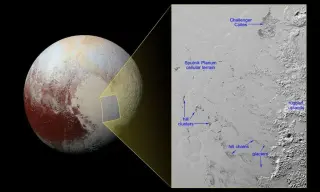
A new analysis of NASA’s New Horizons images of Pluto’s Sputnik Planitia suggests liquid nitrogen may have recently flowed beneath the dwarf planet’s heart-shaped glacier, producing dark surface patterns. While Pluto’s thin atmosphere today makes liquid-nitrogen rain impossible, simulations show underground liquid nitrogen could travel through conduits and remain liquid long enough to form the observed features, indicating a time‑variable process on astronomical timescales and underscoring the need for future observations.

Pluto's Atmosphere Thins as It Recedes, Hinting at Collapse
space-and-spaceflight21 days ago

Pluto's Atmosphere Thins as It Recedes, Hinting at Collapse

New Horizons data and Earth-based stellar occultations show Pluto’s atmospheric pressure rose from 1988 to 2015, stayed roughly constant until about 2021, and then declined by as much as 16% by 2022 as the dwarf planet moved farther from the Sun, potentially signaling the first signs of atmospheric collapse that had been anticipated for decades; continued observations over the coming years will be needed to confirm the trend, with Pluto not returning closer to the Sun until 2114.

Pluto’s Surprising Geology: Glaciers, Mountains, and a Hint of Ocean
space22 days ago

Pluto’s Surprising Geology: Glaciers, Mountains, and a Hint of Ocean

The 2015 New Horizons flyby revealed Pluto as a geologically active world, with flowing nitrogen glaciers in Sputnik Planitia, towering water-ice mountains, a blue haze in its atmosphere, and hints of a subsurface liquid ocean, challenging the idea of a lifeless, frozen relic and suggesting distance and cold don’t preclude internal activity.

New Horizons Awakens for fresh edge-of-solar-system science
space1 month ago

New Horizons Awakens for fresh edge-of-solar-system science

NASA's New Horizons woke from a 321-day hibernation at the solar system’s edge with all systems reported healthy. The spacecraft has resumed science data transmission from about 5.9 billion miles from Earth (≈64 AU) and will study the heliopause and outer heliosphere with more sensitive instruments than the Voyager probes, sending data back across an ~8 hours 52 minutes light-time delay as it continues toward interstellar space.

New Horizons wakes from a long slumber to resume its Kuiper Belt voyage
science1 month ago

New Horizons wakes from a long slumber to resume its Kuiper Belt voyage

NASA's New Horizons spacecraft woke on June 23 from a planned hibernation nearly 6 billion miles from Earth, resuming its distant Kuiper Belt investigations a decade after its Pluto flyby. Flight controllers say the probe is in good shape and will begin transmitting data gathered during the sleep period; hibernation has extended its lifespan, and the mission, focused through 2029, could continue beyond if the spacecraft remains healthy—as it eyes more objects beyond Pluto and toward interstellar space.

Colossal landslides on Pluto could bury Earth’s cities, study finds
space1 month ago

Colossal landslides on Pluto could bury Earth’s cities, study finds

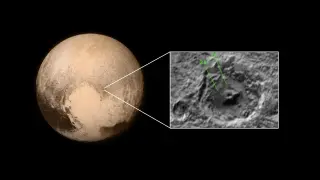
A team analyzing NASA’s New Horizons data from Pluto’s 2015 flyby identified six landslides along the inner walls of three craters on Sputnik Planitia. Debris flows stretch 10–14.5 km, with the largest apron about 130 sq km—large enough to bury a small city. These features show Pluto is geologically active on long timescales, likely driven by Pluto’s low gravity and icy, low-friction material; triggers vary, from nearby impacts to thermal stresses that cause sublimation and condensation of volatiles. The findings mark Pluto as the first Kuiper Belt world with such landslides confirmed, though coverage limits detection of additional events.

Pluto's Hidden Landslides Reframe Its Icy Landscape
space-and-spaceflight1 month ago

Pluto's Hidden Landslides Reframe Its Icy Landscape

Researchers reexamining data from NASA’s New Horizons flyby have identified six massive landslides inside Pluto’s craters, marking the dwarf planet’s first confirmed mass-wasting events. The largest slide spans about 50 square miles (130 square kilometers), with others rising roughly 1,200–1,500 meters, suggesting gravity-driven reshaping of Pluto’s icy terrain and hinting at more landslides that future missions could uncover.

New Horizons wakes to chart the solar system's icy frontier
space1 month ago

New Horizons wakes to chart the solar system's icy frontier

NASA’s New Horizons has awakened from its longest sleep, about 5.9 billion miles from Earth, to resume transmitting data from the Kuiper Belt and continue studying Pluto, Arrokoth, and distant icy bodies. Launched in 2006, the probe’s historic Pluto flyby in 2015 and subsequent Kuiper Belt observations are helping scientists understand how planets form. The spacecraft remains healthy and, if it stays that way, could extend its mission toward interstellar space beyond 2029 as it keeps gathering valuable outer-solar-system data.

New Horizons: A rapid Pluto flyby that yielded a slow, rich science return
science1 month ago

New Horizons: A rapid Pluto flyby that yielded a slow, rich science return

NASA’s New Horizons sped three billion miles to Pluto for a single, high-speed flyby at more than 30,000 mph because it wasn’t designed to brake into orbit; a powerful launch and a gravity assist from Jupiter got it there in under a decade. The mission prioritized data collection during closest approach and briefly went radio-silent to maximize science. Downlink of the roughly 50 billion bits of data took about 15 months due to distance, limited transmitter power, and shared antenna time, but revealed Pluto’s heart-shaped Sputnik Planitia, tall water-ice mountains, a hazy atmosphere, and signs of geological activity, reshaping our view of this distant world.

Brief Pluto Flyby, Enduring Scientific Harvest
space1 month ago

Brief Pluto Flyby, Enduring Scientific Harvest

New Horizons zipped past Pluto in July 2015 for a rapid flyby that captured essential data as it sped by. Because of the great distance and limited power, the full Pluto dataset wasn’t downloaded until over 15 months later, with the final transmission arriving in October 2016, turning the brief encounter into a long-running scientific record that revealed Pluto as a geologically active, complex world.

New Horizons Wakes to Edge of Solar System
space1 month ago

New Horizons Wakes to Edge of Solar System

NASA’s New Horizons has awakened from a 321‑day hibernation about 64 astronomical units from Earth (roughly 10 billion km) and will begin sending back a year’s worth of stored data while studying the outer heliosphere’s termination shock—the boundary where the solar wind slows and blends with interstellar material. Having passed Pluto and Arrokoth, the probe is now venturing farther into the Kuiper Belt region and beyond, with no new target identified; its path could see it leaving the Kuiper Belt around 2028–2029 as it continues toward interstellar space, with an approximate nine‑hour one‑way radio link and a current “green” status from mission control.

NASA's New Horizons Awakens to Return Clues from the Outer Solar System
space1 month ago

NASA's New Horizons Awakens to Return Clues from the Outer Solar System

NASA's New Horizons spacecraft has awakened from a 321-day hibernation about six billion miles from Earth, with all systems reporting green health status throughout. The probe will downlink its health data and begin transmitting science data from instruments like the Venetia Burney dust counter, Pluto Energetic Particle Spectrometer, and Solar Wind at Pluto, with the ultraviolet Alice spectrograph set to map hydrogen in the outer heliosphere in coming weeks. Launched in 2006 and famous for Pluto flybys in 2015, it is expected to continue its mission toward the Kuiper Belt through the decade.