Tag

Pluto

All articles tagged with #pluto

New Horizons Wakes to Edge of Solar System
space1 day ago

New Horizons Wakes to Edge of Solar System

NASA’s New Horizons has awakened from a 321‑day hibernation about 64 astronomical units from Earth (roughly 10 billion km) and will begin sending back a year’s worth of stored data while studying the outer heliosphere’s termination shock—the boundary where the solar wind slows and blends with interstellar material. Having passed Pluto and Arrokoth, the probe is now venturing farther into the Kuiper Belt region and beyond, with no new target identified; its path could see it leaving the Kuiper Belt around 2028–2029 as it continues toward interstellar space, with an approximate nine‑hour one‑way radio link and a current “green” status from mission control.

NASA's New Horizons Awakens to Return Clues from the Outer Solar System
space1 day ago

NASA's New Horizons Awakens to Return Clues from the Outer Solar System

NASA's New Horizons spacecraft has awakened from a 321-day hibernation about six billion miles from Earth, with all systems reporting green health status throughout. The probe will downlink its health data and begin transmitting science data from instruments like the Venetia Burney dust counter, Pluto Energetic Particle Spectrometer, and Solar Wind at Pluto, with the ultraviolet Alice spectrograph set to map hydrogen in the outer heliosphere in coming weeks. Launched in 2006 and famous for Pluto flybys in 2015, it is expected to continue its mission toward the Kuiper Belt through the decade.

New Horizons Wakes from Deep-Space Slumber Near Pluto
space2 days ago

New Horizons Wakes from Deep-Space Slumber Near Pluto

NASA's New Horizons, after roughly a year in hibernation about 5.9 billion miles from Earth, has awakened and is back online, with mission planners reporting all systems green as it resumes data gathering; it takes about nine hours for its radio signals to reach Earth, and the craft—launched in 2006 and famed for its 2015 Pluto images—continues exploring Pluto, the Kuiper Belt, and the outer heliosphere.

JWST Finds Shared, Unknown Chemical Fingerprint on Titan and Pluto
science3 days ago

JWST Finds Shared, Unknown Chemical Fingerprint on Titan and Pluto

NASA's JWST detected the same unidentified absorption feature in Titan and Pluto spectra, suggesting a surface- or near-surface compound common to both nitrogen- and methane-rich worlds. The signal, stronger on Pluto and not explained by known absorbers, appears to originate from the surfaces rather than the atmosphere and was observed by two different JWST instruments, making an instrumental glitch unlikely. Researchers consider possibilities from an unknown compound to a known molecule in an unusual form, with future observations and Dragonfly mission data hoped to help identify it; findings are published in Astronomy & Astrophysics and archived on arXiv.

JWST Finds Mysterious Absorption Signature on Pluto and Titan
science4 days ago

JWST Finds Mysterious Absorption Signature on Pluto and Titan

The James Webb Space Telescope detected a 5.113‑micrometer absorption feature on both Pluto and Titan that cannot be matched to any known compound in spectral databases, suggesting a mysterious mixture or a chemistry not yet characterized. Researchers confirm it isn’t an instrument error and are pursuing laboratory replication and further JWST observations, with the Dragonfly mission potentially helping identify candidate compounds to solve this outer-solar-system puzzle.

Hidden Molecule Behind the 5.11-Micrometer Signature on Pluto and Titan
science5 days ago

Hidden Molecule Behind the 5.11-Micrometer Signature on Pluto and Titan

JWST observations reveal a missing 5.11‑micrometer absorption band in the spectra of both Pluto and Titan, suggesting an as-yet unidentified molecule on their surfaces. After searching prior data, researchers couldn’t find a match for the feature, though candidates such as allenes or benzene-related species are considered; no definitive identification has been made. The findings appear in a paper accepted by Astronomy & Astrophysics and linked as an arXiv preprint, with follow-up JWST data and NASA’s Dragonfly mission to Titan anticipated to help solve the mystery.

New Horizons Reveals Pluto’s Giant Hearts and Hidden Ocean Clues
space5 days ago

New Horizons Reveals Pluto’s Giant Hearts and Hidden Ocean Clues

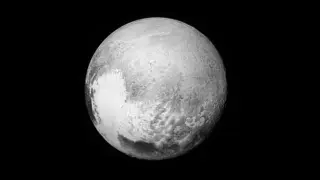
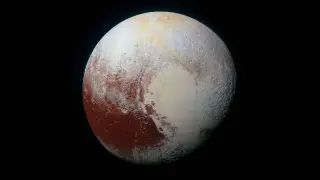
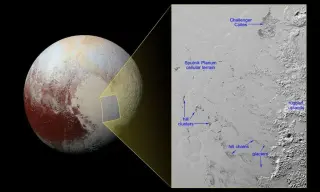
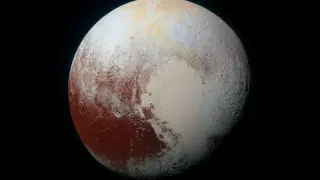
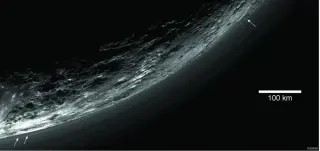
In July 2015, NASA’s New Horizons zipped past Pluto at about 32,000 mph, capturing most of its high‑resolution imagery in a ~30‑minute window and unveiling Tombaugh Regio—the heart-shaped region whose western lobe, Sputnik Planitia, is a vast nitrogen ice sheet roughly 1,200 by 2,000 km and about 4 km thick. The total data from the encounter amounted to about 6.25 GB, downlinked over about 15 months at 1–4 kb/s as the spacecraft continued outward. These findings — from the nitrogen ice plains to high‑albedo uplands, atmospheric haze, and clues to subsurface oceans — fundamentally reshaped planetary science and set the stage for decades of Pluto research as New Horizons travels beyond the Kuiper Belt.

Webb Spots Shared Unidentified Spectral Dip on Pluto and Titan
science6 days ago

Webb Spots Shared Unidentified Spectral Dip on Pluto and Titan

The James Webb Space Telescope has detected the same unidentified absorption feature at about 5.11 micrometers on the surfaces of Pluto and Titan. The dip does not match any known molecule in laboratory data, suggesting it arises from methane–nitrogen chemistry rather than the atmospheres. Despite their differences, the two worlds show a common chemical thread, making this a cross-world fingerprint that awaits lab confirmation. Scientists plan further Webb observations to map the feature and laboratory experiments with candidate molecules in methane-nitrogen ices at frigid temperatures to identify the absorber.

JWST spots a mysterious molecule signature on Pluto and Titan
science9 days ago

JWST spots a mysterious molecule signature on Pluto and Titan

New JWST observations reveal a 5.11‑micrometer absorption line in the spectra of Pluto and Saturn’s moon Titan, hinting at a molecule not yet seen on any solar‑system body or exoplanet. The researchers discuss plausible candidates—benzene with an unknown partner or other hydrocarbons such as acetylene/ketene ice—but emphasize that this is not yet proven and require more data. Pluto’s line is thicker than Titan’s, and Titan’s trailing hemisphere shows a stronger absorption; a future mission like Dragonfly could help identify the substance on Titan and clarify its presence on Pluto.

JWST hints at a mysterious molecule on Pluto and Titan, unseen elsewhere
space9 days ago

JWST hints at a mysterious molecule on Pluto and Titan, unseen elsewhere

A James Webb Space Telescope analysis of Pluto and Saturn’s moon Titan reveals a shared absorption feature near 5.11 micrometers, suggesting an unknown molecule may exist on both worlds. The suspected candidates include benzene or other hydrocarbons, but the exact identifications are unconfirmed and the study has not yet been peer‑reviewed. Researchers say this puzzling signal could be clarified by future observations, including NASA’s Dragonfly mission to Titan, which could help determine whether the molecule is viable on Pluto as well.

From Six to Eight: How Planet Counts Reflect Our Evolving View of the Solar System
space10 days ago

From Six to Eight: How Planet Counts Reflect Our Evolving View of the Solar System

Over 250 years, the list of recognized planets in our solar system has swung from six (Mercury through Saturn in 1776) to seven after Uranus’s 1781 discovery, briefly to 11 as Ceres and similar bodies were once counted as planets, then back to seven before Neptune’s discovery brought the count to eight; Pluto’s 2006 reclassification as a dwarf planet dropped the official total back to eight. The shifts show how scientific definitions evolve with new data (eg., TNOs and the Kuiper Belt) and ongoing debates between dynamical versus geophysical criteria, implying future discoveries could again reshape what we call a planet.

New Horizons Unveils Pluto's 1,000-km Icy Heart, Rewriting Distant-World Science
space19 days ago

New Horizons Unveils Pluto's 1,000-km Icy Heart, Rewriting Distant-World Science

NASA's New Horizons completed a nine-year, 3-billion-mile voyage to Pluto, flyby in 2015 revealed a 1,000-km heart-shaped glacier of frozen nitrogen and a landscape so young it challenged prior models; now 5.7 billion miles away, the probe is in hibernation awaiting NASA's funding decisions, with data still trickling back and potential wake-up in 2026 if approved.

Pluto's 248-Year Orbit Reaches Its First Lap in 2178
space1 month ago

Pluto's 248-Year Orbit Reaches Its First Lap in 2178

Pluto's year is about 248 Earth years, so since its 1930 discovery it has not completed a full orbit and will not until March 23, 2178. Its highly elliptical, inclined orbit takes it between 30 and 49 AU from the Sun, with perihelion in 1989 and aphelion around 2114. Pluto was reclassified as a dwarf planet in 2006, and NASA's New Horizons carried Clyde Tombaugh's ashes on its 2015 Pluto flyby.