
Deep-Sea Expedition Confirms Armored Searobin Can Walk Backward
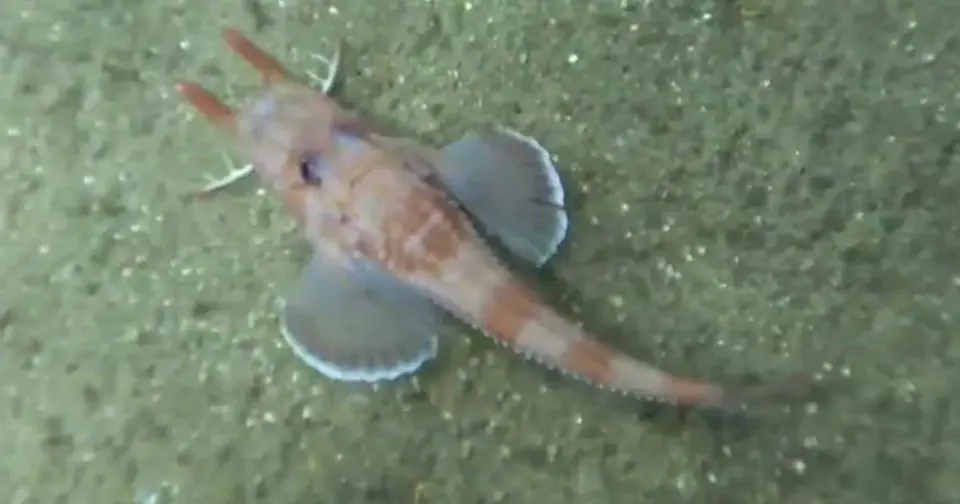
Researchers from Sun Yat-sen University and the Southern Marine Science and Engineering Guangdong Laboratory have captured the first footage of a fish walking backward. The team filmed the armored searobin Scalicus engyceros in the South China Sea using submersibles, confirming it moves sideways and backward like a crab or moonwalker. This behavior, previously only predicted, is enabled by stiffened pectoral fin rays that act as legs. The findings, published in Ocean-Land-Atmosphere Research, highlight new evolutionary adaptations in deep-sea species.
Key points
- Scientists filmed Scalicus engyceros, an armored searobin, walking sideways and backward on the seafloor for the first time.
- The footage was captured in the South China Sea at depths of 1,148 and 1,640 feet using the human-occupied vehicle Shenhaiyongshi and the remotely operated vehicle Haiqin.
- The fish uses thick, stiffened pectoral fin rays to scuttle across the bottom, resembling the movement of a shrimp or crab.
- The species, first described in 1872, was already known to walk, but lateral and backward movement had never been observed until this study.
- The searobin’s pectoral fins have evolved into flat, round plates that improve balance during locomotion and swimming.
- The fish’s large eyes showed sensitivity to light from submersible beams, indicating retained visual function despite the dark environment.
Background
This discovery builds on earlier deep-sea exploration efforts that have utilized advanced submersible technology to observe marine life in situ. Previous archive coverage noted the use of underwater observatories to document tectonic events, highlighting the growing capability to study the ocean floor directly. The current finding adds to the understanding of how extreme environments drive unique biological adaptations, moving beyond the study of preserved specimens to live behavioral observation.
How outlets are covering it
PetaPixel emphasizes the novelty of the backward walking behavior, describing it as 'moonwalking' and highlighting the first-ever nature of the footage. Nautilus focuses on the broader morphological adaptations, such as the skirt-like pectoral fins and unique snout structures used for sensing prey. Both sources agree on the significance of the finding but differ in emphasis: PetaPixel centers on the specific locomotion, while Nautilus provides a more comprehensive overview of the fish’s physical traits and the expedition’s broader implications for understanding deep-sea biodiversity.
Why it matters
This research reshapes scientific perceptions of deep-sea biodiversity by revealing that common species harbor complex behavioral and evolutionary adaptations previously unknown. It demonstrates the value of modern deep-sea diving vehicles in providing functional insights into species that were previously studied only through morphology of preserved specimens. The findings contribute to a better understanding of how extreme marine environments drive the emergence of unique biological structures and behaviors.
What to watch
Researchers may continue to use advanced submersibles to observe other deep-sea species in their natural habitats, potentially uncovering more novel behaviors and adaptations. The study of Scalicus engyceros and similar species could lead to new insights into the evolution of locomotion and sensory systems in deep-sea environments.
Want the full story? Read the original reporting
Read on PetaPixel