Tag

Deep Sea Exploration

All articles tagged with #deep sea exploration

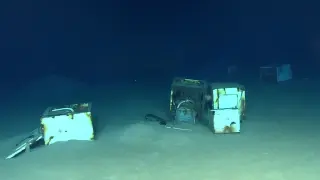
NOAA Scientists Discover Sunken Appliance Graveyard in Gulf of Mexico While Hunting for Shipwreck
science3 days ago

NOAA Scientists Discover Sunken Appliance Graveyard in Gulf of Mexico While Hunting for Shipwreck

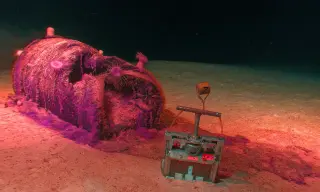
In 2017, a NOAA team searching for a shipwreck in the Gulf of Mexico accidentally discovered a massive deposit of discarded household appliances at a depth of 1.5 kilometers. The site, nicknamed 'Deep Clean,' features rusted white cubes of fridges and washing machines spilled from a red shipping container. Crew members noted the surreal nature of finding consumer goods in the deep ocean, highlighting how human waste persists in remote marine environments. The discovery underscores the long-term degradation timeline of lost cargo and the unintended ecological impacts of shipping accidents.
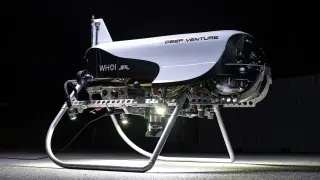
WHOI Unveils Deep Venture: A 36,000-Foot Rated AUV Designed to Scout Seafloor for Crewed Submarines
science-and-technology3 days ago

WHOI Unveils Deep Venture: A 36,000-Foot Rated AUV Designed to Scout Seafloor for Crewed Submarines

The Woods Hole Oceanographic Institution (WHOI) unveiled Deep Venture, an autonomous underwater vehicle (AUV) rated for full ocean depth of 36,000 feet, on November 20. Built in collaboration with NASA’s Jet Propulsion Laboratory, the 550-pound, 6-foot-long robot is designed to scout seafloor sites for crewed submarines like Alvin. It recently completed a test dive to 19,700 feet off Bermuda, capturing high-resolution images and 3D maps to help scientists select optimal dive locations. The vehicle features a modular science bay for sampling and uses photogrammetry for mapping, aiming to reduce reliance on specialized launch equipment and allow deployment from ordinary research ships.

Liquid Carbon Dioxide Bubbles at Pacific Vent Offer Clues to Ocean Acidification Impacts
science8 days ago

Liquid Carbon Dioxide Bubbles at Pacific Vent Offer Clues to Ocean Acidification Impacts

The Champagne Vent, located approximately one mile below the surface on the Northwest Eifuku submarine volcano in the Pacific, releases liquid carbon dioxide bubbles that resemble fizzing champagne. Discovered in 2004 by a remotely operated vehicle, this rare phenomenon involves droplets of liquid CO2 held together by hydrate skins, which rise because they are less dense than surrounding seawater. While the immediate vent area lacks animal life due to high acidity, nearby microbial mats support communities of mussels, crabs, and shrimps. The absence of dead shells suggests rapid dissolution from the acidic environment. Studying this unique habitat helps scientists understand how increased greenhouse gas emissions and resulting ocean acidification may impact marine ecosystems globally.

French Navy Drone Uncovers 16th-Century Wreck at Record Depth
science-and-technology2 months ago

French Navy Drone Uncovers 16th-Century Wreck at Record Depth

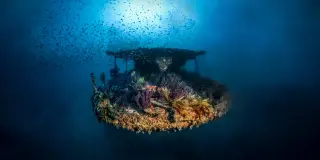
A routine seabed mapping mission by a French Navy drone in March 2025 accidentally discovered a 16th-century merchant ship at 2,567 meters, setting a new record for the deepest wreck in French waters. The vessel, named Camarat 4, lies off Saint-Tropez and remains largely intact due to its extreme depth, which prevented historical looting. Initial surveys revealed a 30-meter hull with approximately 200 ceramic jugs, 100 plates, and six cannons, suggesting an origin in Liguria, Italy. Authorities plan a two-year digital reconstruction rather than immediate salvage, highlighting how modern resource-mapping technology is now uncovering hidden maritime history in previously inaccessible deep waters.

Deep-sea searobin breaks records with unprecedented backward and sideways walking on the ocean floor
science2 months ago

Deep-sea searobin breaks records with unprecedented backward and sideways walking on the ocean floor

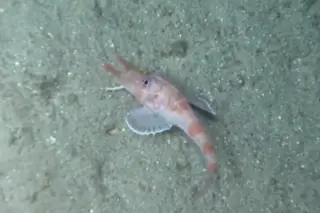
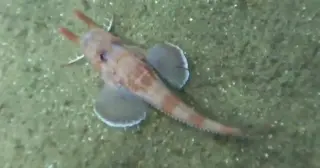
A deep-sea armored searobin, Scalicus engyceros, has been observed walking sideways and backward on the ocean floor, a behavior previously unseen in fish. The discovery, made in the South China Sea, highlights unique adaptations for extreme environments and expands understanding of deep-sea locomotion.

Deep-Sea Expedition Confirms Armored Searobin Can Walk Backward
science2 months ago

Deep-Sea Expedition Confirms Armored Searobin Can Walk Backward

Researchers from Sun Yat-sen University and the Southern Marine Science and Engineering Guangdong Laboratory have captured the first footage of a fish walking backward. The team filmed the armored searobin Scalicus engyceros in the South China Sea using submersibles, confirming it moves sideways and backward like a crab or moonwalker. This behavior, previously only predicted, is enabled by stiffened pectoral fin rays that act as legs. The findings, published in Ocean-Land-Atmosphere Research, highlight new evolutionary adaptations in deep-sea species.

Deep-Sea Fish 'Moonwalks' Backward on Seafloor, Revealing New Locomotion
science2 months ago

Deep-Sea Fish 'Moonwalks' Backward on Seafloor, Revealing New Locomotion

Chinese researchers filmed Scalicus engyceros, an armored searobin in the South China Sea, moving backward and sideways along the seafloor. This 'moonwalking' behavior, enabled by stiffened fin rays, has never been seen in other fish. The study, published in Ocean-Land-Atmosphere Research, highlights how submersibles reveal novel adaptations in deep-sea species.

French Navy Sonar Sweep Uncovers Deepest Shipwreck in French Waters
science-and-tech3 months ago

French Navy Sonar Sweep Uncovers Deepest Shipwreck in French Waters

A routine sonar survey by the French Navy led to the accidental discovery of a 16th-century merchant shipwreck at 8,200 feet depth, the deepest ever found in French territorial waters. Located off Ramatuelle, the well-preserved vessel contains hundreds of ceramic pitchers and other artifacts, offering a unique opportunity for deep-sea archaeological study.

Visual Survey of Deep Seafloor Would Take 100,000 Years at Current Rates
science3 months ago

Visual Survey of Deep Seafloor Would Take 100,000 Years at Current Rates

A 2025 study estimates that visually surveying the entire deep seafloor would take over 100,000 years at current rates, as humans have directly observed less than 0.001% of it. The research highlights severe geographic and technological biases in existing data, urging a shift from exhaustive mapping to strategic, representative sampling to improve global ocean understanding.

Deep-sea dives reveal 200,000 corroded radioactive waste barrels leaking in the Atlantic
environment3 months ago

Deep-sea dives reveal 200,000 corroded radioactive waste barrels leaking in the Atlantic

A 2026 expedition in the Northeast Atlantic confirmed that over 200,000 barrels of radioactive waste dumped in the mid-20th century are actively leaking. The Nautile submersible observed corroded containers and material spilling into seafloor mud, while instruments detected elevated levels of radionuclides like cobalt-60 and cesium-137. Although the waste was designed for gradual release rather than permanent containment, scientists are still analyzing samples to determine if deep-sea organisms are absorbing the radiation.

Nautilus Approaches Submersible During Deep-Sea Survey Near Rotuma
science3 months ago

Nautilus Approaches Submersible During Deep-Sea Survey Near Rotuma

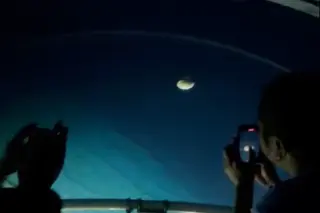
Marine researchers exploring the deep waters near Rotuma, an island roughly 300 miles north of Fiji, captured a rare encounter with a nautilus at a depth of 365 meters. The prehistoric mollusc, which has existed since before the dinosaur era, swam from the seafloor to hover near the submersible's observation dome. Whitney Goodell, a marine ecologist with National Geographic Pristine Seas, described the interaction as a mutual moment of curiosity, noting that such chance sightings in natural habitats are uncommon. The incident highlights the importance of protecting deep-sea features, as nautiluses depend on specific depth zones for survival due to temperature and pressure constraints.

Atlantic Deep Reveals First In-Situ Footage of Rare Barreleye and Serpentinization Vents
science4 months ago

Atlantic Deep Reveals First In-Situ Footage of Rare Barreleye and Serpentinization Vents

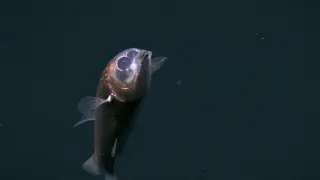
Researchers using the ROV SuBastian and AUV The Childlike Empress aboard the Falkor captured the first in-situ footage of the twilight-zone barreleye Winteria telescopa at 710 m depth in the Atlantic's Doldrums region, and documented two new serpentinization-linked hydrothermal fields around 4,000 m, revealing active deep-sea life and offering clues about life in extreme environments and on other worlds; findings to be published.