
Physics permits 20-year trip to Alpha Centauri, but engineering remains far from reality
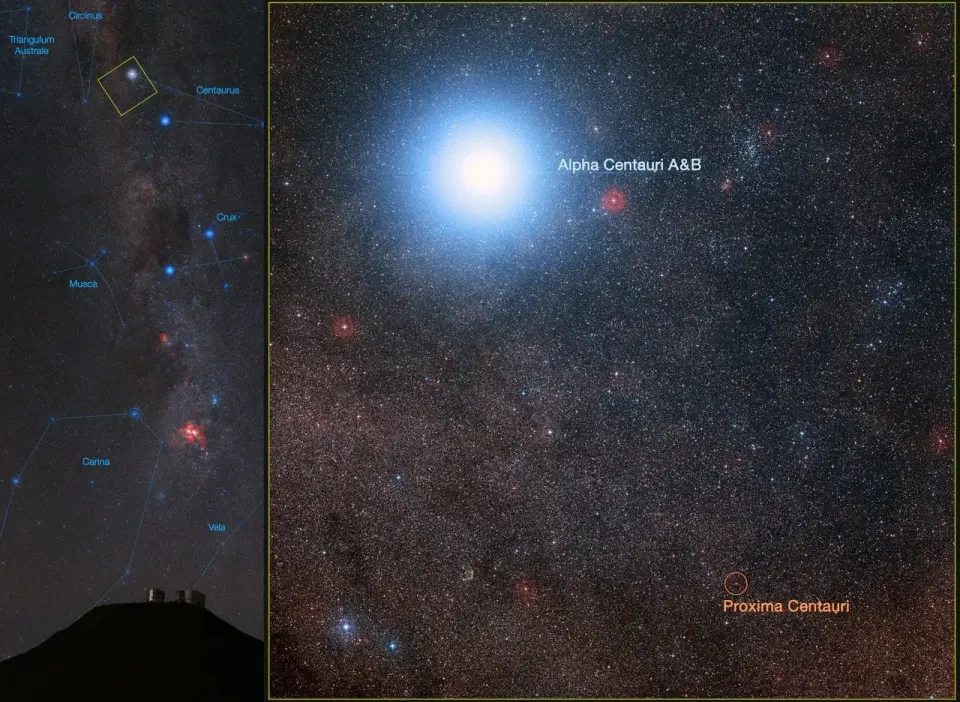
A gram-scale probe could reach the nearest star system in just over 20 years using a laser-driven sail, but the required technology remains unbuilt and the original program is currently on hold.
Key points
- Proxima Centauri, the closest star to Earth, is located 4.2 light-years away, a distance that would take conventional spacecraft tens of thousands of years to cross.
- The Breakthrough Starshot concept proposes using a ground-based laser array to accelerate a micro-scale probe to 20% of light speed, reducing the travel time to approximately 21 years.
- The mission faces significant engineering hurdles, including the need for a sail that can withstand intense laser radiation without vaporizing and a communication system capable of transmitting data across interstellar distances.
- The original $100 million research program was put on hold in September 2025, though related scientific research into materials and radiation pressure continues independently.
- Even if a probe arrives at Alpha Centauri, the first data would not reach Earth for roughly 26 years due to the additional time required for the signal to travel back.
Background
Previous coverage in August 2026 highlighted renewed interest in interstellar missions following the discovery of a helium-rich atmosphere around the exoplanet LHS 1140b. That report noted that while miniature probes propelled by light sails offer a theoretical path to visiting other star systems, they face major challenges in propulsion, data transmission, and deceleration. The current briefing expands on these challenges by detailing the specific physics and engineering requirements of the Breakthrough Starshot concept.
Why it matters
This concept demonstrates that the laws of physics allow for interstellar travel within a human lifetime, shifting the focus from theoretical possibility to practical engineering. While the mission is not imminent, the ongoing research into nanophotonic materials and radiation pressure could benefit smaller, slower missions and advance our understanding of extreme propulsion systems.
What to watch
Researchers will continue to publish findings on sail stability, thermal control, and radiation pressure. The future of the Breakthrough Starshot program remains uncertain, but the underlying scientific work may eventually lead to practical applications in space exploration or other high-energy laser technologies.
Want the full story? Read the original reporting
Read on Space Daily