
NASA Launches $1 Million Student Challenge to Solve Moon Base Engineering Problems
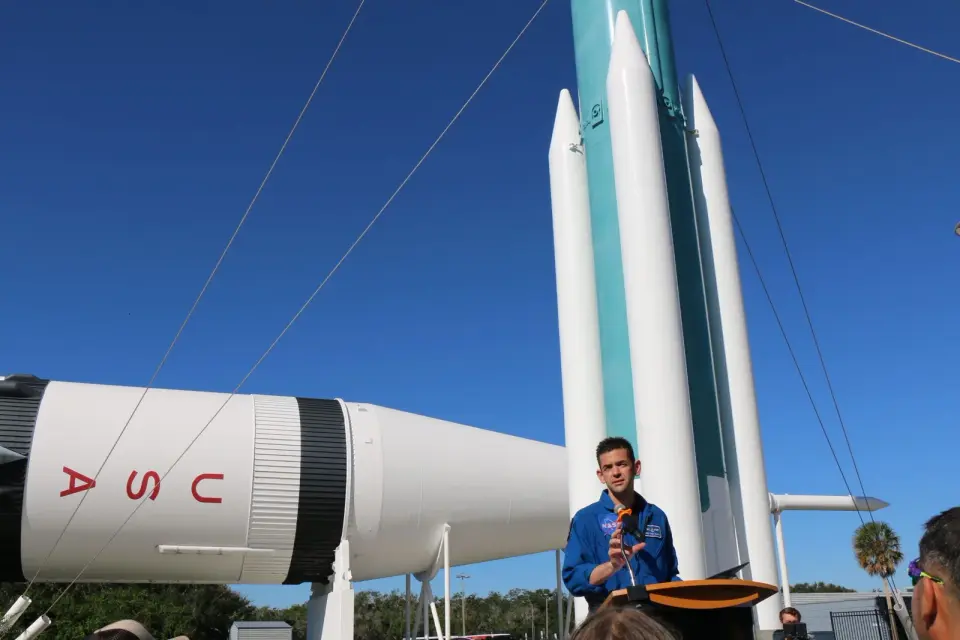
NASA Administrator Jared Isaacman announced the Moon Base Student Challenge on Nov. 8, 2026, offering $1 million in prizes to U.S. high school and post-secondary students. The competition invites teams to propose solutions for six technical categories critical to establishing a permanent lunar presence, including power generation, habitats, and life support. Registration is open until Jan. 25, 2027, and the challenge is designed to develop career-relevant skills while addressing real engineering hurdles for the agency's planned lunar base at the South Pole region.
Key points
- NASA has allocated $1 million in prize money for the Moon Base Student Challenge, announced during the MAX POWER air show at Kennedy Space Center on Nov. 8, 2026.
- The competition is open to U.S. high school and post-secondary students, who must form teams to address technical problems related to lunar infrastructure.
- Six technical categories are included: power generation and storage, construction/habitats, life-support systems, surface mobility, communications networks, and astronaut safety.
- Registration is open through Jan. 25, 2027, via the NASA STEM Gateway, with the challenge administered by the Institute of Competition Sciences.
- The initiative aims to cultivate the next generation of aerospace talent by having students work on authentic mission design parameters without requiring prior specialized engineering experience.
Background
This announcement follows recent major developments in NASA's lunar strategy, including the award of $10 billion in contracts for lunar infrastructure and the opening of applications for the 25th astronaut class. These steps support the agency's goal of establishing a sustained human presence on the Moon by 2032, which serves as a precursor to future crewed missions to Mars. The Moon Base Student Challenge complements these efforts by engaging students in solving the practical engineering challenges required for long-term lunar operations.
How outlets are covering it
Space.com emphasized the dramatic nature of the announcement, highlighting Administrator Isaacman's presence in a flight suit and his skydiving performance at the MAX POWER event, framing the challenge as a direct appeal to the next generation. NASA's official release focused on the educational and workforce development aspects, noting that the challenge is designed to build career-relevant skills through industry-standard deliverables like trade studies and concept proposals. WFTV provided a brief local news summary, confirming the $1 million prize pool and the registration deadline but offering less detail on the technical categories or the administrative structure of the competition. All sources agree on the core facts: the $1 million prize, the target audience, and the six technical categories, but they differ in emphasis, with Space.com focusing on the event's spectacle and NASA's official release on the educational value and technical rigor.
Why it matters
The Moon Base Student Challenge represents a significant step in NASA's strategy to engage the public and develop the future workforce for its lunar and Mars exploration goals. By offering substantial prizes and real-world problem-solving opportunities, NASA aims to inspire innovation and attract talent to the aerospace industry. The challenge also addresses critical technical hurdles for the planned lunar base, such as power generation during the long lunar night and life support systems, which are essential for a sustained human presence on the Moon. This initiative underscores the importance of education and innovation in achieving ambitious space exploration goals.
What to watch
Registration for the Moon Base Student Challenge is open until Jan. 25, 2027. Participants will submit concepts, refine them, and finalists will present their solutions to NASA leaders. The challenge is expected to run through 2027, with winners announced later in the year. NASA will continue to advance its lunar base construction, with Artemis III and IV missions planned for 2027 and beyond, and the $10 billion in lunar contracts set to support infrastructure development by 2032.
- NASA just unveiled $1 million in prizes for students that solve future moon base problems Space
- NASA Announces $1 Million to Students for Moon Base Challenge NASA (.gov)
- NASA launches Moon Base Student Challenge for high schoolers WFTV
- NASA launches $1 million moon base design contest for students WORLD News Group
- NASA announces $1 million moon base challenge KMOV
Want the full story? Read the original reporting
Read on Space