
NASA Opens Public Sign-Up for Dragonfly’s Titan Mission
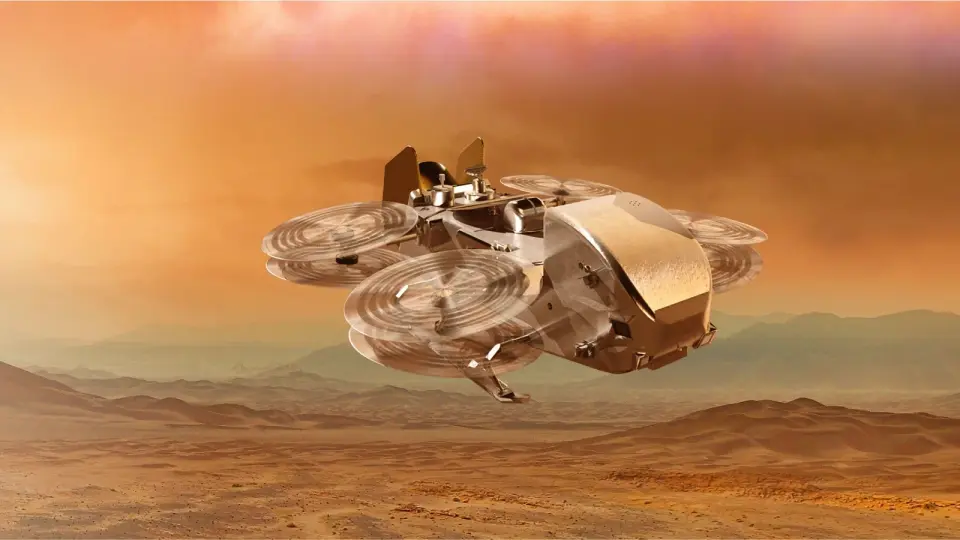
NASA has opened a public campaign allowing individuals to submit their names for inclusion on a microchip aboard the Dragonfly rotorcraft, which is scheduled to launch in 2028 and arrive at Saturn's moon Titan in 2034. The mission aims to explore Titan's surface for signs of prebiotic chemistry and habitability. Submissions are accepted until January 15, 2027, with participants receiving a digital boarding pass. This initiative highlights NASA's effort to engage the public in deep-space exploration while advancing scientific goals related to the origins of life.
Key points
- NASA is accepting public name submissions for the Dragonfly mission until January 15, 2027.
- Names will be stored on a microchip aboard the spacecraft, which launches in 2028.
- Dragonfly is a nuclear-powered rotorcraft designed to fly across Titan's surface for 3.3 years.
- The mission targets specific sites, including the Selk impact crater and dune fields, to analyze organic materials.
- Participants receive a personalized digital boarding pass as confirmation of their inclusion.
Background
This initiative follows earlier Titan missions, such as Cassini's 2004 flyby and the Huygens lander in 2005, which provided initial data on Titan's atmosphere and surface. Recent archival coverage notes that Cassini's images revealed Earth-like surface features, while the Huygens probe confirmed the presence of liquid methane lakes. Dragonfly represents a significant advancement, as it is the first mission designed to fly autonomously on another world, following the success of the Ingenuity helicopter on Mars, which completed 72 flights before its blades were damaged in 2024.
How outlets are covering it
Space.com emphasizes the scientific goals of Dragonfly, focusing on prebiotic chemistry and the search for chemical indicators of life. The Daily Astorian highlights the 'primordial soup' hypothesis, suggesting that frozen remains in the Selk crater could model how life emerged on Earth. WSVN and Inshorts focus primarily on the public participation aspect, noting the deadline and the digital boarding pass incentive. While all sources agree on the launch and arrival dates, The Daily Astorian provides specific dimensions of the craft (12.5 feet long and wide, 5.5 feet tall), whereas Space.com notes its SUV-sized description. There is no disagreement on the core facts, but the emphasis varies between scientific discovery and public engagement.
Why it matters
The Dragonfly mission represents a pivotal step in planetary science by attempting to analyze the chemistry of a world with conditions similar to early Earth. By engaging the public through name submissions, NASA fosters broader interest in space exploration and the search for life beyond Earth. The mission's success could provide critical insights into the origins of life, potentially reshaping our understanding of astrobiology and the habitability of other celestial bodies.
What to watch
NASA will continue accepting name submissions until January 15, 2027. The Dragonfly spacecraft is scheduled to launch in July 2028, with arrival at Titan expected in December 2034. Upon arrival, the rotorcraft will begin its 3.3-year mission, flying between various geological sites to collect and analyze samples. NASA is also planning the SkyFall mission to Mars, which may launch as early as late 2028, featuring three helicopters to explore the Red Planet's surface.
- Send your name to Saturn's moon Titan with NASA's upcoming Dragonfly mission Space
- Want to go to space? NASA is offering the public a chance to 'hitch a ride' to Saturn FOX Weather
- In One Ear: Pursuing primordial soup The Daily Astorian
- NASA offers opportunity for public to put name on microchip expected to launch to Titan WSVN
- NASA invites people to send their names to Saturn's moon Titan | Rotorcraft is currently being assembled | Inshorts Inshorts
Want the full story? Read the original reporting
Read on Space