
Ancient Meteorite Dust Reveals Strong Magnetic Field in Infant Sun's Formation
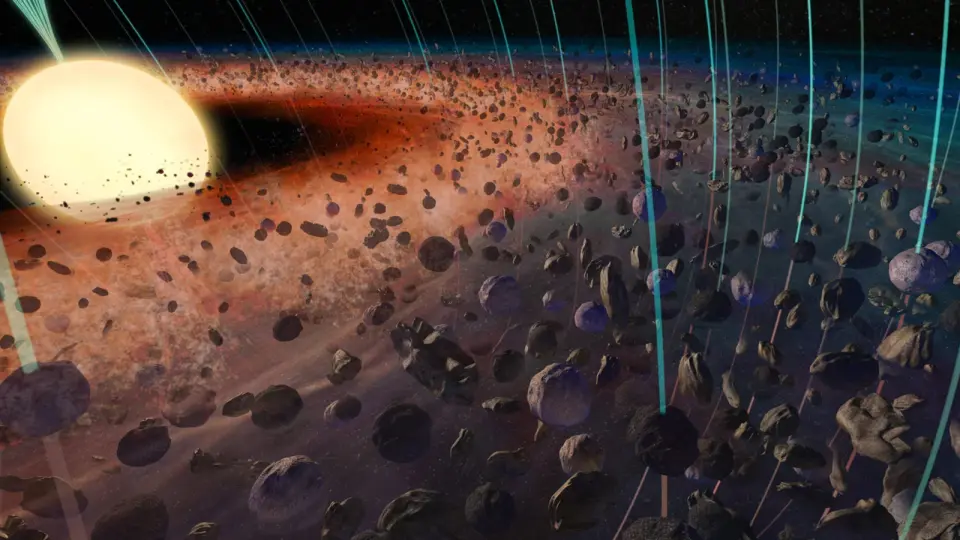
Researchers analyzing a pristine Antarctic meteorite have discovered that strong magnetic fields, not just gravity, played a critical role in the formation of the Sun and early solar system. By examining calcium-aluminum-rich inclusions (CAIs) within the DOM 08006 meteorite, scientists determined that magnetic fields existed as early as 200,000 years after the solar system’s inception. These fields were three to twelve times stronger than Earth’s current magnetic field, helping to funnel gas toward the infant Sun and heat the inner disk. This finding pushes the timeline of significant magnetic activity in the solar nebula back significantly, challenging previous assumptions that gravity was the sole driving force in the early stages of planetary system formation.
Key points
- The study focuses on the DOM 08006 meteorite, recovered from Antarctica in 2008, which is one of the least altered meteorites ever found, preserving a 'fossil record' of the early solar system.
- Scientists analyzed calcium-aluminum-rich inclusions (CAIs) within the meteorite, which formed during the first 200,000 years of the solar system’s existence, making them among the oldest known solid materials.
- Measurements indicate that the magnetic field in the early solar nebula was between 150 and 600 microteslas, significantly stronger than Earth’s current average of 50 microteslas.
- The magnetic field likely worked alongside gravity to pull gas from the outer disk inward toward the infant Sun, heating the inner disk to approximately 1,000 kelvin.
- This discovery pushes the timeline of strong magnetic activity in the solar system back to before the Sun had fully formed, earlier than previously documented evidence from 1 to 4 million years after formation.
Background
This research builds on earlier findings regarding the age and composition of presolar grains, such as the seven-billion-year-old silicon carbide grain found in the Murchison meteorite, which provided insights into galactic history before the Sun’s formation. Additionally, recent studies on the Sun’s midlife magnetic wobbles have highlighted the dynamic nature of stellar magnetic fields, further emphasizing the importance of understanding magnetic processes in stellar evolution and planetary formation.
How outlets are covering it
Space.com and Futura both emphasize the significance of the DOM 08006 meteorite’s minimal alteration, allowing for a clearer view of the early solar system. Space.com highlights the surprise that magnetism played a greater role than previously suspected, while Futura focuses on the specific magnetic field strength measurements and their implications for the Sun’s growth. Universe Today provides a broader context, noting that while gravity is the usual suspect for the solar system’s formation, the new evidence suggests magnetism was a crucial co-factor. All sources agree on the importance of the CAIs and the timeline of 200,000 years, but differ in their emphasis: Space.com and Futura focus on the magnetic field’s strength and role, while Universe Today discusses the broader implications for understanding planetary formation and the debate around the early solar system’s magnetic environment.
Why it matters
Understanding the role of magnetism in the early solar system provides crucial insights into how stars and planets form, which can inform models of exoplanet formation and the habitability of other planetary systems. This research challenges existing theories and highlights the complex interplay of forces in the birth of solar systems, potentially impacting future studies of stellar evolution and the search for life in the universe.
What to watch
Researchers will need to analyze more meteorite samples to map how magnetic strength varied across different regions of the early nebula and determine the duration of these magnetic fields. Further studies may explore the two hypotheses for how CAIs retained their magnetic imprints, either during initial formation or later heating events, to better understand the timeline and mechanisms of magnetic activity in the early solar system.
- How did the infant sun form? Scientists get surprising new insights from 4.6-billion-year-old space dust space.com
- Fossilized Solar System Magnetic Field Found In Dust Grain From The First 200,000 Years After The Sun’s Birth IFLScience
- Meteorite dust holds records of magnetism that may have helped form the sun Technology Org
- How did the solar system form? Ancient meteorite reveals a key magnetic force alongside gravity Futura, le média qui explore le monde
- Ancient Dust Grains Hold Magnetic Clues to the Sun's Birth Universe Today
Want the full story? Read the original reporting
Read on space.com