
Chandra X-ray data reveals hidden compact companion driving 27-year supernova impostor cycle
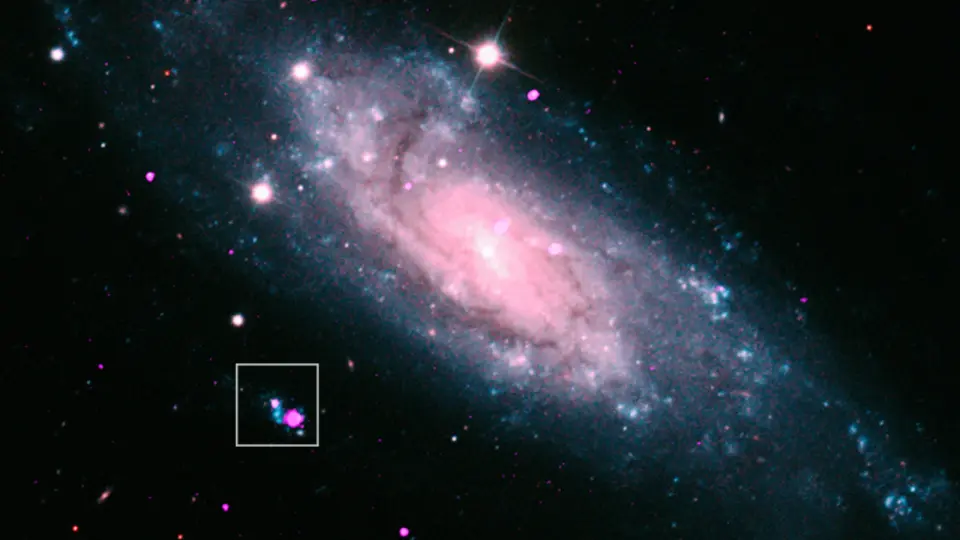
NASA’s Chandra X-ray Observatory has identified the mechanism behind AT 2016blu, a star in galaxy NGC 4559 that has mimicked a supernova 27 times since 2012. The star, a luminous blue variable, is being stripped of material by an unseen companion, likely a black hole or neutron star, every 113 days. This interaction generates intense X-rays that heat surrounding gas, creating the bright optical flashes previously mistaken for stellar explosions. The findings, published in The Astrophysical Journal, mark the first X-ray detection of a supernova impostor with a compact companion.
Key points
- AT 2016blu is a luminous blue variable in NGC 4559, located 30 million light-years away, with a mass at least 33 times that of the Sun.
- The star has produced 27 optical outbursts between 2012 and 2026, each lasting roughly 113 days, mimicking supernova brightness but surviving the event.
- Chandra observations in March 2026 detected X-ray emission 100 times brighter than 2001-2002 data, coinciding with an optical outburst.
- The X-ray source is attributed to material from the luminous blue variable being accreted by a compact companion, forming a hot disk that emits X-rays.
- The system is classified as a candidate ultra-luminous X-ray source, potentially linking supernova impostors to this rare class of bright X-ray emitters.
Background
Astronomers have long struggled to explain 'supernova impostors,' transient events that mimic supernovae but do not destroy the host star. While several such objects have been observed, the underlying mechanisms remained unclear until recent X-ray detections. AT 2016blu was first identified in 2012 by automated surveys, but its periodic nature defied standard supernova models. Prior to this study, no supernova impostor had been confirmed to have a compact companion, leaving the cause of their repeated outbursts a mystery.
How outlets are covering it
NASA Science and The Astrophysical Journal emphasize the significance of the first X-ray detection of a supernova impostor with a compact companion, highlighting the role of Chandra’s high resolution in distinguishing AT 2016blu from nearby bright sources. Universe Today notes the importance of ruling out background quasars and the potential link to ultra-luminous X-ray sources. The Times of India focuses on the collaborative effort, including over 30 amateur astronomers, and the broader implications for understanding pre-supernova stellar behavior. All sources agree on the 113-day cycle and the 27 outbursts, but differ in emphasis: NASA and The Astrophysical Journal stress the binary system mechanics, while Universe Today and The Times of India highlight the observational challenges and the potential for future discoveries.
Why it matters
This discovery resolves a 15-year mystery regarding supernova impostors, providing a physical mechanism for their repeated outbursts. It also offers a potential link between supernova impostors and ultra-luminous X-ray sources, a class of objects whose nature remains poorly understood. Understanding these systems may help astronomers predict and interpret pre-supernova transient phenomena, improving models of massive star evolution and binary interactions.
What to watch
Astronomers plan to expand the sample of similar systems to better understand the evolutionary pathways connecting supernova impostors, luminous blue variables, and interacting supernovae. Further observations may reveal more systems with compact companions, helping to clarify the role of accretion in powering transient events. The study also opens questions about the nature of ultra-luminous X-ray sources and whether they are linked to massive star-compact object binaries.
- This supernova impostor baffled astronomers for 15 years — until they found a hidden black hole feeding on an unstable star Space
- NASA’s Chandra Finds Source of Star’s Mysterious Outbursts NASA Science (.gov)
- The Chandra X-Ray Observatory Unmasks a Supernova Impostor Universe Today
- It exploded 27 times, yet survived every single one: The strange secret NASA finally uncovered about this giant star The Times of India
- Star That Faked 27 Supernovas Is Being Fed On by a Hidden Black Hole or Neutron Star Around Prague
Want the full story? Read the original reporting
Read on Space