
Crew-13 Launches to ISS, Setting Record for Fastest Dragon Transit
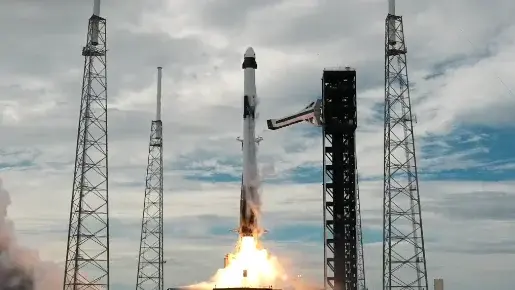
NASA and SpaceX successfully launched the Crew-13 mission on October 1, 2026, from Kennedy Space Center. The four-person crew, led by Jessica Watkins, is on track to reach the International Space Station in a record-breaking transit of less than eight hours. The mission follows a delay caused by a spacecraft leak and marks the first U.S. crewed launch in six months.
Key points
- The Falcon 9 rocket launched at 11:10 a.m. EDT on October 1, 2026, from Space Launch Complex 40 at Cape Canaveral Space Force Station.
- The crew consists of NASA astronauts Jessica Watkins (commander) and Luke Delaney (pilot), Canadian Space Agency astronaut Joshua Kutryk, and Roscosmos cosmonaut Sergey Teteryatnikov.
- The Dragon spacecraft, named Grace, is expected to dock with the International Space Station in approximately eight hours, the shortest transit time ever for a Dragon mission.
- The Falcon 9 first stage booster, tail number B1101, successfully landed at Landing Zone 40 shortly after stage separation.
- Jessica Watkins becomes the first NASA astronaut to fly twice on a SpaceX Dragon spacecraft, having previously served on the Crew-4 mission in 2022.
Background
The Crew-13 mission was originally scheduled for September 12, 2026, but was rescheduled to October 1 due to an oxidizer leak in the Dragon spacecraft. Prior to launch, the crew completed final pre-launch checks, including a dry dress rehearsal and static fire tests, at Cape Canaveral. This launch marks the first U.S. crewed mission in six months, following the departure of Crew-12 in February 2026.
How outlets are covering it
WESH emphasized the local impact, noting that pilot Luke Delaney grew up in Central Florida and that Watkins is a cousin of a former WESH reporter. Spaceflight Now highlighted the technical details, such as the booster’s third flight and the record-breaking transit time. Space.com focused on live updates and the crew’s arrival at the ISS, while all sources agreed on the successful launch and the crew’s composition. There were no significant disagreements among the outlets.
Why it matters
The successful launch and record-breaking transit demonstrate the reliability of SpaceX’s Falcon 9 and Dragon systems. The mission’s scientific focus on long-duration spaceflight effects, including blood circulation and vision, aims to prepare for future lunar and Mars missions. Additionally, the launch marks a significant milestone for international cooperation, involving astronauts from the U.S., Canada, and Russia.
What to watch
The crew will join Expedition 75 on the International Space Station for a six-month mission. They will conduct scientific research, including studies on microgravity effects on the human body, and support station maintenance. After a handover period, the Crew-12 members will return to Earth aboard the Dragon Freedom spacecraft.
- Crew-13's 4 astronauts to launch from Florida's Space Coast on mission to International Space Station WESH
- NASA's SpaceX Crew-13 astronaut bringing 100-year-old heirloom on space station trip ABC News - Breaking News, Latest News and Videos
- Live coverage: NASA, SpaceX to launch next crewed mission to the International Space Station Spaceflight Now
- SpaceX Crew-13 NASA launch live updates: Countdown underway, astronauts ready for liftoff Space
- NASA’s Crew-13 set for liftoff on long-duration space mission FOX Weather
Want the full story? Read the original reporting
Read on WESH