
Curiosity’s ‘Sea of Polygons’ in Valle Grande Offers Unprecedented Clues to Mars’ Watery Past
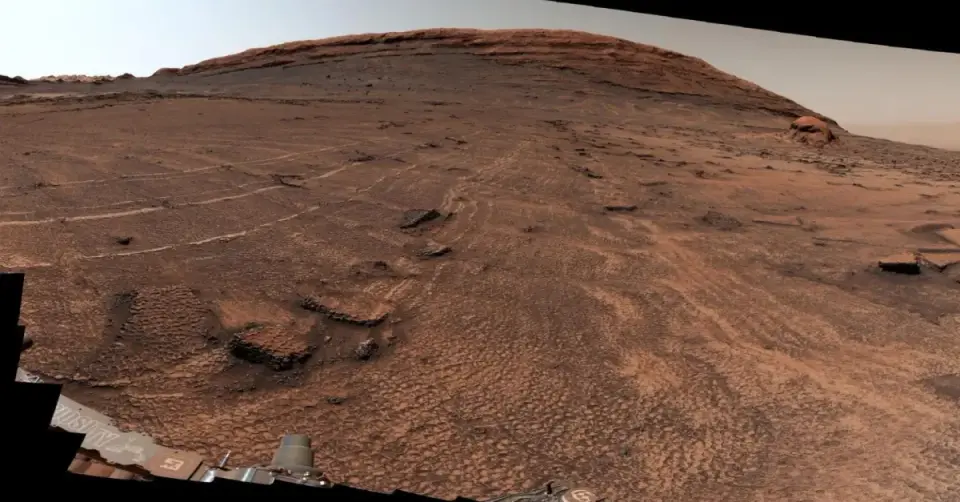
NASA’s Curiosity rover has identified a vast expanse of honeycomb-shaped polygonal fractures in the Martian valley of Valle Grande, marking the largest such discovery in the mission’s 14-year history. Captured on June 19 and 20, 2026, the 360-degree panorama reveals these 1.5-to-3-inch features stretching across the landscape, wrapping around a 20-foot butte named Miraflores. While similar patterns have been seen before, this extensive field suggests significant ancient water activity, potentially offering new insights into Mars’ habitability and the geological processes that shaped its surface.
Key points
- Curiosity captured a 360-degree panorama on June 19 and 20, 2026 (Martian sols 4,930 and 4,931), revealing a vast field of polygonal fractures in Valle Grande.
- The polygons, measuring 1.5 to 3 inches (4 to 8 cm) wide, are the largest concentration of such features found by the rover, extending as far as the camera can see.
- Project scientist Ashwin Vasavada stated the team is analyzing the shapes and chemistry of the polygons to determine their formation mechanisms.
- The discovery supports the hypothesis that the lower foothills of Mount Sharp were once dotted with lakes and streams billions of years ago.
- The panorama was composed of 340 individual images stitched together by scientists on Earth.
Background
Curiosity has been ascending Mount Sharp since 2014, searching for evidence of ancient water and habitable conditions. Previous missions have identified smaller patches of polygonal fractures, often interpreted as mud cracks from wet-dry cycles or sediment compression. This latest finding in Valle Grande represents a significant scale-up of these features, adding to a growing body of evidence that Mars once possessed the chemistry and environment necessary to support microbial life.
How outlets are covering it
All four sources agree on the core facts: the location (Valle Grande), the dates (June 19-20, 2026), and the unprecedented scale of the polygonal fractures. NASA and The Verge emphasize the scientific significance of the 'sea of polygons' as a potential indicator of ancient water. Popular Science highlights the rover's long ascent of Mount Sharp and the butte Miraflores, noting that erosion has shaped the landscape over billions of years. Gizmodo focuses on the technical aspect of the 340-image panorama and the ongoing debate about whether the polygons formed via mud cracks, temperature cycles, or sediment compression. While The Verge and NASA present the discovery as a major milestone, Popular Science and Gizmodo frame it as part of a broader, ongoing effort to understand Mars' hydrological history, noting that the exact formation mechanism remains uncertain.
Why it matters
This discovery provides a new, large-scale dataset for analyzing Mars' paleoclimate and hydrology. The extensive field of polygons in Valle Grande may offer clues about the planet's past water availability and the environmental conditions that could have supported life. Understanding how these features formed helps scientists reconstruct the history of Mars' surface and its potential habitability, contributing to the broader goal of determining if life ever existed on the Red Planet.
What to watch
Scientists will continue to analyze the shape and chemistry of the polygons to determine their formation mechanisms. Curiosity will likely continue its ascent of Mount Sharp, potentially uncovering more evidence of ancient water and habitable conditions. The data from this discovery may inform future Mars missions and help refine models of the planet's past climate and geology.
- NASA’s Curiosity rover found a ‘sea of polygons’ on Mars The Verge
- NASA’s Curiosity Mars Rover Discovers Field of Honeycomb Textures NASA (.gov)
- Curiosity rover spots ancient sea of Martian polygons Popular Science
- Curiosity Mars rover discovers field of honeycomb textures Phys.org
- NASA’s Curiosity Rover Finds a Vast Sea of Strange Honeycomb Patterns on Mars Gizmodo
Want the full story? Read the original reporting
Read on The Verge