
Euclid telescope captures first comet, C/2026 S1, between Jupiter and Saturn
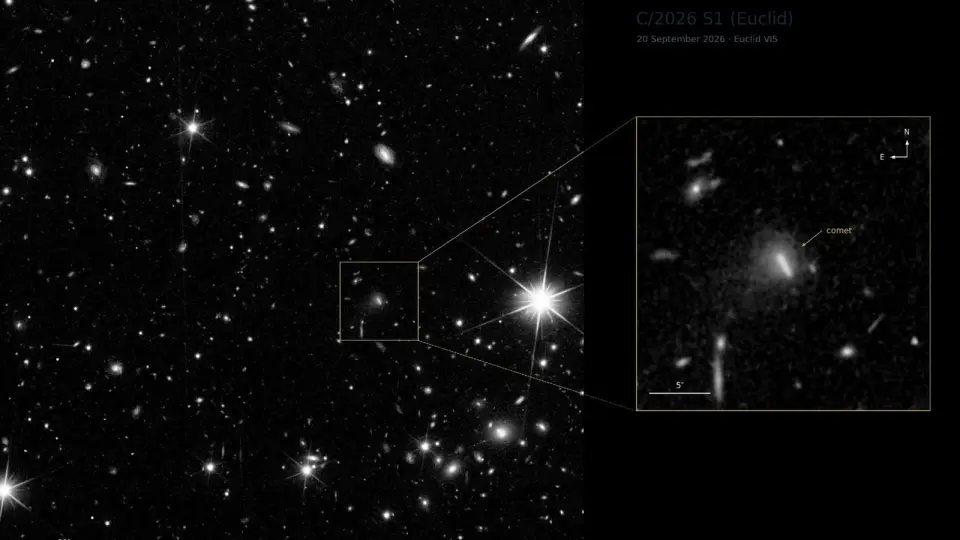
The Euclid space telescope, designed to study dark energy, has detected its first comet, designated C/2026 S1 (Euclid). The object was identified approximately 807 million miles from Earth, located between the orbits of Jupiter and Saturn. This discovery highlights the telescope's potential for detecting fast-moving solar system objects despite its primary focus on deep-space cosmology.
Key points
- The European Space Agency's Euclid mission, launched in 2023 with NASA contributions, identified a new comet named C/2026 S1.
- The comet was detected approximately 807 million miles (1.3 billion kilometers) from Earth, situated between the orbits of Jupiter and Saturn.
- Observations were captured between September 16 and 24, 2026, revealing a fast-moving object with a fuzzy dust and gas cloud.
- Mikko Pöntinen, a scientist at the University of Helsinki, made the initial discovery using software that flagged a 'streak' across multiple images.
- The finding demonstrates that Euclid can be used to target comets in the outer solar system, beyond its original design for dark matter and dark energy research.
Background
Euclid recently released its first major data set, DR1-Foundation, in early November 2026, which cataloged over 900 million galaxies and 15,000 gravitational lenses. This release covered 14% of the telescope's total survey area and aimed to map dark matter and dark energy. The current comet discovery adds a new dimension to the telescope's capabilities, showing it can detect transient solar system objects alongside its primary cosmological goals. This follows other recent cometary observations, such as the analysis of interstellar comet 3I/ATLAS by the James Webb Space Telescope, which revealed ancient, pristine material from a distant stellar nursery.
Why it matters
The detection of C/2026 S1 by Euclid illustrates the versatility of modern space telescopes. Although Euclid was explicitly designed to study dark energy and dark matter through long, slow observations of distant galaxies, its ability to catch a fast-moving comet indicates it can serve as a tool for solar system exploration. This capability allows scientists to identify 'noise' in their data and potentially target other comets in the far reaches of the solar system, expanding the scope of the mission beyond its initial parameters.
What to watch
Scientists plan to use Euclid to intentionally target other comets in the outer solar system. The discovery of C/2026 S1 will help researchers distinguish between background noise and actual celestial objects in Euclid's field of view. Future observations may provide more data on the composition and trajectory of this and similar comets, contributing to a better understanding of solar system dynamics and the origins of cometary material.
Want the full story? Read the original reporting
Read on Space