
Huygens’ Gentle Titan Landing Reveals Surface Properties Through Bounce and Wobble Analysis
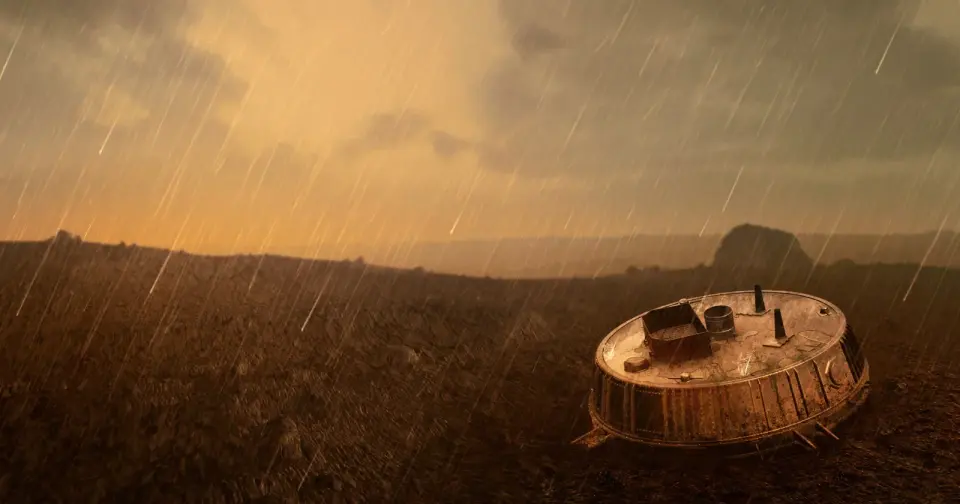
A 2012 study reconstructed the 2005 landing of ESA’s Huygens probe on Titan, revealing that the 200-kilogram craft touched down at a speed comparable to a ball dropped from one metre. The probe dented the ground by 12 centimetres, bounced, slid 30 to 40 centimetres, and wobbled five times before settling. This sequence, derived from onboard sensors rather than external cameras, indicated a surface that behaves like frozen snow: firm under light pressure but yielding under heavier loads. The analysis also suggested the presence of dry organic dust and a pebble, offering crucial insights into Titan’s geology without direct visual confirmation of the touchdown moment.
Key points
- Huygens, weighing approximately 200 kilograms, landed on Titan in January 2005 after being deployed by NASA’s Cassini spacecraft.
- The probe’s impact speed was equivalent to dropping a ball from one metre on Earth, resulting in a 12-centimetre deep dent upon initial contact.
- Following the impact, the probe bounced, slid 30 to 40 centimetres, tilted 10 degrees, and wobbled five times over a period of roughly ten seconds.
- Researchers reconstructed this motion using onboard acceleration data, computer simulations, and physical drop tests, as no external camera captured the event.
- The surface was described by co-author Erich Karkoschka as resembling frozen snow, capable of supporting light weight but breaking under heavier pressure.
- Data spikes suggested the probe encountered a pebble protruding about an inch from the surface, potentially pushing it into the ground.
Background
Huygens’ landing in 2005 marked the first spacecraft to touch down in the outer Solar System. Previous archive coverage noted that data gaps occurred during the descent due to a receiver error on Cassini, though wind data was later recovered. Titan’s environment, characterized by a methane-driven hydrological cycle and extreme cold, makes its surface composition unique. This new analysis provides physical evidence of the ground’s mechanical properties, complementing earlier chemical and atmospheric findings from the mission.
Why it matters
Understanding the mechanical properties of Titan’s surface is critical for future missions, such as NASA’s Dragonfly, which will explore the moon’s dunes. The finding that the surface can yield under pressure informs landing site selection and rover design. Additionally, the detection of dry organic dust suggests that the landing site has not experienced recent hydrocarbon precipitation, offering clues about Titan’s local climate history and the distribution of its methane cycle.
What to watch
Future missions, particularly Dragonfly, will utilize these insights to navigate Titan’s varied terrain. Continued analysis of Huygens’ data may reveal more about the distribution of organic materials and the stability of surface features across different regions of the moon. Scientists will also continue to refine models of Titan’s geology using the indirect evidence gathered from this historic landing.
Want the full story? Read the original reporting
Read on Space Daily