
ISS Milestone: 100th U.S. Spacewalk Installs Seventh Solar Array
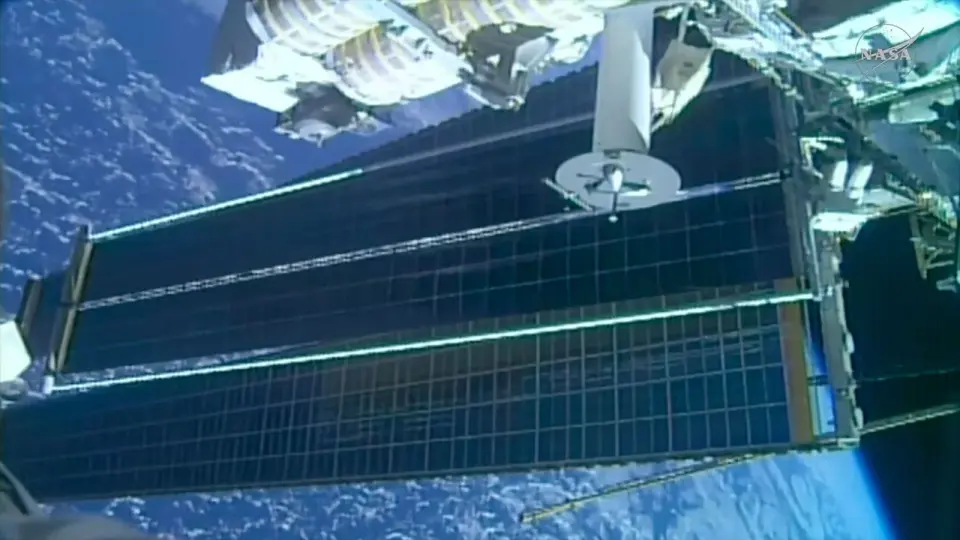
NASA astronaut Anil Menon and Canadian Space Agency astronaut Joshua Kutryk completed the 100th U.S. spacewalk from the International Space Station on October 29, 2026. The seven-hour, 11-minute extravehicular activity successfully installed and deployed the seventh of eight new roll-out solar arrays (IROSAs). This upgrade boosts the station’s power capacity to 200 kilowatts, supporting operations until its 2030 deorbit. The final array is scheduled for installation on November 5.
Key points
- The EVA concluded at 3:08 p.m. EDT, marking the 100th U.S. spacewalk since the retirement of the Space Shuttle program.
- Menon and Kutryk installed the seventh IROSA on the station’s 2A electrical power channel, adding eight kilowatts to the total power supply.
- The new array deployed without motors, utilizing stored potential energy in carbon composite booms to unroll to its full 60-foot length.
- The pair completed 'get-ahead tasks' to prepare for the final IROSA installation, scheduled for November 5 on the 3B power channel.
- This was Kutryk’s first spacewalk and the first Canadian EVA since 2019; Menon logged his fourth spacewalk, totaling 26 hours and 31 minutes in space.
Background
The IROSA upgrade program began in 2021 to address the degradation of the station’s original solar arrays, which exceeded their 15-year design life. The final two arrays were delivered to the ISS in October 2026 via a SpaceX Dragon cargo capsule. The upgrade aims to increase total power generation from 160 to 215 kilowatts, ensuring sufficient energy for life support and research through the station’s planned 2030 deorbit.
How outlets are covering it
All sources confirm the successful installation of the seventh IROSA and the milestone nature of the 100th U.S. spacewalk. NASA emphasizes the technical success and the upcoming completion of the power system augmentation. CBS News highlights the efficiency of the operation, noting the crew worked ahead of schedule to prepare for the final array. Spaceflight Now provides detailed operational insights, such as the 'leapfrog' maneuver planned for the final installation and the specific timing of electrical connections during orbital darkness. Minor discrepancies exist in the reported length of the deployed array, with some sources citing 63 feet and others 60 feet, but all agree on the 8-kilowatt power increase.
Why it matters
This spacewalk is critical for the long-term viability of the ISS, ensuring adequate power for its final years of operation and safe deorbit. It also marks a significant milestone in human spaceflight history, representing the 100th U.S. EVA from the station and the first Canadian spacewalk in seven years.
What to watch
Menon and Kutryk are scheduled for another EVA on November 5, 2026, to install the eighth and final IROSA on the 3B power channel. This will complete the five-year power upgrade program, bringing the station’s total power capacity to approximately 215 kilowatts.
- 100 US spacewalks from the ISS! Astronauts deploy new solar array on landmark EVA Space
- Spacewalkers Install Roll-Out Solar Array for Power Generation NASA (.gov)
- Spacewalkers begin final phase of multi-year space station power system upgrade CBS News
- Spacewalking astronauts unfurl upgraded solar array to boost space station power Spaceflight Now
- Photos: Astronauts make history in 100th ISS spacewalk, install giant solar array Yahoo
Want the full story? Read the original reporting
Read on Space