
JAXA Launches Historic MMX Mission to Return First Samples from Mars' Moon Phobos
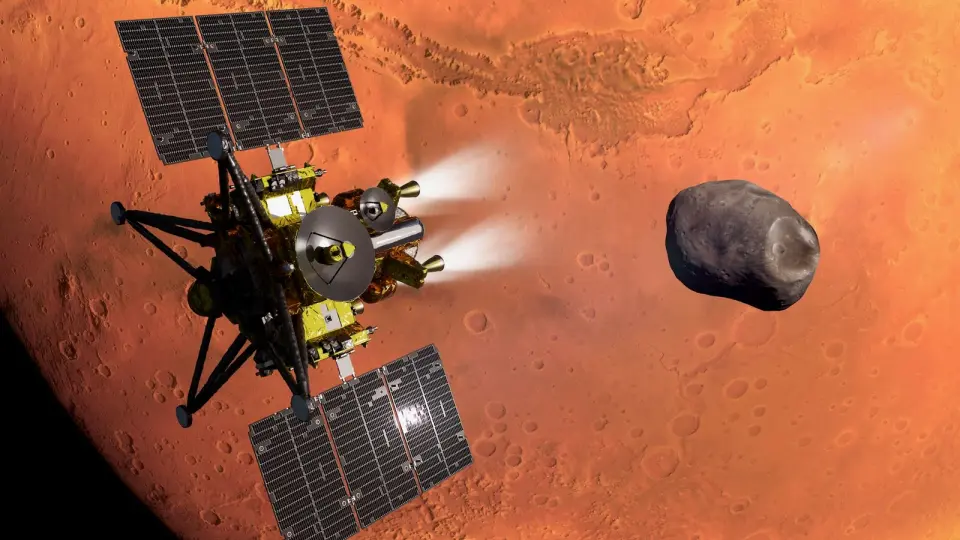
Japan's JAXA launched the Martian Moons eXploration (MMX) mission on October 19, 2026, from Tanegashima Space Center. This historic mission aims to collect at least 10 grams of soil from Mars' moon Phobos and return it to Earth by 2031, potentially resolving long-standing debates about the origin of Mars' moons.
Key points
- The MMX spacecraft launched on an H3 rocket at 3:41 p.m. ET on October 19, 2026, from Tanegashima Space Center in Japan.
- The mission will arrive at Mars in August 2027 and spend approximately three years orbiting Phobos before landing to collect samples.
- MMX aims to return at least 10 grams of Phobos soil to Earth in 2031, with the sample capsule landing in Australia.
- The mission is an international collaboration involving JAXA, NASA, the European Space Agency, and French and German space agencies.
- Scientists hope the samples will determine whether Phobos and Deimos are captured asteroids or debris from a giant impact on Mars.
Background
Previous coverage from our archive confirmed the launch details and the mission's primary goal of returning samples from Phobos by 2031. The mission was highlighted as a historic first for sample return from a Martian moon.
How outlets are covering it
Space.com emphasized the live launch coverage and the mystery surrounding the origins of Phobos and Deimos. CNN highlighted the international collaboration and the potential for the samples to reveal clues about the early days of Mars and the origin of life. The New York Times focused on the historic nature of the mission as the first to return samples from a moon other than Earth's. ABC News detailed the technical aspects of the mission, including the use of a quasi-satellite orbit and the specific instruments like MEGANE that will help determine the elemental composition of Phobos.
Why it matters
The MMX mission is significant because it is the first to attempt to return samples from a Martian moon, which could resolve long-standing debates about the origin of Phobos and Deimos. The samples may also contain traces of Martian material, providing insights into Mars' history and the formation of the solar system. Additionally, the mission could inform future crewed missions to Mars by understanding the environment of the Martian moons.
What to watch
The MMX spacecraft will arrive at Mars in August 2027 and begin orbiting Phobos. It will deploy the Idefix rover in early 2029 to scout potential landing sites. The lander will collect samples in 2029 or 2030, and the sample capsule will return to Earth in 2031, landing in Australia.
- Japan launching bold sample-return mission to Mars moon Phobos today: Watch it live Space
- Mars’ two tiny moons shouldn’t exist. A new mission will reveal why they do CNN
- A Japanese Spacecraft Aims to Bring Back a Bit of a Martian Moon The New York Times
- Mission to bring home 1st samples from a moon other than Earth’s set to launch Monday ABC News - Breaking News, Latest News and Videos
- Japan to launch historic round-trip mission to Mars moon Phys.org
Want the full story? Read the original reporting
Read on Space