
JWST Detects Mysterious Lone Emission Line in 'Empty' Sky Region
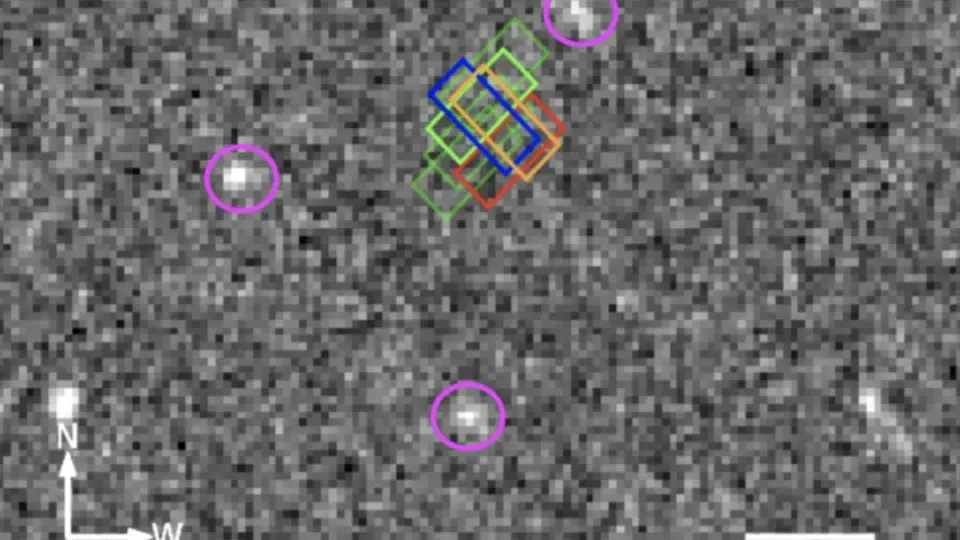
Astronomers using the James Webb Space Telescope (JWST) detected a single, bright emission line in a patch of the Fornax constellation previously cataloged as empty. The signal appeared twice in 2023 but was absent in earlier Hubble and JWST observations. Its origin remains unknown, with hypotheses ranging from early-universe galaxies to black hole events, though none fully explain the lack of accompanying spectral features.
Key points
- Mason Huberty’s team used JWST’s Near-Infrared Spectrograph to scan the Hubble Ultra Deep Field in Fornax, blocking known objects to find new ones.
- Seven emission lines were detected; six matched known galaxies, but the seventh was a lone, bright line with no accompanying features.
- The signal appeared in two observations 88 days apart (August and November 2023) but was missing from earlier 2022 JWST data, suggesting a transient or variable source.
- The line’s brightness implies it should have been visible in prior images, creating a paradox that complicates identification.
- Researchers ruled out simple glitches due to consistent readings across different observation angles and exposures.
Background
This discovery builds on earlier JWST campaigns like JADES, which mapped deep fields in 2022. While previous archive entries noted similar mysterious signals in 'empty' space, this specific detection in the Fornax constellation highlights the limitations of current spectroscopic techniques in identifying transient or faint objects. The Hubble Ultra Deep Field, previously studied for over 270 hours, was expected to be fully cataloged, making this anomaly particularly striking.
How outlets are covering it
Gizmodo and ScienceAlert emphasize the 'mystery' aspect, noting that the signal’s brightness should have made it visible in earlier images, yet it was absent. Futurism highlights the methodological innovation, describing how the team inverted standard spectroscopy by blocking known objects to find new ones. Futura, however, diverges significantly, linking the story to a separate Project Hephaistos study on Dyson spheres, which is unrelated to the Huberty et al. paper. While Futura discusses infrared anomalies, it does not reference the Fornax emission line, indicating a potential conflation of distinct JWST findings. All sources agree that the signal’s origin is unresolved and requires deeper spectroscopy.
Why it matters
This detection challenges the completeness of existing astronomical catalogs and suggests that transient or faint objects may be missed by current imaging techniques. It underscores the need for follow-up observations to resolve the redshift and nature of such signals, potentially revealing new classes of astrophysical phenomena or extreme physical conditions in the early universe.
What to watch
Researchers plan deeper, more sensitive spectroscopic observations to confirm the redshift and identify additional emission lines. Follow-up studies aim to determine whether the source is a transient event, such as a black hole shredding a star, or a previously undetected galaxy. The team emphasizes that resolving this anomaly is essential for understanding the limits of JWST’s detection capabilities.
- Astronomers Pointed Webb at an Empty Spot in Space. Something 'Highly Unusual' Flashed Back Gizmodo
- Astronomers Pointed The JWST At An Empty Region Of Space, And Found A "Highly Unusual" Signal With No Known Source IFLScience
- Scientists Puzzled as James Webb Detects Signal From Completely Empty Void in Space Futurism
- Scientists baffled by strange infrared signal: alien life or cosmic mistake? Futura, le média qui explore le monde
- JWST Detected a Mysterious Signal From Empty Space. Nobody Knows What It Is. ScienceAlert
Want the full story? Read the original reporting
Read on Gizmodo