
Webb Telescope Uncovers Ultra-Light Brown Dwarfs in Nearby Star Nursery
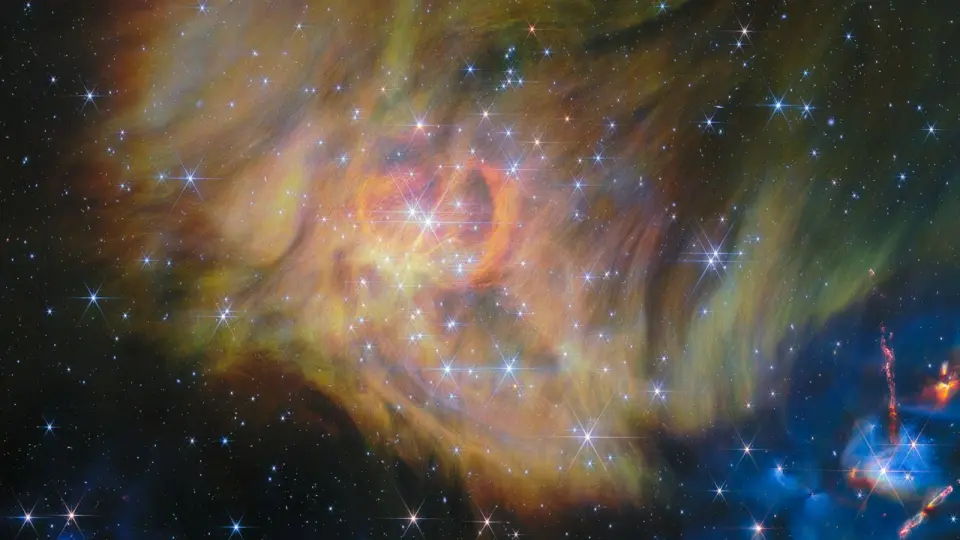
NASA’s James Webb Space Telescope has released a new, high-resolution image of the star-forming region IC 348, located 1,000 light-years away in the constellation Perseus. The primary scientific goal of this observation was to identify the smallest possible brown dwarfs, objects that form like stars but lack the mass to sustain hydrogen fusion. The data revealed brown dwarfs with masses as low as twice that of Jupiter, a finding that challenges existing theoretical models of star formation. Additionally, the images captured young stars ejecting powerful jets into surrounding gas, known as Herbig-Haro objects, and detected a potential disk around one of the lightest brown dwarfs, suggesting the possibility of planet formation around planetary-mass objects.
Key points
- JWST observed IC 348 using its NIRCam instrument in 2024 and NIRSpec in 2025 to search for low-mass objects.
- Researchers discovered brown dwarfs with masses as low as 0.19 percent of the Sun’s mass, or twice the mass of Jupiter.
- These findings are smaller than previous theoretical predictions for the minimum mass of a brown dwarf.
- The image also reveals Herbig-Haro objects, including HH 797 and HH 211, where stellar jets collide with interstellar gas.
- A spectral feature attributed to an unidentified hydrocarbon was detected in the atmospheres of the lowest-mass brown dwarfs.
Background
This discovery builds on earlier Webb observations of IC 348 in 2022, which identified brown dwarfs with masses of three to four times that of Jupiter. The current findings extend the lower mass limit, providing new data for models of how stars and planetary-mass objects form. This follows a broader trend of Webb uncovering unexpected objects in the early universe, such as the 'black hole stars' identified in August 2026, which reshaped understanding of early galaxy formation.
How outlets are covering it
Space.com highlighted the visual spectacle of the image, describing it as an 'ethereal and magnificent display' of gas and dust, while emphasizing the mystery of brown dwarfs as objects stuck between stars and planets. NASA Science focused on the scientific implications, noting that the discovery of brown dwarfs at twice Jupiter’s mass challenges current models of star formation and suggests a new spectral class for these extreme objects. Yahoo’s coverage, though largely obscured by technical code in the source, framed the image as a 'stunning stellar nursery,' focusing on the aesthetic and educational value of the deep-space view. Universe Space Tech provided background on Webb’s capabilities, explaining how its infrared sensitivity and location at the L2 Lagrange point allow it to detect faint, cold objects like brown dwarfs that are invisible to optical telescopes.
Why it matters
The discovery of brown dwarfs at such low masses forces astronomers to revise the theoretical boundaries between stars and planets. If objects as small as twice Jupiter’s mass can form through the same processes as stars, it complicates the definition of a 'planet' and suggests that the star-formation process may produce a wider range of objects than previously thought. Furthermore, the detection of a potential disk around one of these brown dwarfs hints that planetary systems could form around objects that are themselves only planetary-mass, expanding our understanding of where and how planets can exist in the universe.
What to watch
Researchers will continue to analyze the spectroscopic data from NIRSpec to understand the composition of the unidentified hydrocarbon feature found in the lowest-mass brown dwarfs. The team also plans to compare the populations of brown dwarfs in IC 348 with other star-forming regions to determine if these ultra-light objects are common or unique to this environment. Future observations may also focus on the potential disk around the lightest brown dwarf to confirm whether it is indeed forming planets.
- James Webb Space Telescope spies colossal cosmic cloud photo of the day for Sept. 16, 2026 Space
- NASA’s Webb Reveals Dynamic Panorama of Star Formation NASA Science (.gov)
- How Small Can The Smallest Stellar Object Be? One Of The Largest Image From JWST Suggests Smaller Than We Thought Possible iflscience.com
- Fly through a stunning stellar nursery with Webb Telescope views Yahoo
- How the James Webb Telescope Works and Why It Sees the Past Universe Space Tech
Want the full story? Read the original reporting
Read on Space