
JWST uncovers the universe’s closest dual black holes in its early era
TL;DR
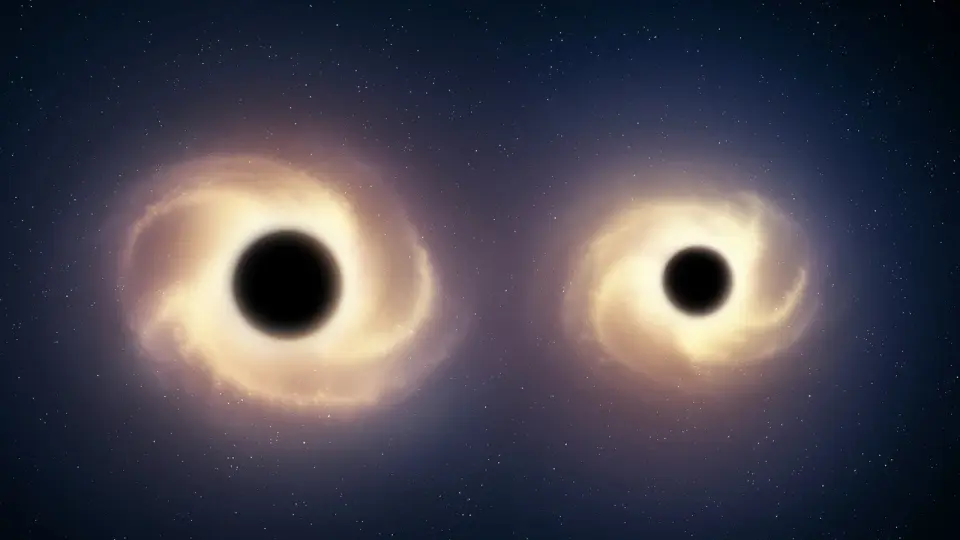
Astronomers using the James Webb Space Telescope (with ALMA) confirm LID-1166—the closest pair of actively feeding supermassive black holes observed this early in cosmic history. The dual SMBHs sit about 4,900 light-years apart in a merging galaxy roughly 1.3 billion years after the Big Bang, with distinct spectral signals and surrounding cold gas indicating two active nuclei. This first close-pair observation helps explain how supermassive black holes grew so rapidly in the early universe and sheds light on galaxy–black hole co-evolution.
- James Webb telescope just spotted the oldest, closest pair of black holes in the early universe Live Science
- Telescope Spots Two Black Holes on the Cusp of Merging The New York Times
- Three supermassive black holes discovered in a single galaxy for the first time phys.org
- Three black holes discovered in a young galaxy for the first time New Scientist
- First Discovery Of Three Supermassive Black Holes In A Galaxy 12.5 Billion Light Years Away Changes Our View On Early Black Hole Formation IFLScience
Want the full story? Read the original reporting
Read on Live Science