
JWST Data Suggests Little Red Dots Are Precursors to Modern Galaxies
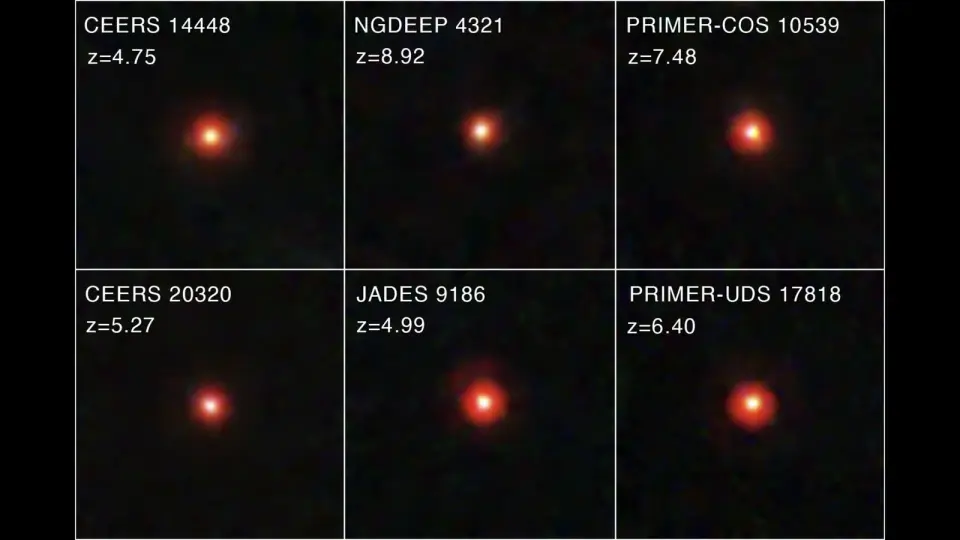
New analysis indicates that the mysterious 'little red dots' (LRDs) detected by the James Webb Space Telescope (JWST) in the early universe may evolve into the active centers of mature galaxies. While LRDs appeared between 12.2 and 13.2 billion years ago, their population drops sharply after 12 billion years. Researchers propose these objects are 'black hole stars'—supermassive black holes enveloped in dense gas—that eventually develop into quasars or spiral galaxies. A recent study of a modern spiral galaxy, nicknamed 'Saguaro,' confirms that when simulated at high redshift, it appears as a single bright LRD, suggesting LRDs are a temporary evolutionary phase rather than a distinct species of object.
Key points
- JWST discovered hundreds of compact, bright red objects in the early universe, appearing roughly 650 million years after the Big Bang.
- The population of these 'little red dots' declines significantly after 12 billion years, prompting questions about their fate.
- A new study by George Rieke and colleagues suggests LRDs evolve into the nuclei of fully formed galaxies, acting as progenitors to modern active galactic nuclei.
- Analysis of the spiral galaxy 'Saguaro' shows that when its light is shifted to high redshift, its surrounding structure fades, leaving only a bright central source resembling an LRD.
- This supports the hypothesis that LRDs are not a unique class of object but rather a transient phase of galaxy evolution affected by observational limits.
Background
Since JWST began operations in 2022, LRDs have challenged standard cosmological models due to their unexpected brightness and lack of X-ray emissions typical of quasars. Previous theories, including the 'quasi-star' model and 'black hole star' hypothesis, attempted to explain their spectral signatures. Earlier coverage noted that some LRDs may be linked to globular clusters or formed via direct collapse of gas clouds, but the evolutionary pathway remained unclear until recent simulations linked them to mature spiral galaxies.
How outlets are covering it
Space.com emphasizes the evolutionary link, citing George Rieke’s assertion that LRDs are the 'progeny' of modern galaxy centers. Wired highlights the complexity of the 'black hole star' model, noting that Charlotte Mason’s spectral analysis suggests the gas envelope may be clumpy rather than uniform, complicating the simple dense-cloud theory. NASA Science provides the critical observational evidence, using the 'Saguaro' galaxy to demonstrate that observational bias at high redshifts can make mature spirals appear as isolated LRDs. Universe Today focuses on a separate but related discovery, identifying a new gravitational arc candidate (A1) in JWST data, which underscores the potential for finding more early-universe objects in existing archives, though it does not directly address the LRD evolution debate.
Why it matters
Understanding the fate of little red dots resolves a major discrepancy in early-universe astrophysics: the presence of supermassive black holes and bright galaxies far earlier than standard models predict. If LRDs are indeed the precursors to modern galaxies, it implies that galaxy formation and black hole growth were more rapid and interconnected in the first billion years of the universe than previously thought, potentially requiring revisions to cosmological simulations and theories of stellar evolution.
What to watch
Researchers will continue using JWST’s Mid-Infrared Instrument (MIRI) and spectroscopic data to test the 'clumpy gas' hypothesis proposed by Mason. Further simulations of galaxies like 'Saguaro' at various redshifts will help confirm whether the disappearance of LRDs after 12 billion years is due to evolutionary change or observational limits. Independent verification of new gravitational lens candidates, such as A1, may also reveal additional early-universe objects that could inform the LRD evolution timeline.
- Inside the mystery of the James Webb Space Telescope's little red dots — and how they might be evolving Space
- 'Little red dots' may be pulsating monster stars that created early-universe black holes Phys.org
- The James Webb Telescope Is Changing Astronomers’ Understanding of the Ancient Cosmos WIRED
- Little Red Dot at Redshift 2: Real and Simulated Graphic NASA Science (.gov)
- Astronomers Find a New Object from the Early Universe Using Webb Data Universe Today
Want the full story? Read the original reporting
Read on Space