
Massive black holes may form in crowded star clusters through successive mergers
TL;DR
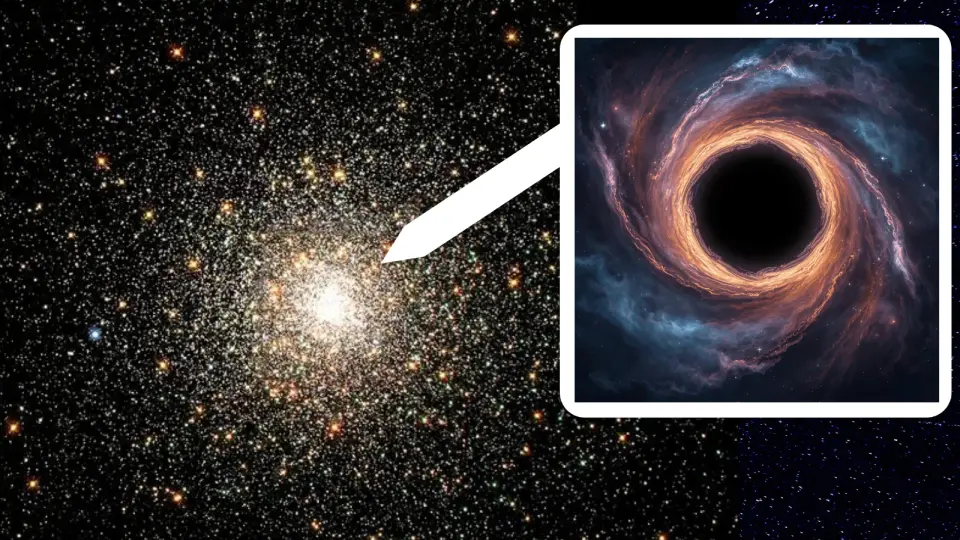
A new study of 153 black hole mergers from GWTC4 finds two distinct populations: lighter black holes born from massive-star collapses and heavier ones likely created by hierarchical mergers in dense star clusters, supporting a predicted mass gap around 45 solar masses and suggesting the largest black holes grow primarily via cluster mergers rather than direct stellar collapse.
Topics:sciencespace#black-holes#globular-clusters#gravitational-waves#ligo-virgo-kagra#mass-gap#space
- How do the biggest black holes in the universe form? Ripples in spacetime provide a clue Space
- These monster black holes did not form the usual way—their history of violence is written into spacetime ripples Phys.org
- Study links biggest black holes to repeated cosmic collisions Courthouse News
- Evidence for a 'forbidden range' of black hole masses emerges in gravitational wave observations Physics World
- Largest black holes formed by violent mergers, rather than collapsing stars Innovation News Network
Want the full story? Read the original reporting
Read on Space