Tag

Ligo Virgo Kagra

All articles tagged with #ligo virgo kagra

Gravitational-Wave Census Maps Diverse Black Hole Origins
space1 day ago

Gravitational-Wave Census Maps Diverse Black Hole Origins

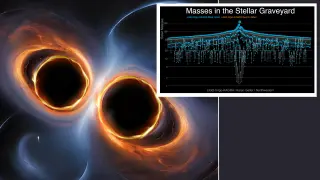
A new gravitational-wave catalog from LIGO-Virgo-KAGRA, with nearly 400 detections, lets scientists census black holes and shows they form through multiple channels—from direct stellar collapse to cluster dynamics and hierarchical mergers—while mass clusters near 10 and 35 solar masses and many objects spin rapidly, signaling a diverse, evolving black-hole population.

Possible Dark Matter Clue Hidden in 2019 Gravitational Wave Signal
science13 days ago

Possible Dark Matter Clue Hidden in 2019 Gravitational Wave Signal

Physicists modeling ultralight dark matter around merging black holes suggest the July 2019 LVK event GW190728 could reflect a dense dark matter cloud, imprinting signatures on the gravitational waves. While intriguing, the statistical significance is not yet strong enough to claim a detection, and independent checks are needed; if confirmed, it would open a new way to study dark matter and its interaction with spacetime.

Massive black holes may form in crowded star clusters through successive mergers
space23 days ago

Massive black holes may form in crowded star clusters through successive mergers

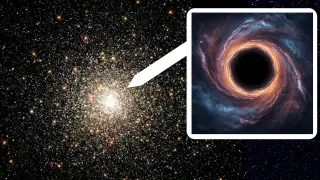
A new study of 153 black hole mergers from GWTC4 finds two distinct populations: lighter black holes born from massive-star collapses and heavier ones likely created by hierarchical mergers in dense star clusters, supporting a predicted mass gap around 45 solar masses and suggesting the largest black holes grow primarily via cluster mergers rather than direct stellar collapse.

science1 month ago

Three Pathways for Merging Black Holes Revealed by GWTC-4

A new GWTC-4 catalog from the LIGO-Virgo-KAGRA collaboration doubles the count of gravitational-wave detections and shows merging binary black holes split into three subpopulations with distinct masses, spins, and merger rates. The study suggests multiple origins for these mergers—from isolated binary evolution to hierarchical, recycled mergers—producing unusually heavy and fast-spinning systems and reshaping our understanding of black hole formation and their cosmic origins.

Black Hole Merger Detected With Gamma-Ray Burst, Redefining Multi-Messenger Astronomy
science2 months ago

Black Hole Merger Detected With Gamma-Ray Burst, Redefining Multi-Messenger Astronomy

An international team reports a rare link between a binary black hole merger (GW event S241125n, about 4.2 billion light-years away) and a short gamma-ray burst with an X-ray afterglow, suggesting such mergers can emit detectable light under certain conditions and signaling a new era for combining gravitational waves with electromagnetic observations.

128 New Gravitational-Wave Signals Redefine Black Hole Demographics
science2 months ago

128 New Gravitational-Wave Signals Redefine Black Hole Demographics

The LVK collaboration released Gravitational-Wave Transient Catalog 4.0 (GWTC-4), adding 128 new gravitational-wave candidates detected from 2015–2024, more than doubling the catalog. The expanded set reveals a wider variety of black-hole binaries, including very massive and rapidly spinning systems, enabling tests of general relativity and new measurements of the universe’s expansion (via the Hubble constant). This growth pushes gravitational-wave astronomy into new regions of parameter space and promises deeper insights into black-hole formation and cosmic evolution.

New Gravitational-Wave Catalog Expands the Testing Ground for Einstein’s Gravity
science2 months ago

New Gravitational-Wave Catalog Expands the Testing Ground for Einstein’s Gravity

A newly released, expanded catalog of gravitational-wave detections from LIGO, Virgo, and KAGRA more than doubles the known events, revealing a broader population of black holes and neutron-star mergers and enabling stringent tests of Einstein’s general relativity as gravity’s effects on spacetime are probed through mass, spin, and merger dynamics. The dataset deepens our understanding of spacetime warping and paves the way for real-time data releases from the collaboration.

Record-Breaking Black Hole Merger Challenges Current Theories
science10 months ago

Record-Breaking Black Hole Merger Challenges Current Theories

Scientists observed the largest black hole collision ever, involving two black holes of 100 and 140 solar masses merging into a 225-solar-mass object, challenging current black hole formation theories and suggesting possible previous mergers of smaller black holes. The event produced an exceptionally powerful gravitational wave signal, prompting further study into black hole evolution.

"Unveiling Deep Space Mystery: Collision Sends Gravitational-wave Signal"
astronomy2 years ago

"Unveiling Deep Space Mystery: Collision Sends Gravitational-wave Signal"

The LIGO-Virgo-KAGRA Collaboration detected a unique gravitational wave signal, likely resulting from the collision of a neutron star and an unknown object, possibly a low-mass black hole, filling the mass gap between neutron stars and black holes. This discovery suggests a higher rate of similar collisions than previously thought and hints at more exciting findings in gravitational wave science, with plans for a space-based observatory to further explore the gravitational universe.