
BepiColombo’s Eight-Year Brake: Why Mercury Orbit Capture Is Harder Than a Pluto Flyby
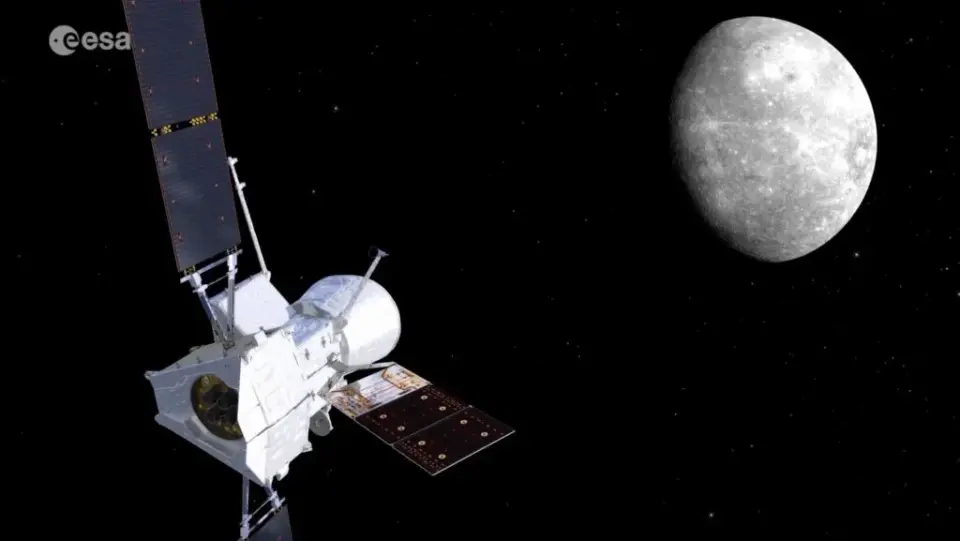
BepiColombo will enter Mercury orbit on November 21, 2026, after an eight-year journey requiring nine gravity assists and ion thruster burns to shed excess velocity gained from falling toward the Sun.
Key points
- ESA states that capturing a spacecraft at Mercury requires more energy than a flyby to Pluto, as the Sun’s gravity accelerates objects falling inward.
- BepiColombo launched in October 2018 and completed nine planetary flybys involving Earth, Venus, and Mercury to reduce its orbital energy.
- The mission used four QinetiQ T6 ion thrusters burning xenon to provide continuous, low-thrust deceleration over months.
- The final solar-electric thrust phase ended on June 15, 2026, with chemical propulsion reserved for the critical orbital capture and release of two science orbiters.
- The mission will deploy ESA’s Mercury Planetary Orbiter and JAXA’s Mio to study the planet’s magnetic environment and polar ice deposits.
Background
Previous coverage noted that BepiColombo’s arrival was delayed by a thruster issue fixed in 2024, with full science operations expected to begin in 2027. The mission represents the third close visit to Mercury and the second orbiter, following earlier flyby missions. Broader context on orbital mechanics highlights that orbit is defined by horizontal velocity rather than altitude, a principle central to the challenge of slowing down in the inner solar system.
Why it matters
The mission demonstrates that proximity does not equate to accessibility in space travel; the physics of the inner solar system creates a significant energy barrier for orbital capture, necessitating complex, multi-year trajectories that leverage planetary gravity and advanced propulsion systems to achieve scientific goals.
What to watch
BepiColombo will execute its Mercury orbit insertion on November 21, 2026, using chemical propulsion. Following capture, the spacecraft will separate into two distinct orbiters to begin detailed scientific operations, with full data collection expected to commence in 2027.
Want the full story? Read the original reporting
Read on Space Daily