
NASA's Roman Telescope Launches on Falcon Heavy, Nine Months Ahead of Schedule
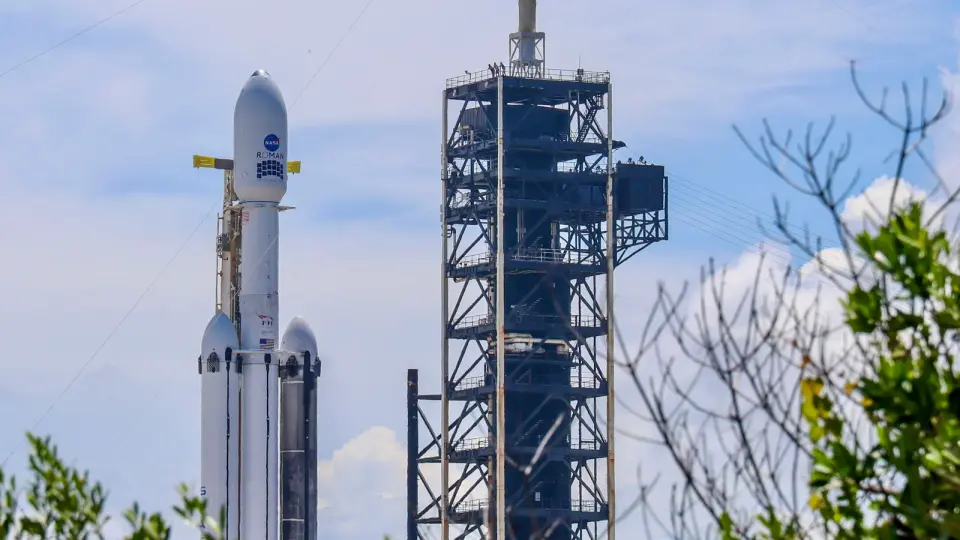
NASA successfully launched the Nancy Grace Roman Space Telescope on August 30, 2026, from Kennedy Space Center. The $4.3 billion observatory, riding a SpaceX Falcon Heavy, is nine months ahead of schedule. It will travel to the Sun-Earth L2 point to map billions of galaxies, study dark energy, and discover over 100,000 exoplanets.
Key points
- Liftoff occurred at 7:26 a.m. EDT on August 30, 2026, from Launch Complex 39A at NASA's Kennedy Space Center.
- The mission is nine months ahead of its original schedule, despite challenges from recent government shutdowns and the pandemic.
- Roman will travel approximately 1 million miles to the Sun-Earth L2 point, joining the James Webb Space Telescope in that orbital region.
- The telescope features a 300-megapixel wide-field camera capable of scanning the sky 1,000 times faster than Hubble.
- Over its five-year primary mission, Roman is expected to downlink 2,500 terabytes of data, compared to Hubble's 172 terabytes over 30 years.
Background
Prior to launch, our archive noted that the telescope had undergone a Flight Readiness Review and was scheduled for prelaunch briefings on August 29. Weather forecasts indicated a 50% chance of favorable conditions, with a backup window set for August 31 if necessary. The observatory was named after Nancy Grace Roman, NASA's first chief of astronomy, who was instrumental in the development of the Hubble Space Telescope.
How outlets are covering it
Space.com and NASA confirmed the successful launch and the 50% weather probability leading up to liftoff. NBC News emphasized the telescope's potential to unlock clues about dark matter and dark energy, noting the mission's cost and schedule efficiency. Spaceflight Now highlighted the technical specifications, such as the 300-megapixel camera and the use of a donated mirror from a canceled spy satellite program. All sources agree on the launch time and location, but Spaceflight Now provides more detail on the data volume and the 'Hubble Tension' Roman aims to resolve.
Why it matters
The Roman Space Telescope represents a significant leap in astronomical capability, promising to resolve long-standing mysteries about the universe's expansion and the nature of dark energy. Its ability to survey the sky 1,000 times faster than Hubble will generate an unprecedented public archive, potentially rewriting our understanding of cosmic evolution and exoplanet atmospheres.
What to watch
Roman will spend approximately three months traveling to L2 and another three months on checkout and calibration before science operations begin. The first core survey, the High-Latitude Wide-Area Survey, will catalog billions of galaxies over 520 days. NASA expects to announce initial findings on dark energy and exoplanet discoveries within the first year of operations.
- Nancy Grace Roman Telescope live updates: Roman and Falcon Heavy delivered to launch pad Space
- NASA readies to launch its next-generation space telescope NBC News
- Roman Space Telescope, NASA’s next ‘great observatory,’ poised for Sunday launch Spaceflight Now
- SpaceX Set to Launch NASA’s Dark Energy-Hunting Space Telescope Bloomberg.com
- NASA’s Roman Space Telescope: Launch Updates NASA Science (.gov)
Want the full story? Read the original reporting
Read on Space