
Hubble Reveals a New 10-Sided Storm at Saturn's South Pole
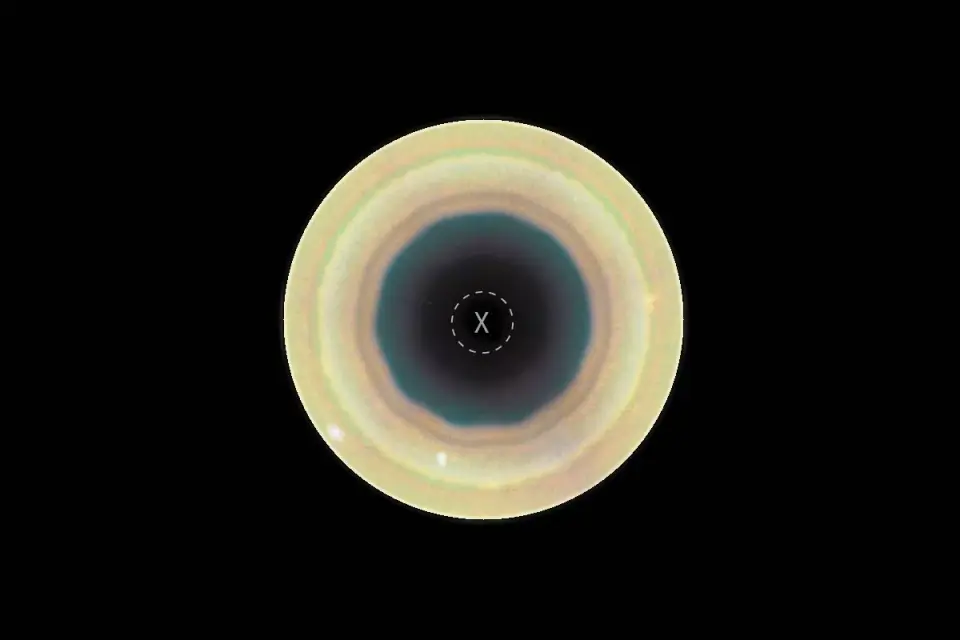
Astronomers have identified a new 10-sided atmospheric wave, or decagon, encircling Saturn's south pole. Discovered via Hubble Space Telescope data and amateur ground observations, this feature is the first regular polygon observed in the planet's southern hemisphere. Unlike the long-standing northern hexagon, the decagon appears to have formed recently, offering a unique opportunity to study the development of complex weather patterns on gas giants.
Key points
- A 10-sided decagon has been detected around Saturn's south pole, marking the first regular-sided jet pattern observed in the southern hemisphere.
- The feature was identified using Hubble Space Telescope data from 2023 to 2025, supplemented by ground-based images from amateur astronomers.
- The decagon is a vertically extended atmospheric structure, not just a surface cloud pattern, and is currently strengthening.
- Scientists are investigating whether a nearby high-pressure vortex, known as a 'Red Spot,' influenced the formation of the new polygon.
- The discovery raises questions about why the southern feature has ten sides while the northern hexagon has six, and whether the decagon will persist or dissipate.
Background
Saturn's north pole has featured a prominent hexagonal storm for over 40 years, first observed by Voyager probes in 1980. Previous missions, including Cassini (2004-2017), failed to find a similar structure in the south. This new discovery, published in Science Advances, provides a real-time view of polygon formation, contrasting with the long-established northern feature.
How outlets are covering it
BBC Sky at Night and NASA Science emphasize the novelty of the decagon and the opportunity to watch it evolve in real-time. ScienceAlert highlights the mystery of the differing side counts and latitudes between the northern hexagon and southern decagon, noting that current simulations cannot fully explain the formation. All sources agree that the feature is distinct from the northern hexagon and requires further study via Hubble and the James Webb Space Telescope.
Why it matters
This discovery challenges the assumption that Saturn's northern hexagon is a unique, isolated phenomenon. By observing a new polygon form in the southern hemisphere, scientists can better understand the atmospheric dynamics that create such structures on gas giants, potentially offering insights into weather patterns on Earth and other planets.
What to watch
Researchers will continue monitoring the decagon with Hubble and the James Webb Space Telescope to determine if it stabilizes, dissipates, or changes shape. They will also refine computer models to identify the specific atmospheric conditions or nearby vortices that triggered its formation.
- Something weird's going on at Saturn. Hubble has spotted a 10-sided geometric formation in the planet's clouds BBC Sky at Night Magazine
- NASA’s Hubble Tracks New Decagon Encircling Saturn’s South Pole NASA Science (.gov)
- Astronomers Detect a 10-Sided Structure in Saturn's Atmosphere sciencealert.com
- New Hubble images reveal a bizarre decagon over Saturn’s south pole Science News
- Mysterious decagon-shaped structure confirmed on Saturn KING5.com
Want the full story? Read the original reporting
Read on BBC Sky at Night Magazine