
Seven Cosmic Anomalies: From Magnetars to Rogue Planets
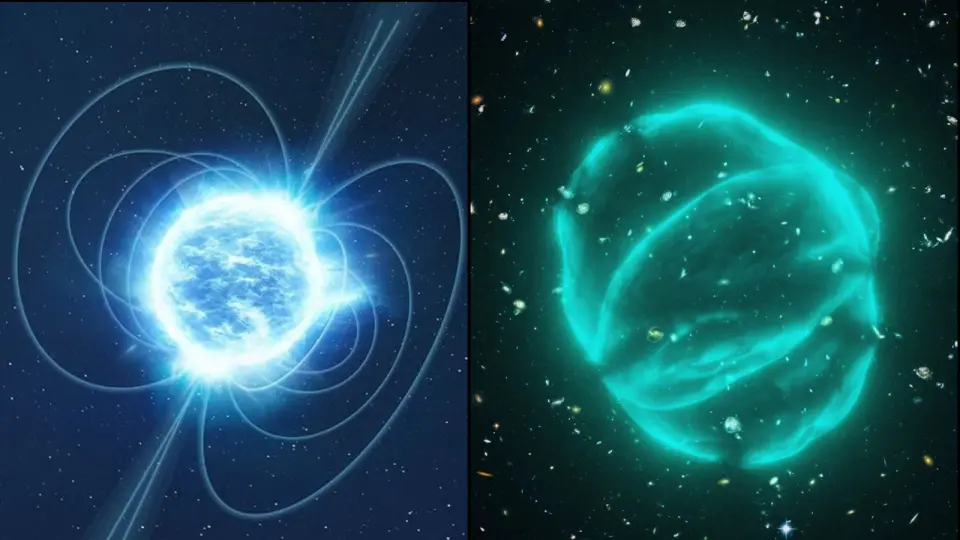
Astronomers continue to grapple with seven bizarre cosmic objects that defy standard classification. These include magnetars with extreme magnetic fields, the coldest known natural object, the Boomerang Nebula, and mysterious Odd Radio Circles. Recent observations using the Very Large Telescope and James Webb Space Telescope have revealed new dynamics in rogue planets and brown dwarfs, while quasars and blazars remain the brightest persistent sources in the universe. These phenomena highlight the limits of current astrophysical models.
Key points
- Magnetars possess magnetic fields 1,000 trillion times stronger than Earth's, emitting intense X-ray and gamma-ray bursts.
- Odd Radio Circles, discovered in 2019, span up to a million light-years and remain unexplained despite multiple theories.
- The Boomerang Nebula, located 5,000 light-years away, is colder than the cosmic microwave background at approximately 1 kelvin.
- Rogue planets, detected by the Very Large Telescope, are actively accreting gas and dust despite lacking a host star.
- Quasars and blazars, powered by supermassive black holes, outshine entire galaxies due to relativistic jet effects.
Background
This overview follows earlier reports on unexplained radio rings, which suggested a new class of cosmic structures, and theories linking cosmic flybys to Earth's mass extinctions. The current focus shifts to a broader catalog of anomalous objects that challenge existing astrophysical definitions.
Why it matters
Understanding these objects refines models of stellar evolution, black hole mechanics, and galactic dynamics. The discovery of active growth in rogue planets and potential moons around brown dwarfs blurs traditional boundaries between celestial categories, impacting how we classify and predict cosmic behavior.
What to watch
The upcoming Square Kilometer Array and continued observations by the James Webb Space Telescope are expected to resolve the origins of Odd Radio Circles and identify more early-universe quasars, potentially revealing how supermassive black holes formed so rapidly.
Want the full story? Read the original reporting
Read on Interesting Engineering