
Hubble and Webb’s Seven Key Images Redefine Cosmic Observation
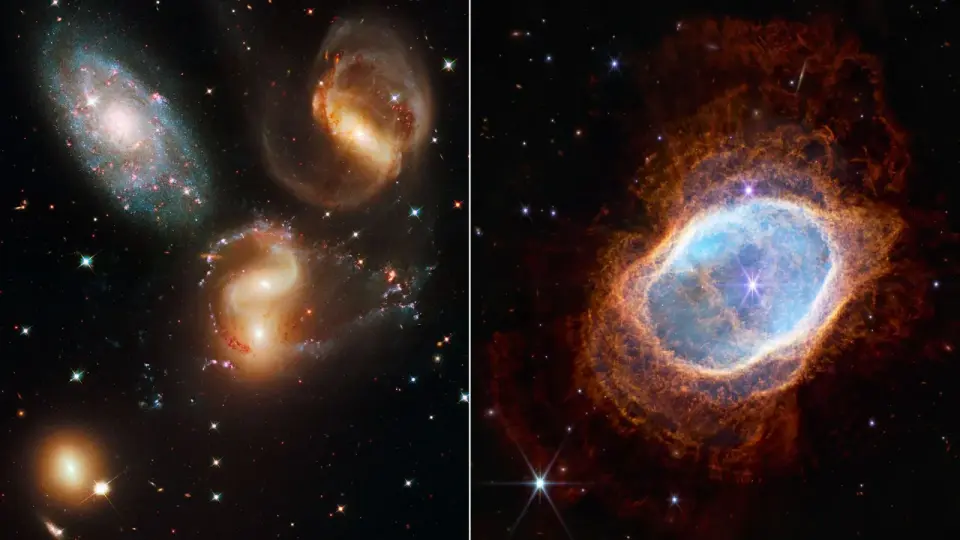
A recent review highlights seven pivotal images from Hubble and the James Webb Space Telescope (JWST), demonstrating how different wavelengths reveal distinct aspects of the universe. Key examples include the Pillars of Creation, where Webb’s infrared view penetrates dust to show hidden stars, and the Hubble Ultra Deep Field, which captured nearly 10,000 galaxies in a tiny patch of sky. Other notable images include Webb’s first deep field of galaxy cluster SMACS 0723, the Cosmic Cliffs in the Carina Nebula, the Southern Ring Nebula, Stephan’s Quintet, and the Crab Nebula. These images serve not just as visual spectacles but as scientific datasets that map star formation, dying stars, and galaxy interactions across billions of years of cosmic history.
Key points
- Hubble’s 1995 Pillars of Creation image shows gas columns in the Eagle Nebula, while Webb’s infrared revisit reveals stars hidden within the dust.
- The Hubble Ultra Deep Field contains nearly 10,000 galaxies in a sky area smaller than a fraction of the Moon, some dating back to when the universe was 800 million years old.
- Webb’s 2022 first deep field of SMACS 0723 utilized gravitational lensing to magnify faint, distant galaxies, revealing some of the faintest infrared objects observed at the time.
- Webb’s NIRCam instrument revealed the 'Cosmic Cliffs' in the Carina Nebula, showing star-forming regions obscured by dust in visible light.
- Observations of the Southern Ring Nebula revealed a binary star system, with the fainter star ejecting material and the brighter companion shaping the nebula.
- Webb’s combined NIRCam and MIRI images of Stephan’s Quintet detailed gravitational interactions between five galaxies in the Pegasus constellation.
Background
This review follows recent advancements in space observation, including the launch of NASA’s Nancy Grace Roman Space Telescope on August 30, 2026, which aims to provide a sky-wide view 100 times larger than Hubble’s to study dark energy and exoplanets. Additionally, recent JWST discoveries, such as the identification of a black hole star in the early universe, highlight the telescope's capability to detect faint, distant objects that challenge traditional astronomical models.
Why it matters
These images underscore that space telescopes are scientific instruments, not just cameras. By observing in infrared and other wavelengths, they penetrate dust and reveal processes like star birth and galaxy evolution that are invisible to ground-based or visible-light telescopes. This multi-wavelength approach provides critical data for understanding the universe's history and structure, from the early cosmos to the final stages of stellar life.
What to watch
Astronomers will continue to analyze the scientific datasets behind these images to refine models of star formation, galaxy interactions, and supernova expansion. Future missions, such as the Roman Space Telescope, will expand these capabilities by surveying larger areas of the sky, potentially uncovering more faint objects and mapping dark energy across billions of galaxies.
Want the full story? Read the original reporting
Read on Interesting Engineering