
Voyager 1’s 1977 Earth-Moon Snapshot Marks First Combined View of Humanity’s Home
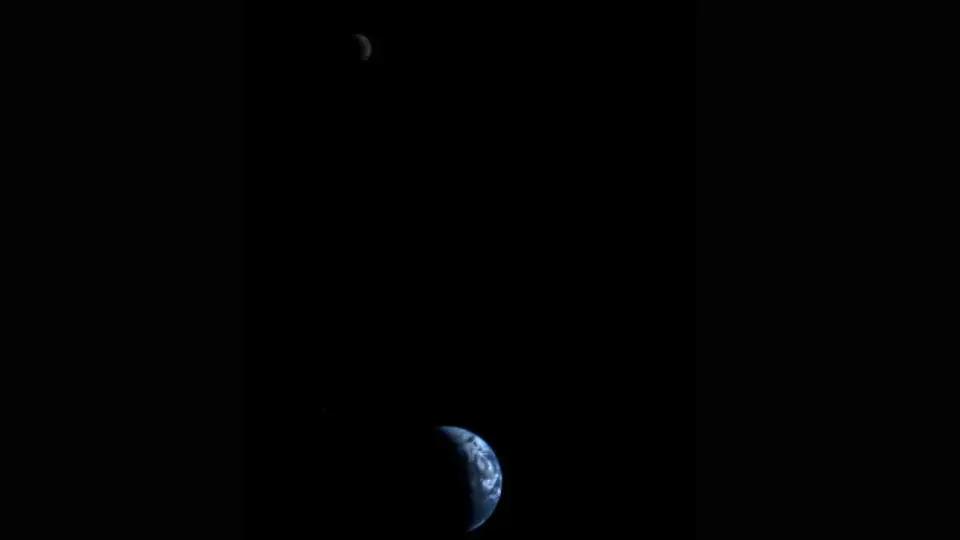
On September 18, 1977, NASA’s Voyager 1 captured the first-ever image showing Earth and the Moon together from deep space. Taken 7.25 million miles from Earth, this photo preceded the famous 'Pale Blue Dot' image by 13 years and highlighted humanity’s fragile presence in the cosmos.
Key points
- Voyager 1 photographed Earth and the Moon together on Sept. 18, 1977, from a distance of 7.25 million miles (11.7 million km).
- This was the first time a spacecraft captured both bodies in a single frame, occurring shortly after the probe’s launch.
- The image served as a precursor to the 1990 'Pale Blue Dot' photo, which showed Earth as a tiny speck from near Saturn.
- Carl Sagan advocated for the 1990 'family portrait' of the solar system, which included the iconic Earth view.
- The 1977 photo was significant as it depicted the only places humans had lived or explored at the time.
Background
Voyager 1 launched in 1977 to explore the outer planets, later passing through the asteroid belt and visiting Jupiter and Saturn before heading into interstellar space. As of 2026, both Voyager 1 and Voyager 2 are in interstellar space, with Voyager 1 approximately 171 AU from Earth. Recent power-saving measures, known as the 'Big Bang' power swap, have extended the operational life of these aging probes by reducing power demands on their radioisotope thermoelectric generators.
Why it matters
The 1977 image provided an early perspective on Earth’s isolation in the universe, predating the more famous 'Pale Blue Dot' by over a decade. It remains a historical milestone in space exploration, illustrating the technological capabilities of the Voyager mission and the growing awareness of Earth’s fragility in the cosmos.
What to watch
Voyager 1 and Voyager 2 continue to transmit data from interstellar space, with ongoing efforts to extend their operational life through power-saving adjustments. Future missions, such as Artemis III and IV, aim to return humans to the Moon, building on the legacy of robotic explorers like Voyager.
Want the full story? Read the original reporting
Read on Space