
MBARI deploys autonomous drones to track carbon sink in California waters
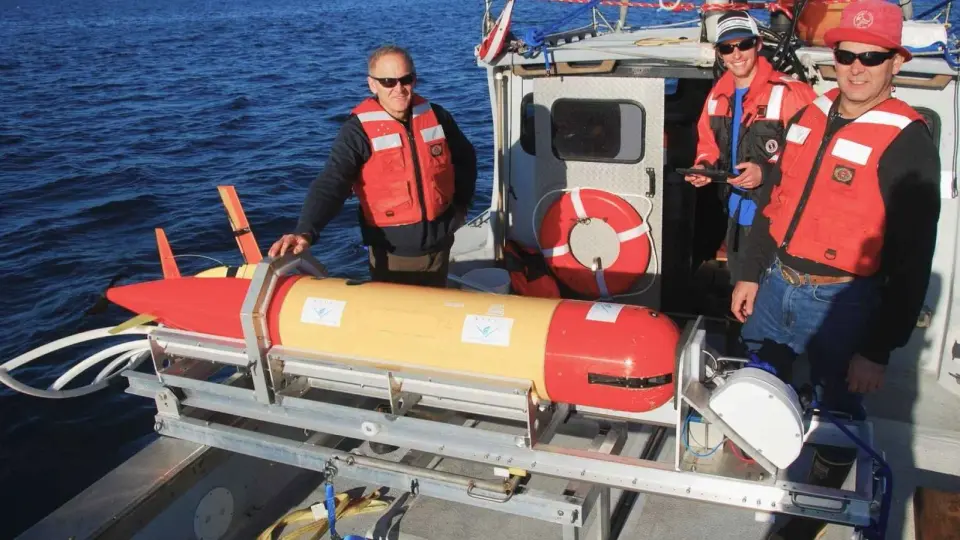
MBARI sent two autonomous underwater vehicles to a mooring off California to track a drifting sediment trap, aiming to measure the ocean's biological carbon pump during an El Nino event.
Key points
- Two 242.5-pound long-range autonomous underwater vehicles (LRAUVs) were deployed from MBARI's MARS observatory on September 12-13, ahead of the R/V David Packard's arrival on September 14.
- The drones used acoustic beacons to follow a drifting sediment trap, photographing plankton in the top 656 feet while the trap collected sinking particles down to 1,640 feet.
- This dual Eulerian-Lagrangian approach aims to quantify the 'biological pump,' where sinking organic matter removes carbon from the atmosphere for decades or centuries.
- The expedition coincides with a strengthening El Nino, which NOAA predicts will weaken upwelling and alter plankton productivity off Central California.
- Fixed cameras like SINKER and SES were serviced and redeployed to monitor the seafloor through the winter, while drones provided mobile tracking of drifting water masses.
Background
Previous coverage of ocean monitoring has highlighted the limitations of fixed-depth records, such as the Continuous Plankton Recorder, which lacks volume and deep-water data. Recent studies on Arctic permafrost also emphasize the need for precise carbon accounting in climate models, as biological processes significantly influence how much carbon is stored versus released. MBARI's earlier work involved sending tracked rovers to the seafloor to measure particle consumption, establishing a foundation for this new mobile tracking approach.
How outlets are covering it
AutoNotion emphasizes the technical novelty of the dual Eulerian-Lagrangian method, highlighting how drones can track drifting water masses to connect surface plankton with sinking carbon, a gap in current climate models. MBARI's expedition logs, particularly from student collaborator Comfort Opoku, focus on the practical challenges of ocean science, such as midnight sampling and the importance of zooplankton diversity in carbon export. While AutoNotion frames the mission as a solution to measurement uncertainty, MBARI presents it as part of a broader international effort to understand upwelling hotspots, drawing parallels between Monterey Bay and the Gulf of Guinea.
Why it matters
Accurate measurement of the biological carbon pump is critical for refining climate models and policy. If the dual-drone approach successfully quantifies how much carbon sinks during El Nino events, it could improve predictions of ocean carbon absorption, directly impacting global climate strategies and market mechanisms tied to carbon sequestration.
What to watch
MBARI has not yet published a wrap-up of the cruise, so it remains unclear if the drones successfully maintained contact with the drifting trap. NOAA is scheduled to publish its next El Nino update on October 8, which will provide data on the strength of the current event and its potential impact on upwelling and plankton productivity off California.
- Two 242.5-pound drones drove themselves out to a mooring off California ahead of a research ship to follow a drifting trap by the sound of its beacon and photograph the top 656 feet of ocean while the trap catches the dead plankton sinking below it Autonocion.com
- When the ocean never sleeps: Exploring zooplankton aboard R/V David Packard MBARI
- Should I stay or should I go? • Chasing Marine Snowstorms: Fall 2026 • Expeditions MBARI
- MBARI researchers join expedition to advance ocean science in West Africa MBARI
- Chasing Marine Snowstorms: Fall 2026 • Expeditions MBARI
Want the full story? Read the original reporting
Read on Autonocion.com