
Korean Orbiter Captures First Images of SpaceX Rocket’s Lunar Impact Crater
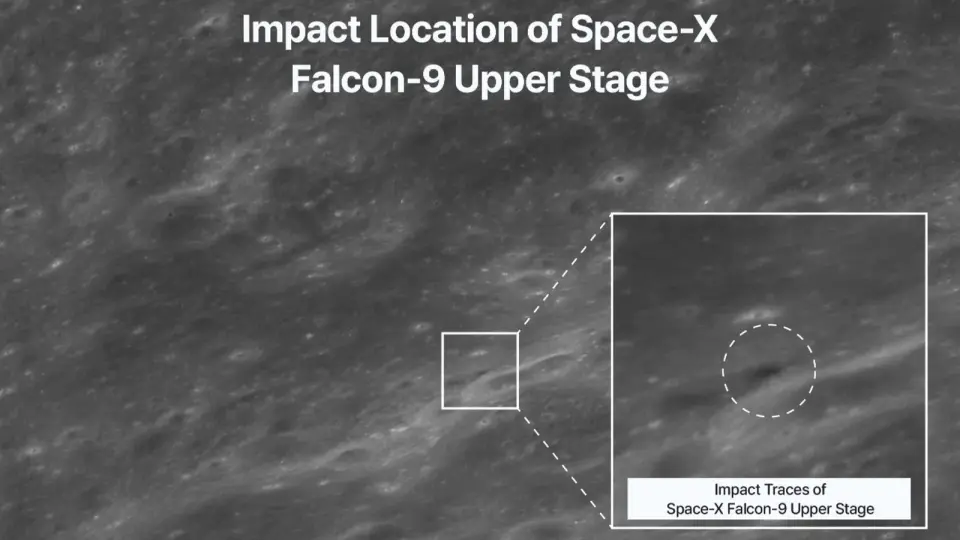
South Korea’s Danuri lunar orbiter has captured the first before-and-after images of the crater created when a SpaceX Falcon 9 upper stage crashed into the Moon on August 5, 2026. The impact, which occurred near Einstein Crater, was the result of an uncontrolled disposal maneuver following a January 2025 commercial lunar mission. While the event posed no danger to Earth, it provided scientists with rare data on artificial impacts and ejecta patterns, highlighting growing concerns about space debris in cislunar space.
Key points
- KARI confirmed Danuri conducted eight imaging sessions, capturing pre- and post-collision footage to analyze terrain changes and ejecta spread.
- The impacting object was the upper stage of a Falcon 9 rocket that launched Firefly’s Blue Ghost and ispace’s Resilience landers on January 15, 2025.
- NASA’s Center for Near Earth Object Studies confirmed a 100% probability of impact, with the stage striking the Moon at approximately 5,436 mph.
- The impact created a crater estimated to be 60 feet wide and 12 feet deep, ejecting dust and rock up to 500 miles from the site.
- NASA and SpaceX are collaborating to develop better disposal methods for high-energy missions to mitigate future debris risks.
Background
This event follows a series of earlier reports from our archive detailing the predicted trajectory and subsequent confirmation of the impact. Previous coverage noted that the upper stage had been drifting since the January 2025 launch, with solar activity and gravity eventually placing it on a collision course. Earlier articles highlighted the scientific value of observing such impacts, as they are rare compared to natural meteoroid strikes, and emphasized the need for improved debris tracking in lunar orbit.
How outlets are covering it
Space.com and KARI emphasized the success of Danuri’s imaging campaign, highlighting the value of pre- and post-collision data for scientific analysis. CNN and The Guardian focused on the broader implications of space debris, noting that while the impact posed no danger to Earth, it highlighted 'carelessness' in the disposal of rocket stages. NASA’s official statement framed the event as a training opportunity for tracking objects and a chance to refine debris mitigation strategies, noting that lunar surface disposal can be a technically accepted method for certain missions. All sources agreed that the impact was a significant but rare event, with The Guardian noting it was only the second known artificial impact on the Moon since a Chinese rocket stage in 2022.
Why it matters
The successful capture of imagery by Danuri provides critical data for understanding the effects of artificial impacts on the lunar surface, which is essential for planning future human missions and infrastructure. It also underscores the growing challenge of space debris in cislunar space, prompting agencies like NASA and SpaceX to develop better disposal methods to prevent future uncontrolled impacts.
What to watch
NASA and SpaceX will analyze the data collected by Danuri and other spacecraft to refine models of ejecta behavior and improve tracking techniques. They will also continue to develop and implement better disposal strategies for rocket stages on high-energy missions to mitigate the risk of future uncontrolled impacts on the Moon and other celestial bodies.
- SpaceX rocket's impact crater on the moon spied by Korean lunar orbiter (photos) Space
- New crater likely to form after SpaceX rocket slams into the moon CNN
- SpaceX rocket thought to have crashed into the moon in unintentional collision theguardian.com
- NASA Will Attempt to Observe Rocket Part’s Lunar Impact NASA (.gov)
- NASA confirms SpaceX rocket slams into moon 18 months after sending a Texas-built lander there San Antonio Express-News
Want the full story? Read the original reporting
Read on Space