
Satellite Images Reveal Rapid Construction of Iran’s New Underground Facility
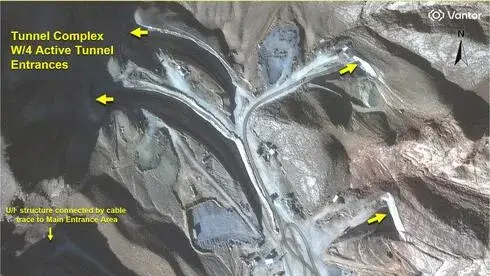
The Institute for Science and International Security (ISIS) reported that Iran is rapidly constructing a fortified underground complex in Bahjatabad, located between the Natanz and Isfahan nuclear sites. Satellite imagery from November 24, 2026, shows the facility is nearing completion, covering approximately 49 square kilometers. While the exact purpose remains unclear, analysts suggest it may house missile systems or nuclear infrastructure, highlighting Tehran’s efforts to rebuild military capabilities despite recent conflicts and a US naval blockade.
Key points
- Construction began in early December 2025, with significant expansion observed throughout 2026.
- The facility is situated approximately 62 kilometers from both Natanz and Isfahan nuclear sites.
- ISIS notes the site’s extensive security measures suggest military use, potentially for missiles or weapons.
- A nuclear connection cannot be ruled out, given the proximity to sensitive nuclear infrastructure.
- The rapid pace of construction contrasts with previous efforts to conceal underground facilities after the 2025 strikes.
Background
This development follows the June 2025 Twelve-Day War and the February 2026 Operation Roaring Lion, which targeted Iran’s nuclear and military infrastructure. Iran has since worked to reconstitute its capabilities, including underground missile production, as noted in recent showcases by the IRGC. The current construction effort appears to be part of a broader strategy to maintain deterrence and resilience against future strikes.
How outlets are covering it
The Institute for Science and International Security (ISIS) and The Jerusalem Post emphasize the facility’s rapid construction and potential military or nuclear significance, citing satellite imagery from Vantor Technologies. Al Jazeera focuses on Iran’s broader military resilience, highlighting the unveiling of a dual-missile launcher and underground 'missile city' as a response to US-Israeli strikes. Iran International, while not directly covering the Behjatabad facility, reports on Iran’s economic pressures and military posturing, including threats to tighten restrictions on shipping in the Strait of Hormuz. The sources generally agree on the facility’s strategic importance but differ in emphasis: ISIS and The Jerusalem Post focus on the construction details, while Al Jazeera and Iran International contextualize it within broader military and economic tensions.
Why it matters
The construction of a new fortified underground facility between two major nuclear sites signals Iran’s intent to rebuild and protect its military and nuclear capabilities. This could complicate future US-Israeli efforts to degrade Iran’s infrastructure and may influence regional stability, especially amid ongoing tensions and a US naval blockade.
What to watch
Analysts expect further satellite imagery to reveal the facility’s final scope and purpose. Iran may continue to showcase its military capabilities, including underground production facilities, to assert deterrence. The US and Israel may monitor the site closely, potentially influencing future diplomatic or military actions. The outcome of the US midterm elections and Iran’s economic pressures will also shape the trajectory of the conflict.
- ‘Built at suspicious speed’: Iran’s new fortified underground facility between two major nuclear sites Ynetnews
- Satellite imagery reveals fast construction of new underground facility in Iran, purpose unclear The Jerusalem Post
- Iran develops new ballistic missile variants, US think tanks say Iran International
- Iran unveils dual-missile launcher, new ‘missile city’: What to know Al Jazeera
- Iran developing more powerful hybrid missiles for long-range strikes, experts warns The Independent
Want the full story? Read the original reporting
Read on Ynetnews