
Seoul vows military self-reliance after Trump cuts joint drills
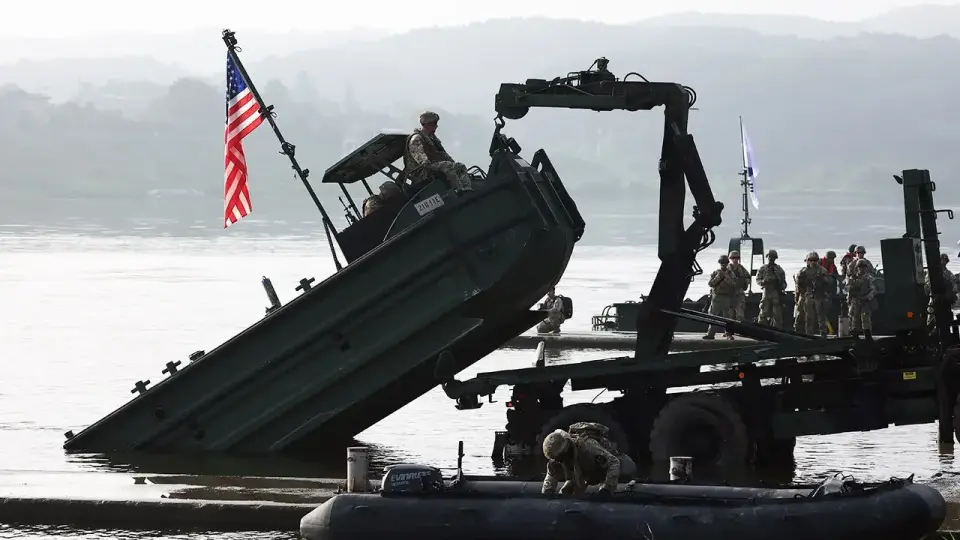
South Korean President Lee Jae Myung has pledged to boost domestic military capabilities, including a nuclear-powered submarine program, following President Donald Trump’s order to substantially reduce joint US-South Korean military exercises. Trump cited his relationship with North Korean leader Kim Jong Un and Seoul’s refusal to assist in the Iran conflict as reasons for the cut. While Seoul maintains the drills are defensive, Washington is also frustrated by delays in a $350 billion investment pledge.
Key points
- President Lee Jae Myung stated that South Korea must prepare for a 'worst-case scenario' while prioritizing peace, emphasizing the need for stronger independent defense capabilities.
- President Trump ordered Defense Secretary Pete Hegseth to 'substantially reduce' the annual Ulchi Freedom Shield exercises, which involve approximately 18,000 South Korean troops and 28,500 US troops.
- Trump criticized South Korea for refusing to assist the US in the conflict with Iran, noting that the US maintains 39,000 soldiers in the region to protect Seoul from North Korea.
- The US administration is also frustrated by South Korea’s slow progress on a $350 billion investment pledge, with officials describing Seoul as 'the slowest negotiators ever.'
- North Korea condemned the US move, stating that the exercises are a rehearsal for aggressive war, while South Korea’s national security advisor expressed hope that US-North Korea dialogue could lead to lasting change.
Background
This development follows a series of earlier reports in August 2026 regarding Trump’s decision to scale back the Ulchi Freedom Shield exercises. Previous coverage highlighted bipartisan alarm in the US over the potential strain on the 73-year-old alliance and warnings that reduced drills could weaken deterrence against North Korea. Retired military officials and analysts had already noted that the drills are critical for joint defense and that Seoul contributes significantly to their cost.
How outlets are covering it
Fox News and CNBC focus on the diplomatic friction, highlighting Trump’s criticism of Seoul’s refusal to help with Iran and his praise for Kim Jong Un. Fox News notes that Lee’s administration hopes the US-North Korea relationship could lead to dialogue, while CNBC emphasizes Lee’s assertion that the drills are purely defensive. Politico provides a broader economic context, revealing that the drill cuts are also driven by Washington’s frustration over South Korea’s slow-walking of a $350 billion investment pledge and its handling of the Coupang fine. The New York Times frames the situation as a potential repeat of Trump’s first-term failure to disarm North Korea, suggesting that his focus on Iran may lead to similar diplomatic dead-ends with Pyongyang. Outlets differ on the primary driver of the cuts: Fox and CNBC emphasize the Iran/North Korea dynamic, while Politico highlights the economic leverage and investment delays.
Why it matters
The reduction in joint military exercises could weaken the deterrence posture against North Korea and strain the US-South Korea alliance, which has been a cornerstone of regional security for over 70 years. The conflation of security and economic issues by the Trump administration may lead to further instability in US-Asia relations. Additionally, the shift in focus from Iran to North Korea could have unpredictable consequences for global nuclear nonproliferation efforts.
What to watch
South Korea is expected to accelerate its independent military modernization, particularly its nuclear-powered submarine program. The US and South Korea will continue to negotiate the $350 billion investment pledge, with potential announcements expected by late August or early September. The outcome of the Ulchi Freedom Shield exercises, which are scheduled to run until August 27, will be closely watched for signs of US-South Korea coordination. There is also a possibility that Trump may use the reduced drills as leverage to encourage a meeting with Kim Jong Un, similar to his 2018 strategy.
- South Korean president jumps to invest in military after Trump cuts joint exercises Fox News
- Facing Quagmire in Iran, Trump Turns to a Familiar Face: North Korea’s Kim Jong-un The New York Times
- S. Korea stresses US alliance amid confusion over Trump drill cut NPR
- ‘Not the way it works’: Korea’s miscalculation on trade may cost them on security Politico
- South Korea must brace for ‘worst-case scenario,’ President Lee says, as Trump cuts military drills CNBC
Want the full story? Read the original reporting
Read on Fox News