
Global study reveals 1,758 butterfly species shifting ranges due to climate and land-use changes
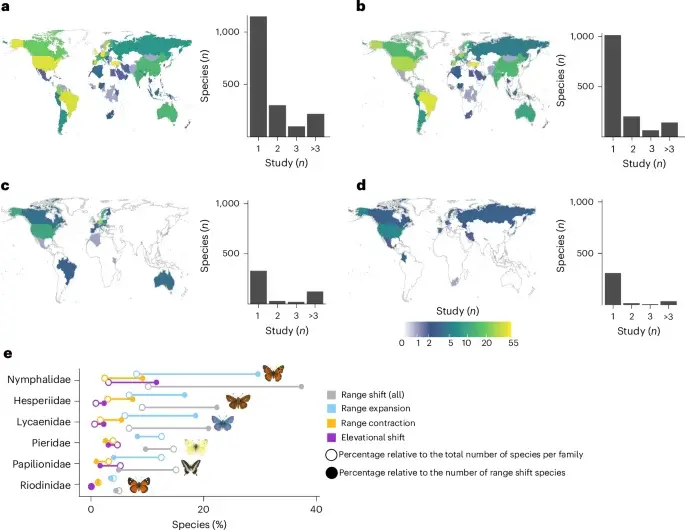
A comprehensive global study published in Nature Ecology & Evolution finds that 80% of 1,758 monitored butterfly species have expanded their ranges, while 27% have contracted them, primarily driven by climate change and extreme weather. The research highlights significant data gaps in tropical regions and calls for improved international monitoring and conservation strategies to address these shifts.
Key points
- 80% of the 1,758 butterfly species studied experienced range expansions, while 27% saw contractions and 22% shifted elevationally.
- Climate change and severe weather were the most frequently cited drivers, affecting 278 species, followed by agriculture and human intrusion.
- Range expansions were most common in tropical countries, whereas contractions were concentrated in Europe and North America.
- Elevational shifts were documented almost exclusively in the Northern Hemisphere, with minimal evidence from tropical regions.
- The study utilized 6,182 records from 105 countries, including non-English literature and 68 expert assessments to reduce bias.
- Researchers warn that major biodiversity hotspots like Central Africa and Southeast Asia remain under-monitored, risking incomplete conservation planning.
Background
Previous coverage in our archive has highlighted broader climate-driven biological shifts, such as the expansion of tick habitats in the US and UK due to warming temperatures and suburban land-use changes. Additionally, historical DNA analysis of koalas revealed that ancient climate shifts caused significant population bottlenecks, underscoring the long-term impact of environmental changes on species survival. These earlier reports provide background on how climate and habitat alterations influence species distribution and population health, complementing the current findings on butterfly range dynamics.
How outlets are covering it
The primary source, Nature, emphasizes the complexity of range shifts, noting that 23% of species exhibited multiple types of shifts simultaneously, such as expansion in one area and contraction in another. The Guardian highlights the 'sentinel' role of butterflies, quoting lead author Shawan Chowdhury on the 'astonishing' scale of change and the need for coordinated global monitoring. Courthouse News focuses on the disparity in data collection, pointing out that while European countries have records for over half their species, most other nations have data for less than 10%. Yahoo News, in a separate but related report, notes a 22% decline in US butterfly populations over 20 years, attributing it to extreme heat and habitat loss, which aligns with the primary study's findings on climate-driven contractions. While all sources agree on the impact of climate change, they differ in emphasis: Nature and Courthouse News stress the methodological gaps and data bias, whereas The Guardian and Yahoo focus on the ecological warning and practical conservation implications.
Why it matters
This study provides critical evidence that butterfly range shifts are a global phenomenon, not limited to well-studied temperate regions. The findings underscore the urgency of integrating diverse data sources, including non-English literature and expert assessments, to accurately assess biodiversity trends. For conservationists, the data highlights the need for adaptive strategies that account for multidirectional range shifts and the specific vulnerabilities of tropical species, which are often under-monitored. Understanding these dynamics is essential for developing effective policies to protect biodiversity in the face of ongoing climate change and land-use pressures.
What to watch
Researchers recommend expanding monitoring programs in under-represented regions, particularly in the tropics and arid areas, to close data gaps. They also advocate for integrating citizen science and local knowledge into biodiversity assessments to improve data quality and coverage. Conservation planning must shift from static protected area models to dynamic approaches that account for species range shifts, including the establishment of ecological corridors and the protection of microrefugia. Future studies should focus on quantifying the magnitude of range shifts using standardized metrics and exploring the relative contributions of climate change versus landscape constraints on species redistribution.
- Extensive climate-induced range shifts in butterflies across the globe nature.com
- Butterflies around the world are changing habitats – and experts say it’s ‘signalling a warning’ The Guardian
- Climate change driving butterfly range shifts worldwide Courthouse News
- Butterflies belong to summer, but heat waves are turning against them Yahoo
- Butterflies reveal hidden signs of ecosystem health and habitat change EIN Presswire
Want the full story? Read the original reporting
Read on nature.com