Tag

Biocomputing

All articles tagged with #biocomputing

Consent urgently needed as brain-organoid biocomputing advances
ethics29 days ago

Consent urgently needed as brain-organoid biocomputing advances

A Nature commentary argues that using lab-grown brain tissue for biocomputing raises an overlooked consent issue: donors may not foresee that their cells could power brain‑like computers or commercial AI tasks, and open-ended consent is inadequate. It calls for explicit, nuanced consent and new independent review boards, outlining three pathways—create new cell lines, obtain fresh consent from existing donors, or secure independent approval—before expanding biocomputing research.


Moss Waves Hint at a Living Biocomputer Substrate
science1 month ago

Moss Waves Hint at a Living Biocomputer Substrate

Researchers led by computer scientist Andy Adamatzky measured electrical activity in mats of the common moss Brachythecium rutabulum, recording fast spikes, slower rhythms, and neuron-like spike trains that propagate across the cushion over days. The patterns imply moss cushions function as a dynamic, interconnected excitable system rather than a collection of unrelated cells, raising the possibility that moss could be used as a low-power substrate for biohybrid sensing and unconventional computation. However, the study has limitations—no inert-control recordings and natural variability in wild-collected moss—and more work is needed to determine whether these signals meaningfully encode information; the work was published in Royal Society Open Science.

"World's First Energy-Efficient 'Living Computer' Created Using 16 Lab-Grown Human Brain Cells"
technology2 years ago

"World's First Energy-Efficient 'Living Computer' Created Using 16 Lab-Grown Human Brain Cells"

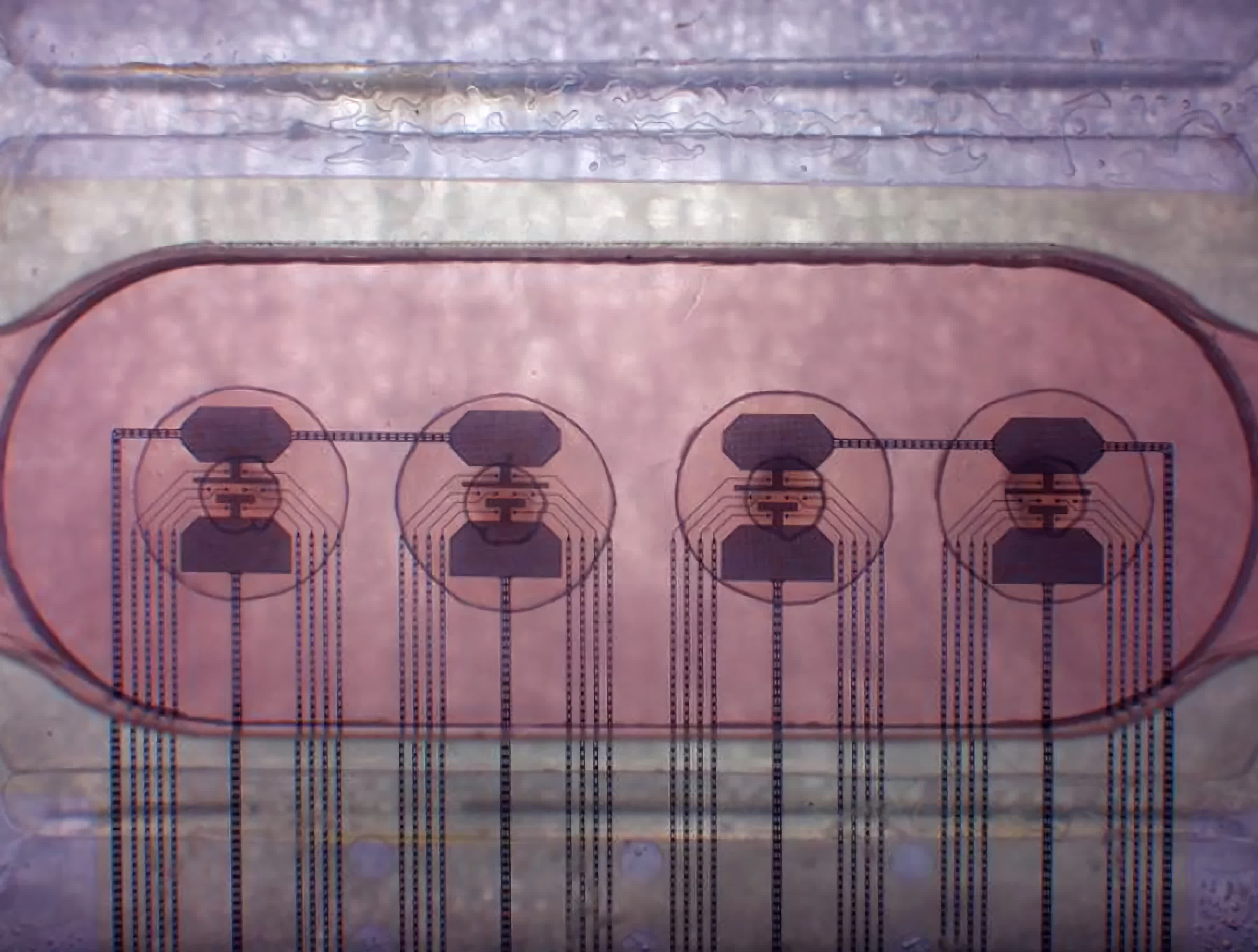
Researchers are developing the world's first "living processor" using human brain organoids, which could significantly reduce the energy demands of large artificial neural networks. The project, led by Swiss startup FinalSpark, is in its early stages and aims to achieve this ambitious goal through international collaboration. The platform allows universities to conduct long-term experiments on biological neural networks, with the potential to revolutionize energy-efficient computing.

"Biochip Merges Brain Tissue and Electronics for Advanced Voice Recognition and Machine Learning"
technology2 years ago

"Biochip Merges Brain Tissue and Electronics for Advanced Voice Recognition and Machine Learning"

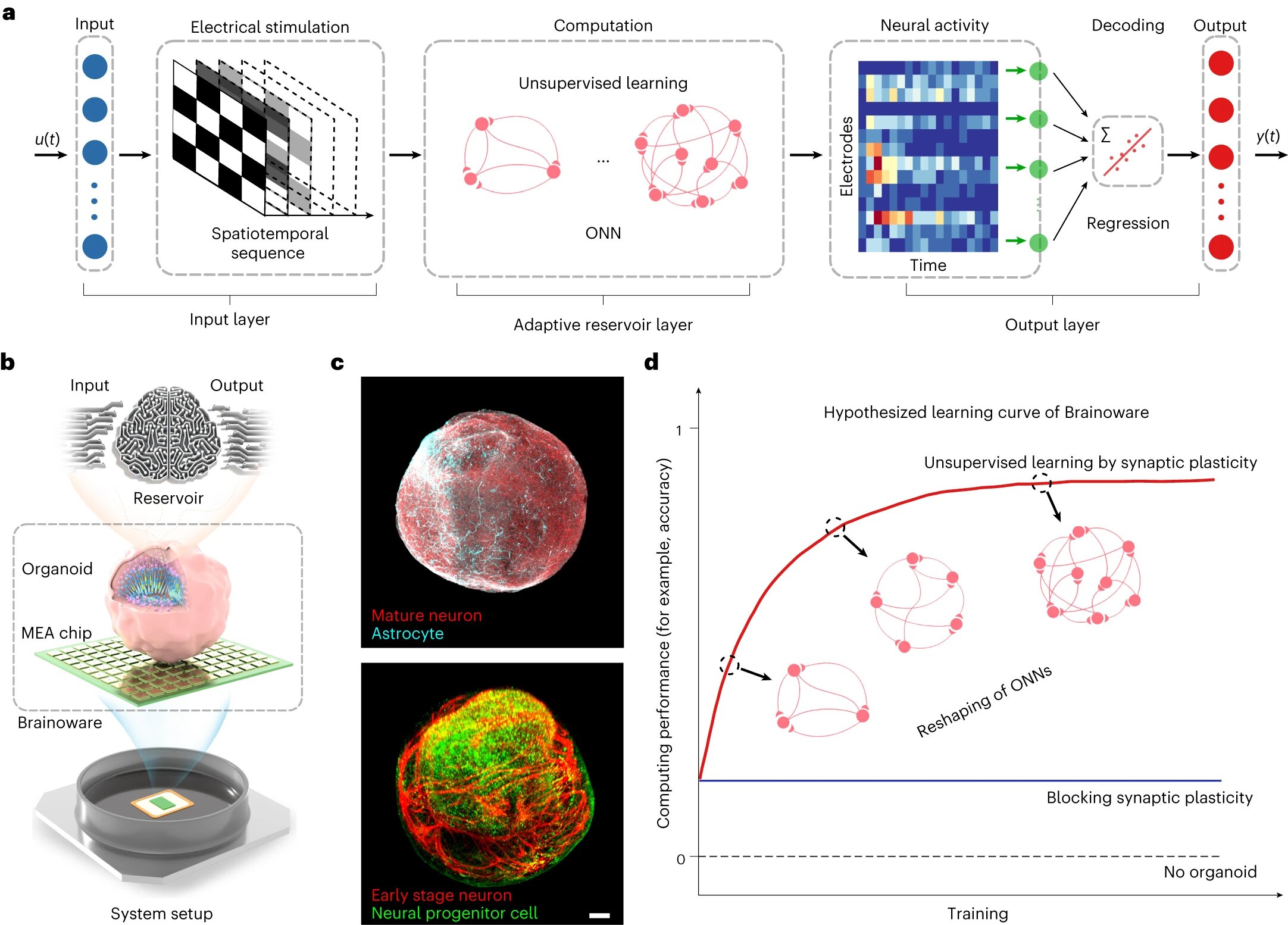
Researchers have connected clusters of lab-grown brain cells to a computer and achieved elementary speech recognition and math problem-solving. The brain cells, grown from specialized stem cells, formed a nanometer-wide organoid that was connected to a circuit board. After training, the system, called Brainoware, was able to distinguish between different voices and predict mathematical constructs with high accuracy. This breakthrough demonstrates the potential of using brain-inspired neural networks for advancing artificial intelligence capabilities. Biocomputing systems like Brainoware offer energy efficiency and could be used for studying neurological diseases and decoding brain wave activity. However, challenges remain in maintaining the health and nourishment of organoids and addressing neuroethical concerns.

Advancements in Brain Tissue Integration Revolutionize Speech Recognition and Machine Learning
technology2 years ago

Advancements in Brain Tissue Integration Revolutionize Speech Recognition and Machine Learning

Researchers have developed a hybrid system called Brainoware, which combines human brain cell networks (organoids) with a computer chip, demonstrating capabilities in processing, learning, and memory. The system achieved basic speech recognition skills by decoding audio clips of Japanese vowels, improving its accuracy to about 78% with training. While the system is less accurate than artificial neural networks, this research opens new possibilities in biocomputing and showcases the potential of brain organoids in complex computational tasks.